
Comparison / Roof bars and compatibility
Aero Roof Bars vs Square Bars: Noise, Mounting and Accessories
Compare aero and square roof bars for noise, T-track fittings, clamps, usable width and complete-system cost, with relevant Amazon product examples.
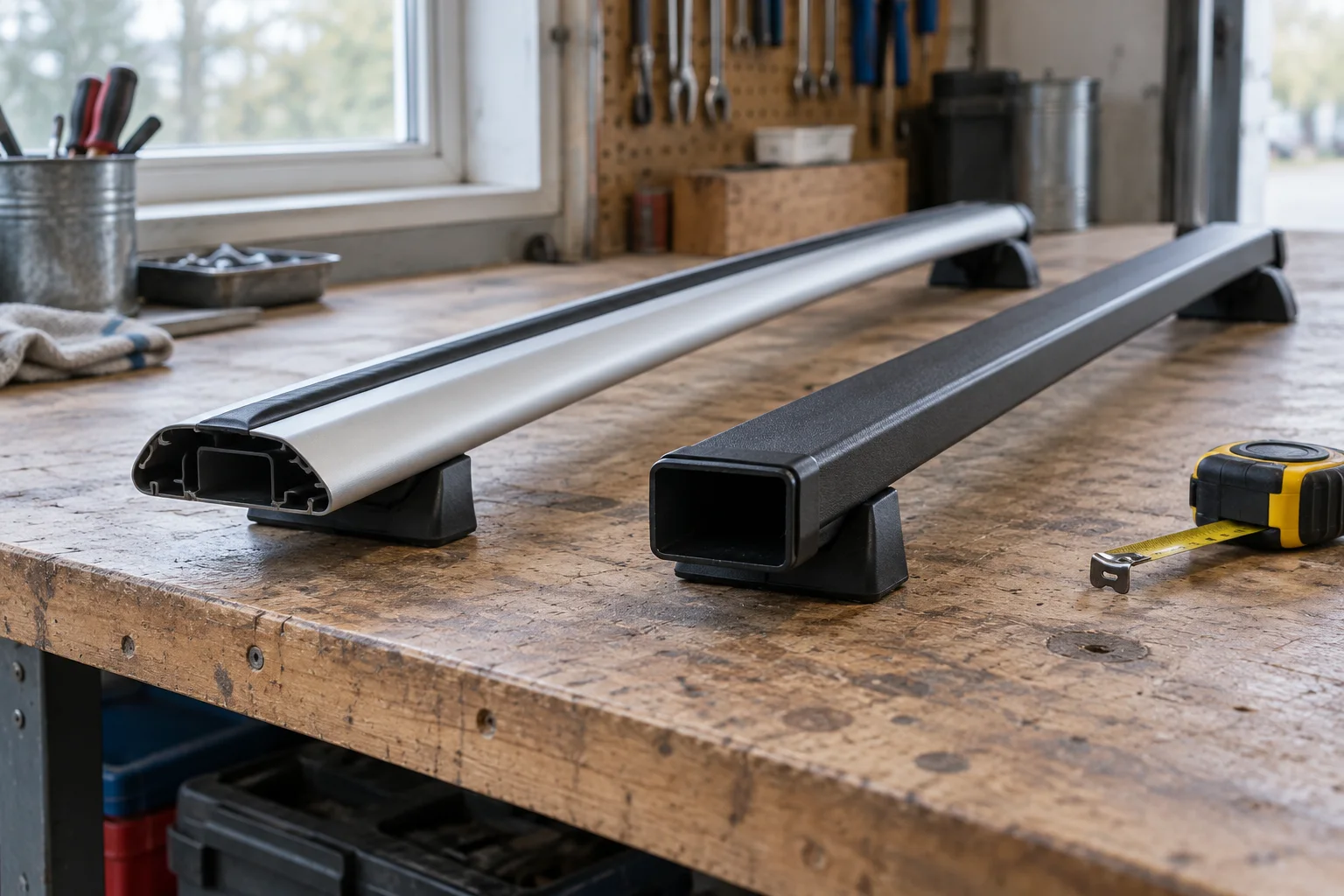
Compare the complete arrangement
Aero bars are designed to manage airflow and often include an accessory track; square bars can suit approved around-bar fittings at a lower complete-system cost. Choose the vehicle-approved combination that works with your carriers, rather than assuming either shape guarantees silence or universal fit.
Start with approved options for the same vehicle
A meaningful comparison starts with rack systems approved for the same car and roof. If one profile is unavailable for your exact attachment, it is not an alternative simply because it is quieter-looking or cheaper. Confirm the permitted bar family, lengths, feet and any fitting kit before weighing the trade-offs.
The two 127cm Thule examples below are specific listing variants. Their shared nominal length does not establish that either fits every car, and a foot pack or kit can still be needed. Compare the total rack cost, installation effort and accessory hardware. Existing carriers can make one profile more practical even when its bars alone cost more.
For a first roof-box purchase, consider the whole carrying plan: perhaps a box for family holidays now and a bike carrier later. For an existing setup, record the exact mounts you already own. Replacing a compatible clamp with an unrelated T-bolt to save the cost of an adapter is not a valid comparison.
Understand what an aerodynamic profile offers
An aero bar uses a shaped cross-section to manage airflow around the bar. Some designs also use patterned strips, under-bar covers and end caps as part of that approach. Fit those pieces exactly as instructed; leaving a channel or underside opening exposed can undermine the intended arrangement.
The manufacturer describes airflow-management features, but that does not supply a measured saving for your car. Roof shape, rack location, speed, weather and accessories all influence what you hear and how the vehicle behaves.
Understand the square-bar alternative
A conventional rectangular or square profile can work well with accessories designed to clamp around it. The selected SquareBar Evo uses coated steel. Its accessory interface differs from the top channel on WingBar Evo, so a carrier supplied with T-track bolts may need a specifically approved square-bar conversion.
Do not generalise from “square” to a particular clamp size. Measure or obtain the actual bar width and height and compare them with the accessory instructions. Protective coating, the position of feet and the available space underneath can affect how the fitting engages.
Separate bar shape from bar overhang
A through-bar extends beyond its feet within the approved arrangement. An integrated or low-overhang system has a different relationship between the bar ends and feet. Either approach can use an aerodynamic profile, so “aero” and “flush-ended” are not synonyms.
For a box beside a bike, loading width can matter more than overall appearance. Measure the positions where both carriers actually attach, allowing for the feet, handles and lid sweep. Do not mount beyond a foot or on an end section unless both the rack and accessory instructions expressly allow it.
Check every accessory interface before buying
A roof-box jaw can be too narrow for a broad aero bar even if the same box previously fitted a square bar. Conversely, a T-track-only sports carrier may need an adapter on the square profile. Neither problem is resolved by a seller’s broad claim that the accessory fits “most roof bars”.
A sports carrier’s bike, wheel or frame limits are separate from its bar interface. A suitable T-track connection does not make a heavy bike acceptable, and a box beside the carrier consumes part of the same vehicle roof allowance. Use the load calculator after establishing every component weight and applicable limit.
Compare the practical trade-offs side by side
| Decision | Aerodynamic example | Square-profile example |
|---|---|---|
| Airflow design | Shaped profile and specified strips/covers | Simpler coated rectangular profile; no silence claim |
| Accessory connection | Top track or approved around-bar mount | Approved around-bar fittings or carrier-specific adapter |
| Complete cost | Bars plus correct feet, kit and any adapters | Bars plus correct feet, kit and any adapters |
| Shared roof | Check loading area around feet and mount footprint | Check loading area around feet and mount footprint |
| Vehicle approval | Exact family, length and attachment required | Exact family, length and attachment required |
Frequency of use can help decide how much installation convenience matters. A family removing a rack after two holidays may value compact storage and clearly labelled parts. A driver changing between sports carriers regularly may value an approved track interface. Neither preference can override the physical fit or the manufacturer’s load and placement limits.
Investigate noise without inventing a cure
If an approved rack makes an unexpected whistle, first stop and inspect its assembly in accordance with the instructions. Check bar orientation, end caps, rubber strips and underside covers, plus the correct positions of feet and accessories. Resolve loose or missing parts before treating the sound as a normal feature.
Do not wrap the bars with improvised material or drill them to change airflow. A modification intended to reduce noise can interfere with clamping, drainage or the bar itself. Ask the maker for the correct infill or replacement part and fit it as directed.
Adding a box or bike changes the airflow again, so the quietness of empty bars is only one part of the eventual carrying setup. Remove equipment when the manufacturer advises and when it is not needed; do not infer a promised fuel saving from a bar’s shape alone.
Make the final choice with a complete shopping list
For each approved option, list the two bars, all feet, kit, locks and accessory adapters, along with their exact codes and quantities. Check total height, access to the box controls and storage at home. Keep any existing carrier manuals beside the new rack specification during this comparison.
If both options fit, choose according to the interfaces and handling you will actually use. If the profile forces an unapproved clamp, leaves insufficient shared width or conflicts with roof glass, it is not a usable option for that plan. The T-track comparison explains the next connection in more detail.
Product details checked October 2026 against WingBar Evo 127, SquareBar Evo 127, WingBar Edge 95 and ProRide 598. Exact vehicle selection and supplied instructions remain essential.
Frequently asked questions
Are aero roof bars always silent?
No. They are shaped to manage airflow, but the car, bar position, rubber strips and accessories affect noise. We do not publish an unsupported decibel saving or promise silence.
Can a roof box clamp around an aero bar?
Only where the exact clamp approves that bar width, height and shape, with sufficient clearance and engagement. A broad aerodynamic bar can exceed an older mount’s permitted dimensions.
Do square bars have T-tracks?
The selected SquareBar Evo is a coated steel profile for approved around-bar fittings, rather than the WingBar Evo accessory channel. Check each exact bar model instead of treating all square profiles alike.
Is WingBar Edge 95 a complete pair?
No. The selected 721400 listing contains one 95cm bar. A complete approved Edge setup needs both specified bar lengths, compatible feet and any vehicle kit.
Which profile is better for bikes beside a box?
Choose the approved system that offers enough usable mounting width and compatible interfaces for both carriers. Profile alone cannot verify side-by-side fit or the combined roof-load allowance.