
Compatibility guide / Bikes and sports equipment
Roof Bike Racks for Carbon Frames: Contact Points and Restrictions
Check carbon frame, wheel and fork contact points before choosing a roof bike rack. Compare wheel and fork mounts, protector restrictions and axle adapters.
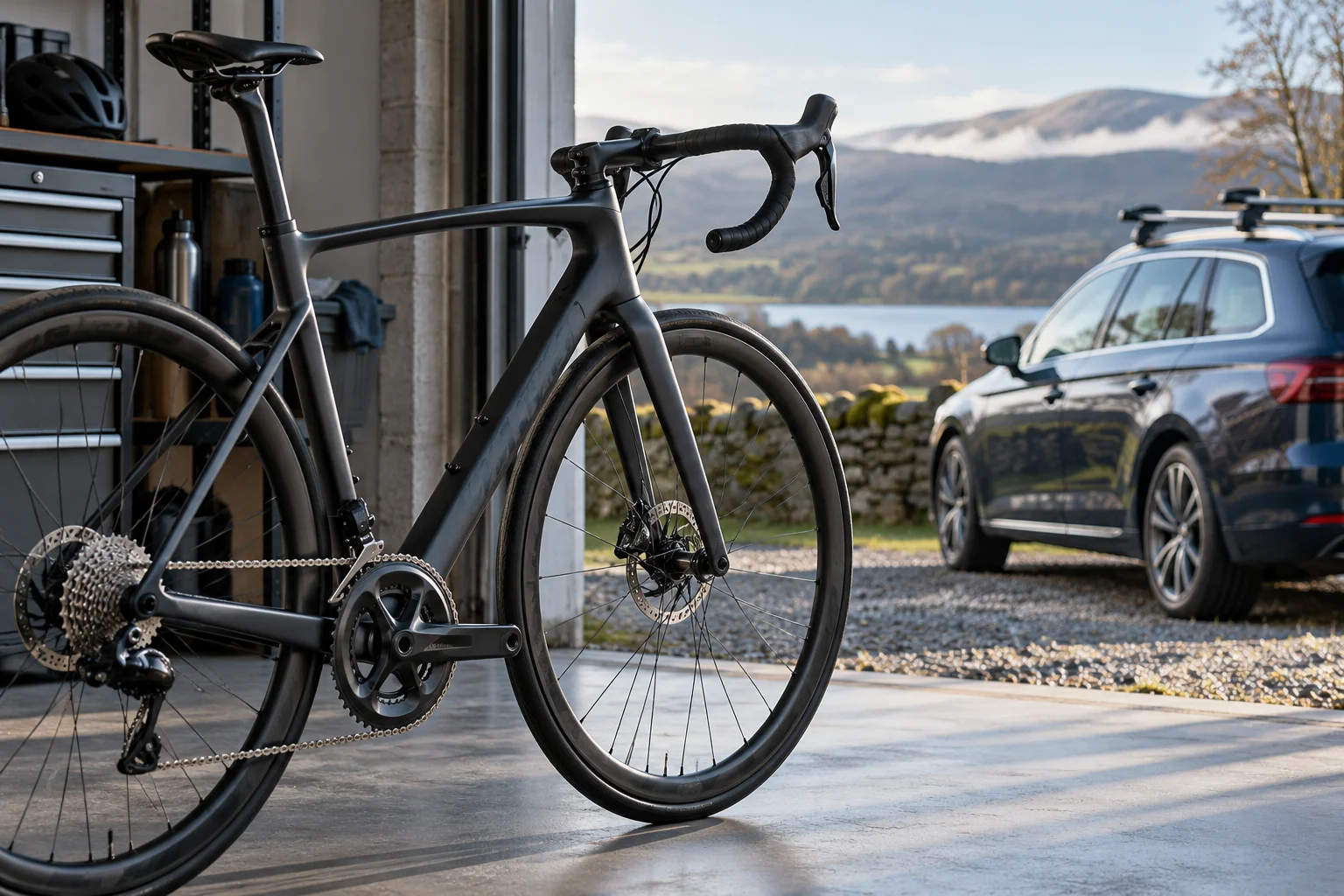
Permission comes before protection
Choose a roof carrier around the contact points permitted by the bicycle, fork and wheel makers. A frame protector or a “carbon-compatible” carrier description does not override a restriction on the exact bicycle. Wheel holding and fork mounting avoid a tube clamp but still need their own checks.
Read the bicycle instructions before the carrier shortlist
Carbon construction is not a single transport specification. A frame, fork, seatpost and wheel can each have different requirements, even on the same bicycle. Start with the model and year, then identify any replacement components. A bicycle supplied with alloy wheels may now have carbon rims that change the relevant contact points.
Look for the transport or car-rack section of the bike manual, not just the workshop torque chart. A torque allowed for a bicycle’s own seat clamp does not authorise a car carrier to grip a nearby tube. If the manual is silent about your proposed method, ask the manufacturer or its authorised support team for clarification before buying the carrier.
SCOTT’s general guidance favours wheel or underside support while avoiding frame clamping. Trek’s owner guidance warns against clamping a carbon tube unless it is designed for that purpose. Those examples explain why a carrier maker’s broad material claim cannot settle permission for every bicycle.
Make a map of every contact point
Separate the part that supports weight from the part that prevents movement. A wheel-holding rack can retain the front tyre and strap the rear wheel. A fork mount connects at the dropouts and still secures the rear wheel. A frame-clamping carrier adds a tube contact area as well as its wheel supports.
Write down the component at each point and the relevant instruction. For example: front tyre hook, rear rim strap, fork adapter, frame jaw. This makes an enquiry to a manufacturer much clearer and helps you spot an overlooked carbon component. Do not use extra foam, tape or a wheel cover to change a specified interface unless the makers permit that exact solution.
| Part | Question to resolve | Why it matters |
|---|---|---|
| Frame | May this exact tube be clamped? | Material, shape and local construction vary |
| Front wheel and tyre | Is the specified hook contact permitted? | No frame contact still involves the wheel |
| Rear wheel | Is this strap and contact area permitted? | Rim shape and construction may impose restrictions |
| Fork | Is this dropout/axle transport method approved? | Correct diameter alone is not full approval |
| Accessories | Will anything obstruct the retaining mechanism? | Mudguards, hoses and cages change the setup |
Keep the completed worksheet with the carrier instructions. Revisit it after changing wheels, tyres, mudguards or the fork. An approval for the original bicycle specification may not answer questions about a modified setup.
Wheel holding can avoid the frame-clamp problem
A suitable wheel-holding design is a useful starting point where the bike maker permits that method. You still need to check actual wheel diameter, tyre width, wheelbase and the construction of the contact surfaces. The mechanism must operate in its intended position without trapping a mudguard or leaning on an accessory.
Try the loading routine at the actual vehicle height. The appeal of avoiding a tube clamp does not remove the need to control the bike while the retaining arms and rear strap are secured. If that is awkward with a tall car, investigate another approved location or carrying method rather than improvising a standing platform.
Fork mounting changes the permission you need
With the front wheel removed, a fork-mounted carrier relies on the approved fork interface. Identify the exact axle standard, including spacing and any relevant dropout features. Check clearance around disc-brake components and follow the bicycle maker’s precautions for a removed wheel and subsequent reassembly.
Do not assume a carbon fork is acceptable because the frame does not touch the rack. The carrier and fork instructions need to agree. Store the removed wheel securely for the drive and keep the axle and other removable parts together so reassembly can follow the bicycle’s instructions without substitutions.
Understand what a frame protector can and cannot do
Thule’s Carbon Frame Protector 984101 is intended for specified carriers with a torque-limiter knob, and the ProRide instructions call for the named protection for carbon frames. That describes an approved carrier-side arrangement; it does not grant permission from the bicycle maker to clamp its frame.
If your bicycle manufacturer prohibits that contact, stop there. Do not treat a click from the torque limiter as proof that the tube can withstand the load, and do not substitute packaging foam for the prescribed accessory. Where both manufacturers permit a particular protected clamp arrangement, follow the exact placement and installation instructions rather than adding more layers.
Check the car, bars and complete load separately
A permissible bicycle contact method does not approve the carrier’s connection to the roof bars. Confirm the vehicle-approved rack, the carrier’s bar hardware and the permitted mounting positions. The T-track and clamp guide helps distinguish those interfaces.
Add the complete vehicle rack, carrier, bicycle and other equipment to the driving roof-load calculation. Use an actual travelling weight and include separate adapters once. A light frame can still be part of a heavy bicycle with robust wheels and accessories, while a heavier wheel-holding carrier consumes more roof allowance than a lighter fork-mounted example.
Before each journey, inspect the specified contact surfaces and retaining parts for damage, trapped grit or an obstruction. Follow the bicycle maker’s advice if carbon damage is suspected; an apparently small mark is not something a rack adjustment can diagnose. Use our departure checklist alongside the exact equipment instructions.
Sources checked October 2026: SCOTT carbon transport guidance, Trek owner manual, Thule protector restrictions and the carrier/adapter specifications linked in the bike buying guide.
Frequently asked questions
Can a carbon bike go on a roof rack?
It can only use a method permitted for the exact frame, fork and wheels, within the carrier’s dimensional and weight limits. Check the bicycle maker’s transport instructions before selecting a rack.
Does a carbon frame protector make any clamp acceptable?
No. A protector distributes pressure in a specified carrier arrangement. It does not change a bicycle maker’s restrictions, approve an unsuitable tube or permit using an incompatible clamp.
Are wheel-holding carriers automatically safe for carbon wheels?
No. Avoiding frame contact does not answer whether the rims, tyres and wheels accept the specified hook and strap loads. Check the actual wheels and all contact points separately.
Is fork mounting suitable for every carbon fork?
No. Confirm the fork maker’s transport permission, axle dimensions, dropout interface and the exact adapter. A correctly sized axle is only one part of an approved mounting arrangement.
What should I do if the instructions conflict?
Do not transport the bicycle in that arrangement until the relevant manufacturers clarify it. Give them the exact bike, component, carrier and adapter models so they can address the real contact method.