
Measurement guide / Bikes and sports equipment
Can You Fit a Roof Box and Bike Rack Together?
Measure usable bar width, mounting zones, box opening and bike clearance before sharing the roof. Includes a load example and narrow-box Amazon options.
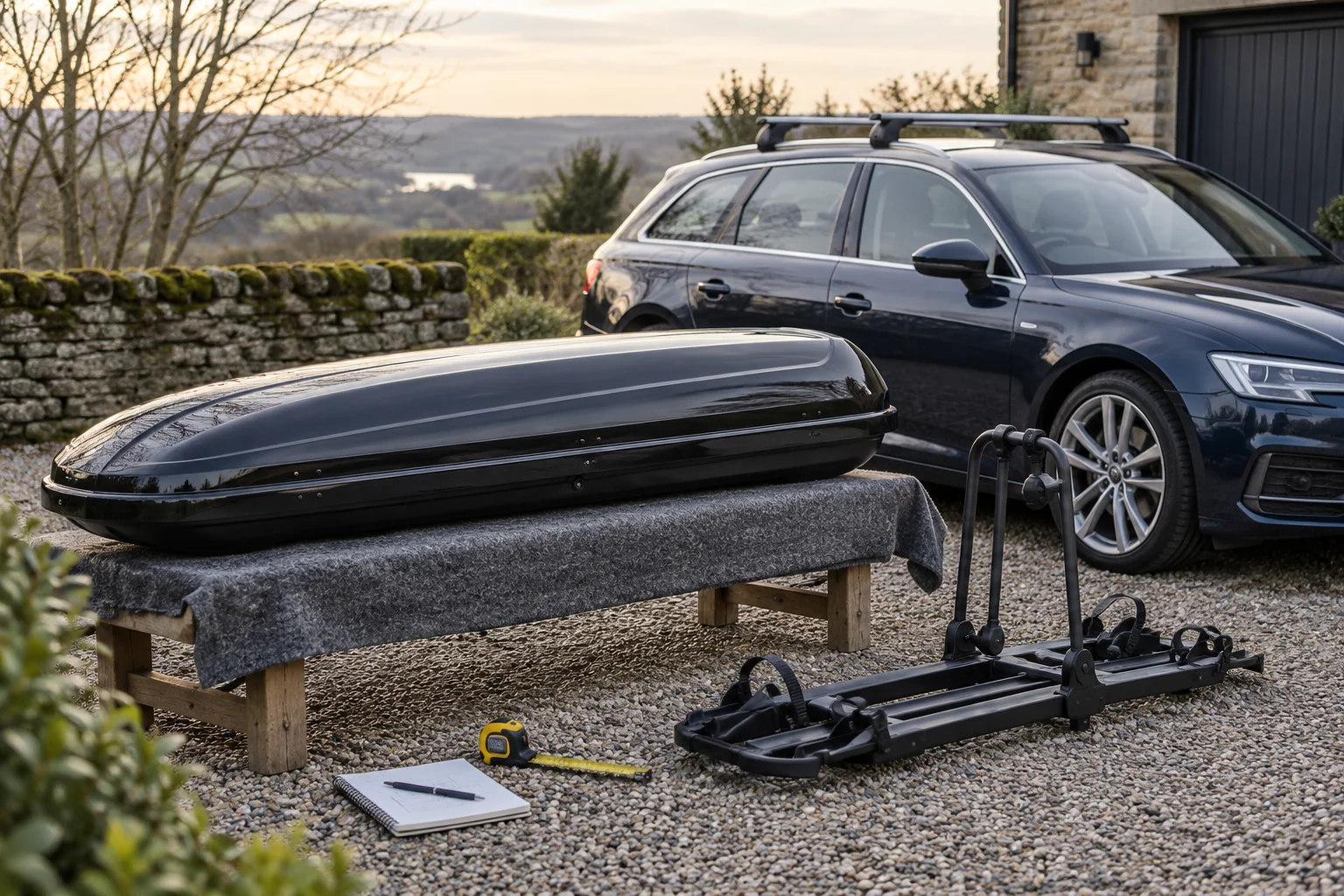
Plan a working layout, not just two footprints
A box and bike rack can share an approved bar system only if their mounts, full operating movements and combined load all fit. Measure usable mounting zones on both bars, then check the box lid, handlebars, pedals, loading access and the finished roof weight.
Start with the vehicle-approved bars
Find the complete rack specified for the exact car, including bar length, feet and fitting kit. A longer crossbar can seem like a simple solution to a crowded roof, but only a manufacturer-approved length and arrangement is acceptable. Do not swap to an arbitrary wider bar or move vehicle mounting points to create space.
Note where the bar maker allows accessories to mount. Some usable sections lie between the feet; some systems permit particular outboard positions. End caps, foot covers, slot openings and clamping mechanisms can all reduce or interrupt the area available. Check both bars because a narrower rear roof or a different foot position can make one bar the constraint.
Our complete roof-bar guide covers the vehicle side of this decision. Keep that approval separate from whether a box and bike carrier accept the resulting profile and spacing.
Measure the mounting zones on each crossbar
Make a simple plan view of the two bars and mark the feet, permitted accessory zones and any excluded areas. Add the proposed box mounting positions and carrier attachment points using the exact instructions. Measure to the relevant centres or edges defined by those diagrams rather than mixing external shell dimensions with mounting-foot dimensions.
A nominal 127cm bar minus a 63cm box shell leaves a numerical 64cm, but that is not a guaranteed accessory bay. Part of the bar may be unavailable and the box shell can overhang its mount. The carrier also needs hardware and operating room, while the bike projects beyond its tray.
Add the box’s real operating envelope
A narrow shell is a useful candidate where roof width is limited, but its width alone cannot approve a shared layout. Check the mounting spacing and permitted adjustment, then the position of the lid hinges and the direction in which the top moves when opened.
Where the box permits opening from either side, choose an access side you can actually reach with the bike in place. Test opening, loading, closing and locking. A layout that lets an empty lid lift slightly may still fail once bulky bags need to pass through the opening.
Check the bicycle above and beyond its tray
The carrier’s mounting footprint is only the start. Handlebars, pedals, brake levers and a tilted or moving bike may occupy space beside the box. Inspect the final secured position and the movements needed to load and unload it. A fork-mounted bike changes the front-end arrangement, but can still have a wide handlebar and projecting controls.
Keep the bicycle in the orientation and mounting position permitted by the carrier. Do not turn bars, remove parts or reverse components merely to avoid contact without checking the bicycle and carrier instructions. Include any permitted removed equipment in the secure packing plan.
Use a layout checklist before the trial fit
| Item | What to record | A reason to stop |
|---|---|---|
| Vehicle rack | Approved bar length and positions | Layout needs an unapproved wider bar |
| Box mounts | Permitted spacing and attachment zones | Clamps overlap feet or carrier hardware |
| Bike carrier | Both mounting points and fastening access | An approved fastener cannot operate |
| Box lid | Full opening and locking movement | Lid touches bike or blocks loading |
| Bicycle | Bars, pedals and loading movement | Contact occurs even before final securing |
| Rear of car | Hatch, spoiler and antenna clearance | Approved adjustment cannot clear the car |
Where the instructions permit a trial arrangement, work on level ground with another person if required for controlled handling. Keep the box empty during the initial space check. Do not drive an incompletely secured trial setup, and do not resolve interference by leaving a restraint out.
Calculate the luggage left after the bicycle
Consider a hypothetical 75kg vehicle roof allowance, a 5kg complete rack, a 15.4kg empty box, a 4.2kg bike carrier and a 14kg bicycle. The vehicle-side allowance for box luggage is 75 − 5 − 15.4 − 4.2 − 14 = 36.4kg. Separately check the complete rack, box and bike carrier limits; the lowest applicable result governs.
This example does not establish a compatible combination for any car. Use the worked guide and calculator with the carrier plus bicycle entered as other roof load. Adapters, extra carriers and changed bicycle accessories must be included too.
Rehearse access and record the highest point
Try the practical jobs you will do on the trip: securing each bike restraint, opening the box, removing a bag and reaching the lock. Check door access and whether you can stand in a safe place on the loading side. Roadside access may be different from your driveway, so a technically spacious layout can still be inconvenient.
Measure the finished overall height using the tallest bicycle point. A low box does not make the bike lower. Plan parking, ferries and covered entrances for the combined arrangement, and repeat the checks whenever either accessory or its load changes.
Sources checked October 2026: Force 3 L Sport, Motion 3 Sport, ProRide instructions and the vehicle rack selector. Obtain approval for the exact combined layout.
Frequently asked questions
Can a roof box and a bike rack share the same bars?
Sometimes, if each accessory and their combined position are approved, the usable mounting space and operating clearance are sufficient, and the full roof load stays within every relevant limit.
Is bar length minus box width the space left for a bike?
No. Nominal bar length includes areas that may be occupied by feet or unavailable for accessory mounting. Clamps, mounting zones, opening movement and bicycle parts also need clearance.
Can I fit wider bars just to make a shared setup work?
Only use a bar length and complete rack combination approved for the exact vehicle. Extra width must not override vehicle fit, overhang, mounting-position or load restrictions.
Does a dual-side opening box solve access beside a bike?
It can offer a choice of access side, but the lid still needs its full operating space. Confirm that you can open, load, close and lock the box with the bike secured.
How do I enter a bicycle in the roof-load calculator?
When a box is also fitted, include the other bike carrier, bicycle and relevant separate adapters in the other-roof-load total. Use verified weights and retain the carrier’s independent bike limit.