
Decision guide / Occasional roof-box use
Hiring vs Buying a Roof Box: Which Makes Sense for Occasional Use?
Compare roof-box hire and ownership using complete setup costs, trips, storage, fitting and collection. Work through a transparent break-even example.
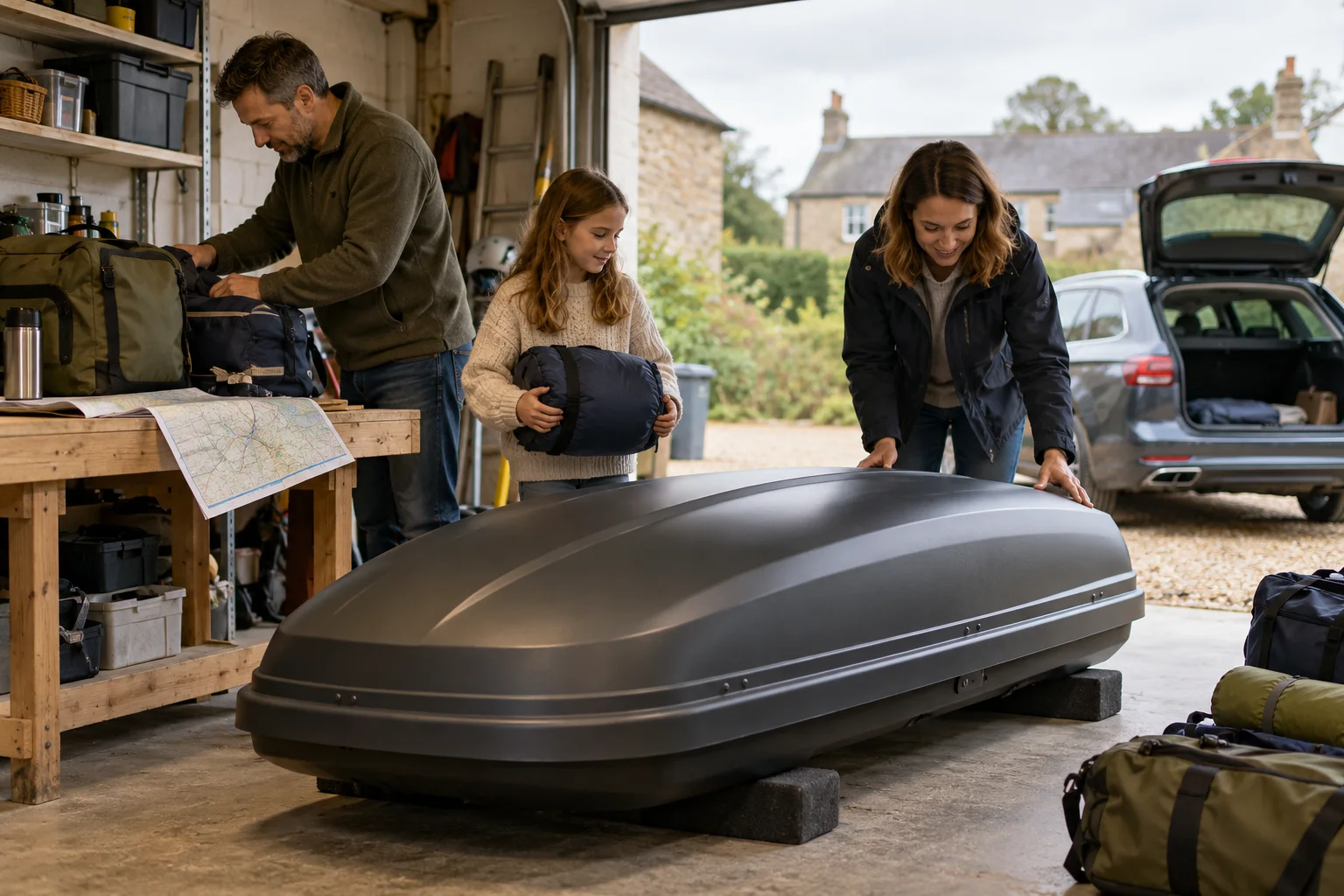
Compare the complete arrangement
Hire is worth comparing for occasional trips or limited storage. Buying becomes more attractive when repeated use, convenient access to the equipment and suitable storage justify the full ownership cost. Obtain quotes for the same usable box-and-rack setup before comparing totals.
Start with trips and fitting requirements
Write down the journeys where you actually need extra luggage space. Separate a firm holiday from trips you might take. Consider whether the same car and rack are likely to be used throughout the period you are comparing.
Then identify the carrying arrangement the vehicle supports. Whether hired or purchased, the box needs an approved rack, suitable mounts and enough load allowance. A provider's availability or a low listing price does not establish fit for your car.
Capacity and shape also need to match. A hire quote for a large box and a purchase price for a short compact box are not like-for-like options if only one carries the intended bags. Use the size guide to establish the required luggage shape before comparing money.
Ask what the hire quote includes
Check the hire period, collection and return times, any permitted extensions and what happens if plans change. Ask whether bars, feet, vehicle-specific kits, fitting and removal are included or charged separately. A box-only quote can look cheaper while leaving the rack problem unresolved.
Request the exact model, included keys, internal restraints and instructions. Confirm how the provider checks the setup and what information they need about the car. Ask about condition recording, cleaning expectations and the process for reporting a problem.
Terms differ between providers. Read the actual quote and agreement for deposits, damage responsibility, cancellation and late return, rather than assuming a standard policy. This guide does not assign a typical charge or interpret your legal rights under a particular hire contract.
Add ownership costs that are easy to overlook
Include the box, approved rack components you need to buy, required adapters, suitable storage and any collection or delivery costs. Existing rack components may reduce the cost only if they are approved for the intended vehicle and accessory.
Allow for genuine replacements and maintenance when relevant, but do not invent a fixed annual cost. Resale can reduce the eventual cost, yet the future amount and sale timing are uncertain. Keep it as a separate scenario rather than money you know you will recover.
Use a transparent break-even calculation
For a simple starting point, divide the total purchase setup cost by the comparable non-refundable hire cost per trip. This ignores timing, resale and some ownership differences, but makes the assumptions visible.
Suppose, purely as an arithmetic example, a suitable complete purchase setup costs £450 and equivalent hire costs £100 per trip. Four hires total £400; five total £500. The simple crossing point is therefore the fifth trip. These are invented comparison figures, not current market prices or quotes.
| Trips | Cumulative hire expense | Initial purchase setup | Question to revisit |
|---|---|---|---|
| 1 | £100 | £450 | Will there be enough future use? |
| 3 | £300 | £450 | Do collection and storage change convenience? |
| 5 | £500 | £450 | Have repairs, changed car or resale altered the comparison? |
If hire includes fitting but buying requires additional components or help, include those costs consistently. If the hire deposit is refundable under the agreed terms, it is a cash requirement while held, not automatically a hire expense. Any deduction changes that outcome.
See which assumptions move the hire-versus-buy crossing point
A single hire price can hide collection costs, storage purchases and uncertain eventual resale. Compare those assumptions separately over the same number of trips, keeping a refundable deposit out of the expense calculation.
Inputs and assumptions. Every money figure below is invented: £450 equipment purchase, optional £75 one-off storage cost, £100 hire per trip, optional £20 non-refundable collection cost per hire, and optional £125 eventual resale. No interest, tax, repair cost, annual fee or ownership cost per trip is included.
| Illustrative scenario | Initial cash outlay | Assumed resale | Eventual net ownership | Hire expense per trip | First strictly cheaper ownership trip |
|---|---|---|---|---|---|
| Equipment only | £450.00 | £0.00 | £450.00 | £100.00 | 5 |
| Add storage | £525.00 | £0.00 | £525.00 | £100.00 | 6 |
| Add hire collection expense | £525.00 | £0.00 | £525.00 | £120.00 | 5 |
| Also assume eventual resale | £525.00 | £125.00 | £400.00 | £120.00 | 4 |
| Exact-tie example | £525.00 | £125.00 | £400.00 | £100.00 | 5 |
Storage moves the simple crossing point from trip five to trip six. Adding a £20 hire collection expense moves it back to trip five. The resale scenario crosses at trip four, but still needs £525 initial cash; the future sale is not money available at purchase.
In the exact-tie row, four £100 hires equal the £400 eventual ownership scenario. Buying becomes strictly cheaper on trip five under those assumptions. Replace every figure with equivalent current quotes and costs for your approved setup before making the decision.
Calculation method and sources
Net ownership scenario = purchase + one-off additions − assumed eventual resale. Hire expense = trips × (hire + non-refundable collection cost). The first trip at which ownership is strictly cheaper is floor(net ownership / hire expense per trip) + 1; an exact tie is not strictly cheaper. Resale reduces eventual net cost only if realised.
- Thule roof-box safety instructions: Complete roof load, restraint, fit and operating checks remain separate requirements.
- Thule roof-rack safety guidance: Exact vehicle-kit positions and applicable accessory instructions take precedence over general spacing advice.
Download the inputs and workings (CSV). Source review: October 2026.
Put a value on collection, return and storage convenience
Hire usually means working around collection and return arrangements. Check how they fit around your travel dates and whether an extra journey is needed. A delayed return or changed itinerary can affect the practical choice even before any charge is considered.
Ownership gives access to the equipment between trips, but also leaves you responsible for somewhere to keep it. Measure the shell's storage position and the clear handling route. Consider whether another person is available to help remove it when needed.
Do not buy a storage accessory simply because there is unused ceiling space in a photograph. The storage hub explains support and clearance decisions that should be settled before ordering a long shell.
Consider a fold-away alternative where it is approved
A soft carrier can change the storage calculation, because it may pack away between trips. It still needs an approved support surface, attachment method and load arrangement for the vehicle. It is not automatically a substitute for a hired box and complete rack.
Compare its actual packed arrangement with the required luggage. Flexible storage at home does not mean unlimited capacity on the car. Do not rely on an unverified empty weight or a claim of complete weather protection when making the decision.
Revisit the decision if the car or load will change
A purchased box may be usable with a future approved rack, but the old feet or fitting kit may not transfer to the next car. Check compatibility rather than treating the carrying system as a single universal purchase.
Likewise, a box chosen for compact clothing may be unsuitable when the trip changes to long sports equipment. Hire can be useful for trying the practical size of a category without pretending that one trip establishes every future need. If buying used, include the condition and missing-parts checks in the cost comparison.
Keep the decision based on likely use and a load you can carry, not pressure to make a purchase pay for itself through extra trips. The right arrangement is the one that fits both the vehicle and the way you actually travel.
Make the comparison on one page
Collect a written hire quote and a complete purchase list for the same usable load. Add collection/return logistics, storage, fitting responsibilities and any genuine required accessories. Show resale separately and label every assumption.
Before the first trip, complete the load calculation, hatch and height checks regardless of ownership. A hired setup still needs the supplied operating instructions and a clear understanding of the checks you must perform during the journey.
Decision framework reviewed October 2026. Technical constraints follow Thule cargo-box safety instructions and the exact vehicle/equipment manuals. Product details use the named manufacturer's information and selected Amazon variants; hire terms and actual prices must come from your own current quotes.
Frequently asked questions
How many trips make buying cheaper than hiring?
There is no fixed number. Divide the complete suitable purchase cost by a comparable hire expense per trip, then consider fitting, collection, storage, repairs and uncertain resale separately.
Do I need my own roof bars to hire a box?
It depends on the provider and quote. Confirm whether approved bars, feet, fitting kits, installation and removal are included or must be arranged separately.
Should I count a refundable deposit as a hire cost?
Show it as cash that must be available while held. It becomes an expense only to the extent that the actual agreement permits a deduction that is made. Read the provider’s terms.
Can I keep the same bars if I change cars?
Only if the complete combination is approved for the new vehicle. Bars, feet and fitting kits have separate compatibility requirements; do not assume the old complete rack transfers.
Is a folding roof bag a cheaper alternative?
It may change purchase and storage costs, but compare the exact supported and approved arrangement. A low bag price does not establish vehicle permission, fit or adequate packing capacity.