
Product comparison / Roof bars and upgrades
Thule WingBar Evo vs WingBar Edge: Carrying Width, Fit and Practical Differences
Compare Thule WingBar Evo and WingBar Edge around usable width, feet, bar lengths and accessories. Understand pair versus single-bar listings before buying.
Quick answer
Choose around the approved vehicle fit and the space your accessories need. WingBar Evo provides a through-bar layout; WingBar Edge provides a compact end arrangement. The examples here are a pair of Evo 127 bars and ONE Edge 95 bar, so their listing prices would not represent equivalent complete racks.
Two bar layouts, with different package contents
Jump to the full specs table ↓Thule WingBar Evo 127 — pair
- 2 × 127cm bars
- Silver aluminium
- Feet and fitting kit separate
For drivers whose confirmed Thule fit specifies 127cm Evo bars. Check the bar profile against each box or sports carrier, and compare the complete system rather than the bars alone.
View on Amazon UK ↗Read the full comparison ↓Thule WingBar Edge 95 — single bar
- 1 × 95cm bar
- 82–92cm published loading width
- Edge feet and second bar separate
For a vehicle fit that specifically calls for this Edge length. Select both bar lengths, Edge feet and any fitting kit together; check usable width before sharing the roof.
View on Amazon UK ↗Read the full comparison ↓| Check | WingBar Evo 127 / 711300 | WingBar Edge 95 / 721400 |
|---|---|---|
| Selected listing | Two 127cm silver bars | One 95cm silver bar |
| Layout | Through-bar Evo system | Compact Edge system |
| Published loading width | 127cm; actual permitted positions still need checking | 82–92cm, dependent on fitted arrangement |
| Feet and kit | Specified Evo feet and any kit separate | Specified Edge feet and any kit separate |
| Accessory connection | Top T-track or approved around-bar hardware | Top T-track or approved around-bar hardware |
| Main buying check | Correct length and complete Evo package | Correct front/rear lengths and complete Edge package |
These are exact listing variants, not a fit result for your car. Compare the complete approved system, including feet, kit and accessory adapters.
The selected variants in detail
Thule WingBar Evo 127 — pair
An aluminium aerodynamic pair with T-tracks for compatible accessories. The selected listing contains two 127cm bars; feet and any vehicle-specific fitting kit are separate.
For drivers whose confirmed Thule fit specifies 127cm Evo bars. Check the bar profile against each box or sports carrier, and compare the complete system rather than the bars alone.
- 2 × 127cm bars
- Silver aluminium
- Feet and fitting kit separate
Why consider it
- Top accessory track for approved fittings
- Pair clearly identified as two bars
Keep in mind
- Feet and any vehicle kit are separate
- 127cm is only for confirmed fits
Thule WingBar Edge 95 — single bar
A single 95cm aluminium bar for an Edge system with little overhang. This is one bar, not a pair or a complete rack; the other bar may need a different length.
For a vehicle fit that specifically calls for this Edge length. Select both bar lengths, Edge feet and any fitting kit together; check usable width before sharing the roof.
- 1 × 95cm bar
- 82–92cm published loading width
- Edge feet and second bar separate
Why consider it
- Compact end arrangement for a confirmed Edge fit
- Top accessory channel for approved fittings
Keep in mind
- One bar; the second may need a different length
- Edge feet and any vehicle kit are separate
Start with the permitted systems for your exact car
Check the vehicle handbook and Thule's current selector before deciding between the bar families. Record the body style, model generation, model year and actual roof option. If only one approved combination is offered, a preference for the other silhouette does not establish an alternative fit.
The selector's complete result matters: bars, feet and any fitting kit form one arrangement. Bar length is not selected simply by measuring the overall width of the car. Front and rear positions, the foot interface and any roof restrictions all contribute to the specified choice.
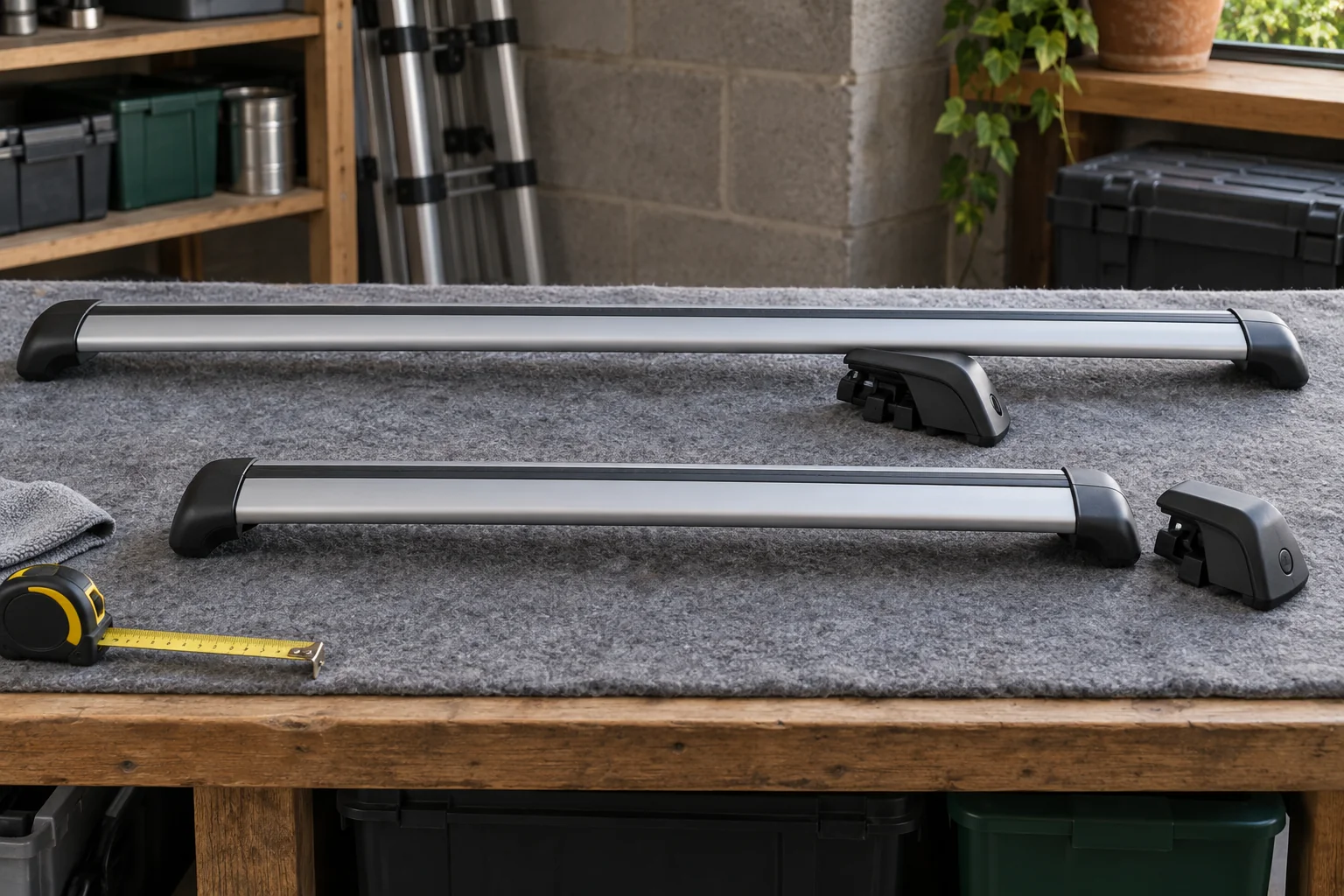
This comparison examines published specifications, carrying width, component selection and the complete purchase. The generic hero illustrates two layouts; the Amazon photographs show the actual selected product listings.
Compare through-bar space with a compact end arrangement
WingBar Evo extends through its feet. Where the fitted instructions permit accessory mounting beyond a foot, that arrangement can be useful for a wide carrying combination. The relevant question is where each mount may sit, not whether the metal extends beyond the car's rails.
WingBar Edge finishes close to its dedicated feet. That creates a compact appearance, but its usable accessory width should be checked carefully. A short overall bar with feet occupying part of the layout is not equivalent to the same nominal length on a through-bar system.
For the selected examples, Thule publishes 127cm loading width for Evo 127 and 82–92cm for Edge 95. These are different variants, not two alternative lengths automatically approved for the same car. Confirm the fitted system before comparing practical space.
Measure the accessory footprint at both crossbars
A box's outer shell width is not its clamp footprint. A bike carrier's wheel tray can sit above mounting parts that require a different amount of space on the bar. Measure the actual front and rear interfaces and identify any foot obstruction.
For a box beside a bike, allow space to operate tightening controls, close clamps and open the box. A layout that appears to fit as two rectangles can fail when a clamp lands against a foot or a lid strikes the adjacent equipment.
If the intended arrangement fails, compare an approved different bar configuration or a different accessory. Do not slide feet outside their prescribed positions, assume unused bar ends are authorised mounting areas or choose a longer variant without an exact fit result.
Keep Evo and Edge feet matched to their systems
Do not assemble an Evo/Edge hybrid because the bar profile looks similar or a kit has the same manufacturer. Follow the complete combination specified for the car and check the actual generation when considering used components.
Thule's older-system reuse guidance documents specific Rapid/Evo possibilities while distinguishing older and current Edge systems. That guidance should help frame an exact parts enquiry, rather than replace the vehicle selector.
Keep the component numbers with the instructions so a later missing part can be identified without guessing from an online photo.
Compare complete baskets rather than individual prices
The Evo example is a pair; the Edge example is a single bar. A complete Edge arrangement can require different front and rear lengths. Confirm whether the selected seller package contains one or two pieces before comparing its cost with anything else.
Write down all required bars, feet, vehicle kits, locks and accessory adapters. Check whether any pieces are included in a bundle or sold separately. A low displayed bar price can be misleading if the rest of the system is omitted.
If you already own equipment, check its approved mounting hardware before finalising the basket. A carrier that attaches to the existing rack may need a different adapter or may not accept the new profile. Include that change in the comparison.
Check T-tracks and clamps against the actual accessory
Both families offer top-channel accessory mounting, but that does not make every T-bolt suitable. Use the carrier manufacturer's specified adapter and check the exact bar compatibility. Do not choose a fixing only because its head slides into the opening.
Around-bar hardware must close and engage correctly around the profile, with enough clearance beneath the bar. Inspect foot covers, roof surfaces and bolt ends in the full installed arrangement. A compact rack can leave less room in a critical area without the headline width revealing it.
For existing accessories, use the mounting-interface guide before ordering. An approved adapter changes a particular connection; it does not increase the vehicle allowance or extend a box's mounting range.
Keep load and noise claims in proportion
Apply the vehicle's dynamic roof limit and the complete rack and accessory limits according to their definitions. A larger bar headline figure does not allow extra luggage if the vehicle, feet, kit or carrier imposes a lower limit. Weigh the whole fitted arrangement where required.
Use the calculator after establishing the correct inputs. Do not compare a single Edge bar's listed weight with an entire Evo pair and call the difference a system saving; front/rear bars, feet and kits all count.
Both bar families are designed with airflow in mind, but that is not evidence that either will be quiet on every car. Correct strips, caps, fitting positions and accessories matter. If the existing system is noisy, work through the motorway-noise checks before assuming replacement is necessary.
Choose for the carrying job and the way you use the car
For one compatible box, either approved layout may provide the working space you need. For several accessories, focus on permitted mounting positions and the full width calculation. For frequent changes, consider whether you can easily reach the track openings and fastening controls.
Check hatch clearance, glass restrictions and total fitted height after choosing the complete system. A compact-looking bar arrangement does not prove roof-box clearance, and a through-bar layout does not automatically provide more fore-and-aft adjustment.
Choose the approved option that accommodates the actual accessories, handling routine and full purchase cost. The narrower-looking rack is not automatically the simpler purchase, and additional width is useful only where the installation permits it.
Specifications and selected Amazon packages checked October 2026. Primary references: WingBar Evo 711300, WingBar Edge 721400, the linked reuse guidance and Thule vehicle selector.
Frequently asked questions
What is the main difference between WingBar Evo and Edge?
Evo uses a through-bar layout, while Edge has a compact arrangement with bar ends close to its dedicated feet. Compare the approved fitted loading space and accessory positions rather than treating one layout as better for every vehicle.
Does the WingBar Edge 95 listing contain two bars?
The selected 721400 Amazon listing is one 95cm bar. A complete rack requires the prescribed front and rear bars, which can be different lengths, plus Edge feet and any vehicle-specific kit.
Can I fit WingBar Edge bars to Evo feet?
Do not treat Evo and Edge as interchangeable component sets. Follow the exact bars, feet and kit combination specified for the vehicle, and confirm the generation if you are reusing older parts.
Is WingBar Evo always quieter than Edge?
No independent noise comparison is provided here. Both are aerodynamic systems, and real noise depends on the car, correct installation, strips, openings and accessories. Product descriptions do not establish a reliable noise ranking for your setup.
Which is better for a roof box beside a bike?
A permitted through-bar layout may offer useful mounting positions, but the actual result depends on foot obstruction, usable width and both carriers' mounting footprints. Measure the approved fitted system and check the complete load before choosing.