
Inspection checklist / Roof bars and upgrades
Buying Used Roof Bars: Checking for Missing Feet, Kits and Parts
Inspect second-hand roof bars before buying. Identify bars, feet and fitting kits, price missing parts and recognise damage or uncertain fit that should stop a purchase.
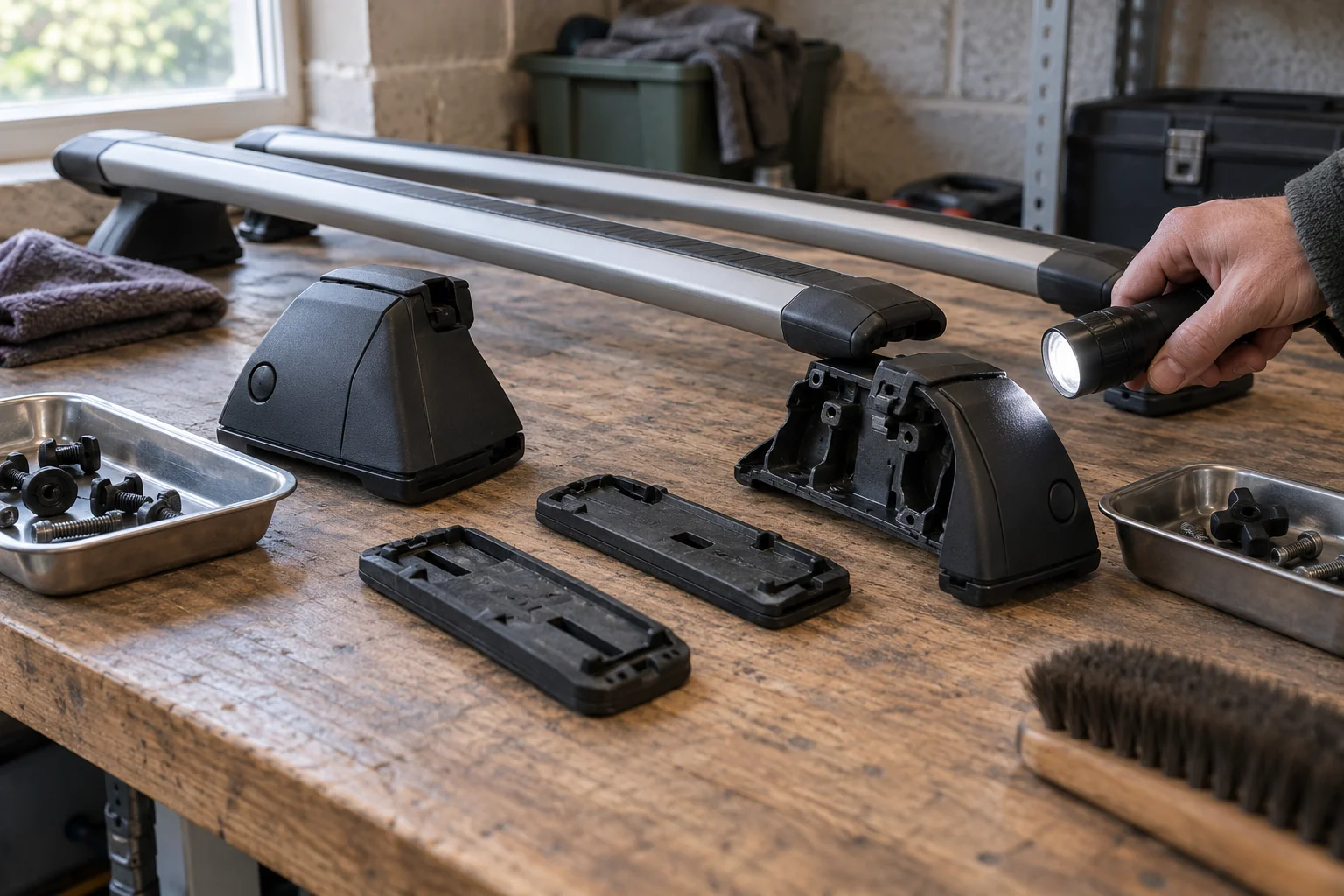
A used roof-bar set can be good value when you can identify every component, confirm the vehicle fit and inspect its condition. The bargain disappears quickly if the feet are wrong, a kit is incomplete or the correct replacement pieces are no longer available.
Treat “came off the same car” as a lead to investigate. Your purchase decision should rest on the actual part numbers, complete instructions and condition of the equipment in front of you.
Ask for identification before arranging collection
Request clear photographs of bar labels, each foot, kit markings and the underside connections. Ask which vehicle, body style, year and roof configuration the rack was used on. Find out whether it was sold as a complete package or assembled from separate purchases.
Ask about impacts, overloads, persistent movement, modifications and repairs. A seller may not know the full history, especially with equipment they acquired second-hand themselves. Record uncertainty honestly rather than treating an unanswered question as a clean history.
Obtain the relevant manufacturer's instructions before inspection. They provide an inventory and identify interfaces that may not be visible in an advertisement. If the parts cannot be identified, pause before paying or travelling to collect them.
Check the manufacturer’s current safety notices using the exact model and identification details before buying. For Thule equipment, use its official recall page. A notice can concern particular components or batches; a familiar range name and an apparently good condition do not resolve that check.
Confirm fit independently of the seller's car
Run the manufacturer selector for your exact vehicle and roof. Compare the required bars, feet and kit with the advertised components. The same model badge can span generations and several roof attachments, so an apparently identical car in a photograph is insufficient.
Check whether the feet and bars belong to the same permitted system generation. Some manufacturers document specific cross-generation combinations; others require entirely different interfaces. The moving-bars guide explains how to evaluate reuse without assuming that all matching-brand parts interchange.
If your vehicle has no confirmed fit, buying first and hoping to find a kit later is a poor starting point.
Count parts against the correct diagram
Lay the equipment on a clean protected surface and compare it with the matching inventory. Separate front/rear and left/right pieces where the instructions distinguish them. Count small inserts, washers, brackets, retainers and covers rather than grouping them as “a bag of fittings”.
| Check | Evidence to obtain | Reason to pause |
|---|---|---|
| Identity | Readable bar, foot and kit references | Parts identified only by appearance |
| Fit | Exact vehicle and roof result | A different year or attachment is being assumed |
| Inventory | Every component on the matching diagram | Unidentified or unavailable missing pieces |
| Condition | Visible surfaces, connections and threads | Cracks, distortion, repairs or unresolved corrosion |
| Operation | Permitted movement and fastening checks | Seized, stripped or unreliable mechanisms |
| Full cost | Purchase plus verified replacements | Saving depends on unsuitable substitutes |
A bag containing four pads does not establish that all four are correct. Some kits use position-specific pieces. Keep moulded references associated with their actual location instead of assuming they are interchangeable.
Examine the bars and their attachment areas
Look along each bar for bending or twisting. Inspect the top profile, underside connection, ends and accessory track where present. Pay particular attention to local damage at foot positions and clamping areas, where a small-looking defect may affect the intended connection.
Distinguish ordinary surface marks from deformation, cracks, corrosion or repairs. Do not straighten a bent bar, drill a replacement hole or file a damaged slot into shape. If a defect's significance is unclear, obtain a manufacturer assessment before using the component.
Check that removable pieces can be operated as instructed, without using excessive force. An apparently secure assembly can still hide a damaged thread or seized mechanism.
Inspect feet, pads and fastening parts
Examine foot bodies, clamp arms, threaded components and the surfaces that contact the vehicle. Look for cracking, distortion, missing protective material and wear that changes how a part engages. Grit embedded in a pad should not be trapped against the car.
Confirm that pads and brackets have the required shape and reference. Extra foam, tape or hand-cut rubber is not evidence of a correct kit. A distorted bracket should not be bent back to approximate a roof edge.
Check locks and keys where supplied, using the normal operating method. A functioning lock does not establish structural condition or compensate for an incorrect foot. Replacing cylinders is a separate question from whether the rack fits and clamps properly.
Identify modest replacements without disguising larger damage
A documented missing cap or strip may be straightforward to replace when the receiving bar is sound. Check the diagram's part number, handedness, quantity and generation before adding it to the purchase cost.
A replacement cap does not repair a cracked end, and a new contact pad cannot restore a damaged foot.
Price the complete working system
Add the used purchase price, all verified missing parts, correct kit, any required locks or adapters and collection costs. Check that essential spares remain obtainable before agreeing a price. A photograph on an old parts page does not guarantee supply.
Compare that total with a new approved combination containing the same components. Account for support and the evidence available for the used rack's history. Avoid a comparison where the used price includes bars only but the new price covers a complete fitted system.
If missing items cannot be identified or a safety-critical replacement is unavailable, the appropriate conclusion may be to leave the set behind.
Keep the inspection separate from installation approval
After purchase, fit only according to the complete vehicle-specific instructions. An inspection on a workbench does not establish the final rack position, load allowance or accessory clearances. Recheck the installation as specified before carrying anything.
Keep a record of the part numbers and any replacement receipts. Review box compatibility and the roof-load calculation for the completed arrangement. If you are buying a used shell too, use the separate second-hand roof-box checklist.
Parts and sources checked October 2026: Thule vehicle selector, roof-rack safety and WingBar Evo parts diagram.
Frequently asked questions
What should come with a used roof-bar set?
Everything required by the exact approved installation: the correct bars, all feet, vehicle-kit pieces, contact pads, fastening hardware and any specified inserts or tools. Some advertisements legitimately sell only bars, so check the inventory rather than assuming a complete rack.
Can I buy a used rack because it came off the same car model?
That is useful background but not proof of fit. Check body style, model generation, year and roof option, then compare every component number with the current approved fit and instructions.
Are missing end caps just a cosmetic problem?
Identify the exact missing component and consult its instructions. An end cap is different from a foot cover or load-bearing attachment, and damaged receiving parts can make a new cap insufficient. Do not assume any missing piece is optional.
Can I replace missing roof-bar bolts with hardware-shop bolts?
Use the specified manufacturer parts or an expressly approved replacement. Thread, material, length, head shape and retaining features can affect the connection; a bolt that screws in is not enough to confirm suitability.
When is it better to walk away from used roof bars?
Walk away when identity, approved fit, structural condition or required parts cannot be established. Bent bars, cracked feet, damaged threads, improvised repairs and an unresolved impact or overload history need more than a lower price.