
Driving guide / Journey and ownership
Driving with Roof Equipment in Strong Winds: Checks and Journey Decisions
Plan journeys with roof boxes, bikes and boats in strong winds. Check warnings, exposed roads, equipment condition and when to postpone, stop or change the carrying plan.
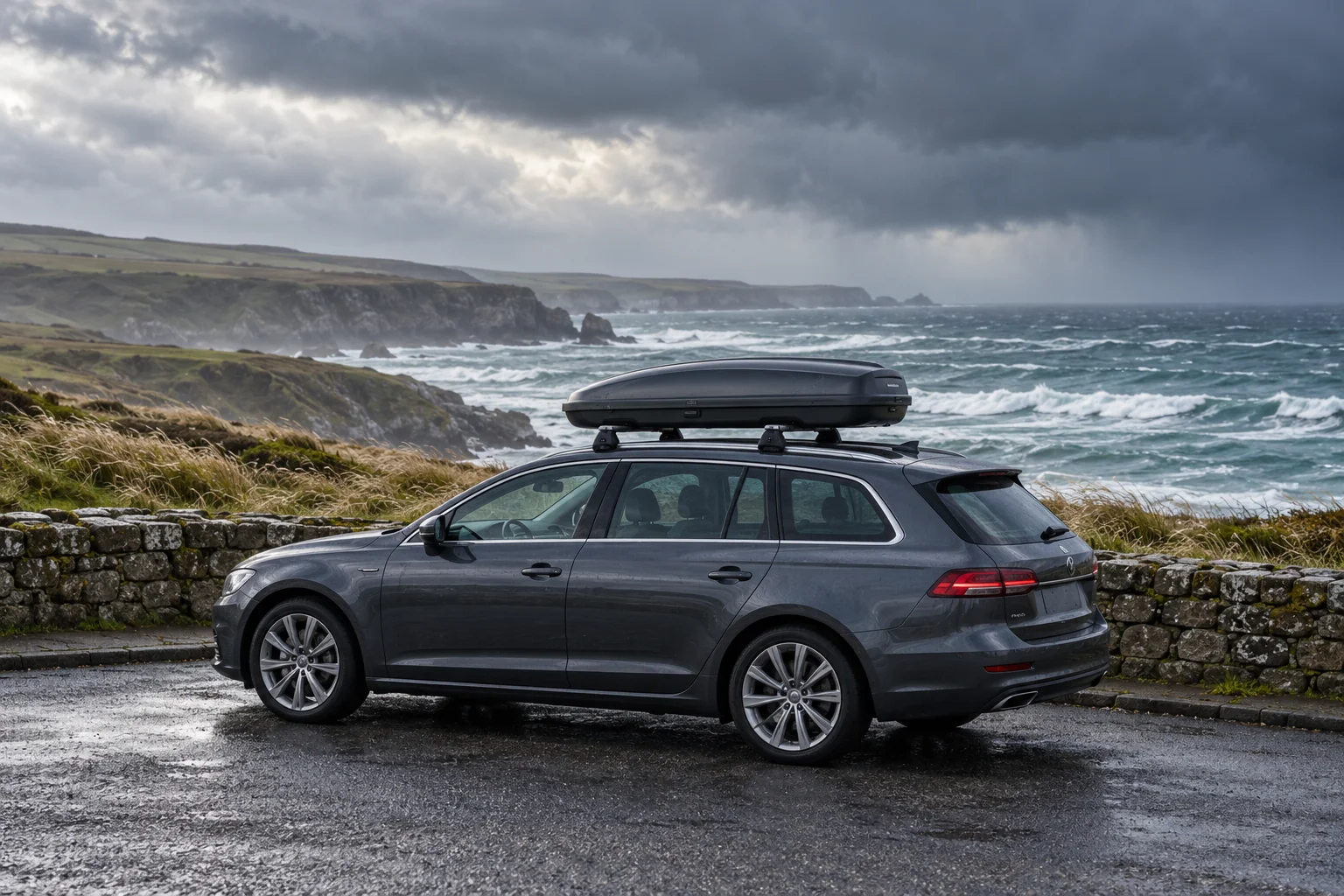
Decide whether the journey should go ahead
With roof equipment fitted, the first wind check is a journey decision. A secure installation is essential, but it does not cancel the effect of gusts on the vehicle or make a closed road available. Consider whether travelling later, using a less exposed approved route or taking less equipment is practical before departure.
Read the forecast and warnings for the complete route and likely travel period. Conditions at home can be sheltered while a bridge, coastal road or upland section is exposed. Check official road and bridge updates, including any restriction that applies to your actual vehicle or load configuration.
Do not interpret the absence of a named roof-box restriction as assurance that conditions suit your car. Equally, do not assume a restriction for high-sided vehicles automatically describes every passenger car. Follow the operator’s classification and advice, and choose to postpone if there is doubt about safe control.
Understand gusts and the shape of your load
A roof box, upright bicycle, canoe and stack of boards present different shapes to a side wind. Their carriers also put mass and surface area above the normal luggage position. The effect depends on the vehicle, direction of travel, speed and exposure; one driver’s experience with another load is not a transferable limit.
The Highway Code highlights open roads and gaps in hedges or bridges as places where gusts can push road users off course. The Met Office similarly points to sudden exposure between buildings, trees and bridges. Anticipate those changes rather than waiting for visible movement in the roof equipment.
Check the configuration, not just the nominal roof-box size. A box beside a kayak is a different arrangement from the box alone. Read the shared box-and-kayak checks if that is your load, including every prescribed restraint and the complete roof allowance.
Inspect the normal installation before adding luggage
Work in a safe, suitable place before departure. Check the correct bars, feet and kit, their approved positions, the carrier’s attachment and the condition of the actual parts. Look for missing caps, damaged clamps, loose fasteners, worn straps and signs that a load has shifted.
Follow the manufacturer’s fitting and tightening method. A stronger gust forecast is not permission to exceed the specified torque or crush a plastic component. If a mount cannot be brought into its prescribed condition, the setup needs repair or removal before travelling.
Close and lock the box as instructed and remove its key. For boats, boards and bikes, verify the contact areas and all specified restraint routes. Revisit the pre-journey checklist rather than relying on a quick shake of one exposed end.
Check load and access while still sheltered
Weigh the travelling equipment and luggage, including the complete rack and empty carrier. Extra mass does not provide a remedy for wind sensitivity, and adding ballast to make a load feel steadier consumes allowance without approving the setup.
Use the roof-load calculator for the weight arithmetic and keep a separate record of the car’s total loaded mass. Neither calculation is a wind forecast or a handling test. Check that necessary stops can be made without uncontrolled lid opening or roadside unloading.
Plan exposed sections and alternatives
Identify where the route crosses open ground, elevated structures or coastal stretches. Consider whether a later crossing avoids the warning period and whether an alternative road is actually suitable for the loaded dimensions. A sheltered-looking narrow lane may introduce low branches, flooding or poor turning space.
Check ferry or shuttle updates if applicable and allow time for disruption. A booking does not override an operator’s decision to restrict access. Keep essential clothing, food and overnight items reachable if the journey needs to pause.
Decide in advance what would trigger a change: an official restriction, worsening warning, repeated steering disturbance, unusual carrier noise or inability to inspect the equipment safely. This avoids treating the original schedule as a reason to press on despite new evidence.
Drive for the actual conditions
Use both hands to maintain steering control and leave appropriate space around vulnerable road users. Be cautious when passing large vehicles or emerging from shelter, where the wind effect can change quickly. Avoid sudden steering or braking responses that make the situation harder to control.
A printed equipment maximum is an upper bound under its stated conditions, not a target. Use the lowest applicable requirement and a speed appropriate to the road, visibility, traffic and weather. If a manageable speed still does not allow safe control, the answer is to stop the journey safely, not to continue searching for a magic number.
The speed guidance explains how road and component limits interact. This article adds the decision about whether conditions permit travelling at all; it does not create a separate wind allowance.
Respond to a change in noise, movement or handling
A sudden new noise deserves attention, especially if accompanied by altered steering or visible load movement. Do not assume every sound is harmless aerodynamic noise. Reach a safe stopping location without abrupt manoeuvres and inspect only where it is safe to do so.
Check the prescribed fastenings and load position, following the equipment’s journey-inspection schedule. If anything has loosened, identify the cause. Repeated movement is not solved by repeatedly overtightening the same part or adding an unapproved rope.
If safe travel cannot resume, use the appropriate breakdown or road-operator assistance. A motorway emergency area or hard shoulder is not a normal workshop. Keep people clear of traffic and follow the official advice for that road and situation.
Handle the lid and unload with the same care
Wind remains relevant after the car is parked. Choose a sheltered space with stable footing and room to work; check the lid’s permitted support and avoid standing where it can strike you. A lifting aid or second person helps only where the task can be controlled safely.
Keep loose bags secured until you are ready to remove them. Do not leave an open box unattended or allow a lid to act as a sail. If the wind prevents controlled access, close it correctly when safe and postpone unloading.
Sources checked October 2026: Met Office wind travel advice, Highway Code wind rules 232–233 and Thule roof-box safety. Check current warnings and the actual equipment instructions before each journey.
Frequently asked questions
What wind speed is safe with a roof box?
There is no single safe threshold for all vehicles, loads and roads. Gusts, wind direction, exposed sections and the complete equipment shape matter. Follow any specific manufacturer restriction, official warnings and road closures; postpone where safe control or inspection cannot be maintained.
Does driving below the box’s maximum speed make strong winds safe?
No. A manufacturer ceiling does not guarantee safe handling in adverse weather. Conditions can demand a much lower appropriate speed or a decision not to travel. The road limit and the requirements of every component still apply.
Can I add a strap over the outside of a roof box for windy weather?
Only if the exact box manufacturer expressly approves that arrangement. Do not improvise extra shell straps, drill anchors or use another carrier as a tie-down point. Inspect the prescribed mounts, locks and internal restraints; an uncertain fit needs correction rather than an added workaround.
Should I open a roof box in gusty weather?
Choose a sheltered, safe place and follow the lid-support instructions. Do not open it where the lid or loose luggage cannot be controlled, or lean on the shell to hold it down. Delay access or move safely to a suitable location if conditions prevent controlled handling.
Should I stop immediately if the setup moves?
Find a safe place to stop, avoiding abrupt manoeuvres. Follow road-specific breakdown advice if the vehicle cannot safely continue. Do not inspect from a live lane or carry on with an unsecured load merely to reach your planned destination.