
Travel guide / Loading, driving and travelling
Taking a Roof Box on a Ferry: Booking Height and Journey Checks
Take a roof box on a ferry with the correct fitted height and roof-item declaration. Compare current operator guidance and plan luggage access and boarding.
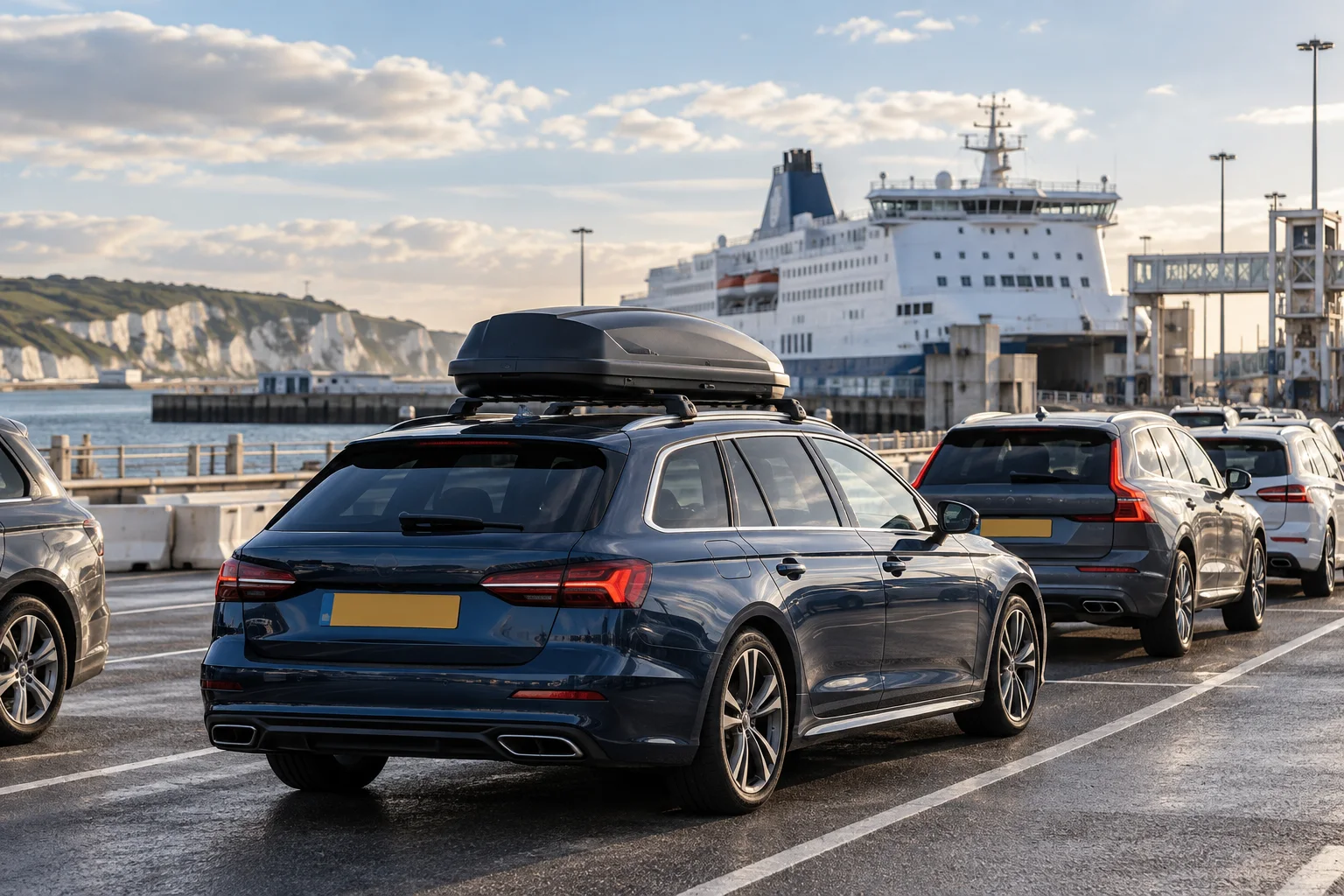
Book the complete travelling vehicle
Declare the fitted height, other required dimensions and roof accessories using your ferry operator’s current booking questions. A roof box can affect allocation or fare, and rules differ between operators and routes. Plan crossing essentials separately because routine access to the car deck should not be assumed.
Measure the setup before choosing a fare
A registration lookup or catalogue specification normally identifies the car, not every accessory you plan to carry. Measure the complete travelling height with the approved rack, box and any other roof equipment installed. A bicycle can stand above the box, while a rear carrier can change the overall length that the operator needs to know.
Use the height-measurement guide to establish a reliable record on level ground. Keep units clear and do not round a borderline result down to fit a cheaper category. If the booking form does not clearly accommodate the arrangement, ask the operator for the correct category before paying.
Declare roof items as well as height
Read the booking questions separately. Some operators ask for dimensions and also ask whether roof items are fitted. Selecting a taller category does not necessarily complete the roof-item declaration, and a lower fitted height does not necessarily remove it.
Brittany Ferries’ current guidance asks for the full height including roof loads and says roof items must be declared so the correct space can be allocated. Stena Line’s roof-box FAQ directs eligible cars higher than 2m including the box to its over-2m car option.
| Operator | What the cited guidance establishes | What to verify in your booking |
|---|---|---|
| Brittany Ferries | Full fitted height and a separate roof-items declaration | Actual vehicle category, dimensions, route and any supplement |
| Stena Line | Cars including roof box above 2m need the stated taller-car option | The appropriate length/category and actual vehicle details |
These examples are not a universal ferry height threshold. A category boundary is also different from the maximum vehicle accepted by a particular service. Check the actual operator, route, vessel arrangements and booking confirmation rather than applying one company’s figure to another.
Check the whole quote and confirmation
Enter the actual configuration for both outward and return journeys. Include trailers or rear carriers where requested, using the operator’s way of recording their dimensions. A roof-box declaration does not cover another addition automatically.
Do not assume a box always travels free or always attracts a fixed supplement. The correctly declared dimensions, category, route and fare conditions can affect the quote and available space. Compare the final booking with your measurement record and keep any clarification from the operator.
The operator guidance warns that incorrect vehicle information can lead to extra charges or refusal of travel. Treat accuracy as part of planning the trip, not a detail to resolve on the loading ramp. A large ferry in a photograph does not prove that every deck or booked lane can accommodate your vehicle.
Amend a booking when equipment changes
If you add a roof box after booking, change cars or return with a different carrier, use the operator’s permitted amendment process before travel. Confirm that the revised configuration is accepted for the sailing. Availability, ticket conditions and a fare difference may affect the change.
A hired box is best identified and measured in time to update the booking. Do not reserve a bare-car category and rely on finding an empty high space at the port. If the equipment cannot be fitted before booking, obtain a credible measurement plan and resolve uncertainty with the operator rather than inventing a final height.
Record the updated confirmation and check both directions. If only one leg changes, make sure the operator’s record reflects what will actually travel on each leg. Revisit the driving-load calculation if a different shell or carrier is substituted.
Pack a crossing bag before the boarding queue
Do not rely on being able to open the roof box once parked on the vehicle deck. Space around the car and above the lid may be restricted, and passenger access during the crossing depends on the service. Brittany Ferries’ cited onboard guidance says the vehicle cannot be accessed during the sailing.
Keep tickets and required documents, essentials for children, appropriate clothing and items needed during the crossing in a manageable bag accessible before boarding. Check the operator’s rules for what can be taken to passenger areas and follow crew directions about leaving and returning to the vehicle.
Once the essentials are removed, restore the roof load to its approved arrangement and recheck restraint and closure. Do not leave a loosened internal strap or partially closed lid because boarding is about to begin.
Consider a lower box for practical reasons, not a promised fare
Compare total ownership value rather than buying a new shell solely to chase an assumed supplement. A different box can change usable space, empty weight, hatch clearance and storage at home. It must remain suitable for the whole journey, not just one booking field.
The low-profile guide helps with that decision. If the operator separately asks about roof items, a lower shell does not remove the need for a truthful answer.
Keep the driving and boarding checks separate
Correct ferry allocation does not approve the rack or roof load. Use the calculator with verified dynamic limits, follow the packing guidance and complete the pre-journey checks before leaving home.
At the port, follow current signs and staff directions for the declared vehicle. Use the assigned route and lane; do not choose a lower-looking or faster lane based on another car’s path. If your configuration is wrong in the booking or clearance is unclear, raise it with staff before approaching an obstruction.
Check the actual check-in requirement and travel updates on your booking rather than using one generic arrival time for all ferry routes. If access assistance or another specific arrangement is needed, organise it through the operator’s process in advance.
Recheck before the onward and return journeys
After the sailing, follow the maker’s appropriate checks before continuing, including attachment and closure after unattended periods. Account for the complete vehicle height when choosing the first service stop, accommodation entrance or car park ashore.
Repeat the load and booking checks for the return leg if the luggage or equipment changes. Extra holiday purchases may fit the box’s remaining volume while exceeding the driving allowance. The LeShuttle guide covers that separate operator if one direction uses the train service instead.
Operator guidance checked October 2026: Brittany Ferries vehicle booking, Stena Line roof-box FAQ and Brittany Ferries onboard access guidance. Recheck the current requirements for your actual sailing before booking and travel.
Frequently asked questions
Do ferry bookings need the roof box included in vehicle height?
Yes, declare the complete travelling setup using the operator’s current fields and roof-item questions. Do not rely only on a registration lookup or the car’s unmodified height.
Is a roof box free on every ferry?
No universal promise is reliable. Operator, route, vehicle category, dimensions and ticket conditions can affect the fare or allocation. Check the exact quote and booking confirmation with the equipment declared.
What if I add the roof box after booking?
Update the vehicle details through the operator’s permitted amendment route before travel and confirm acceptance for the sailing. Availability, fare differences or other conditions may apply.
Can I get things from the roof box during the crossing?
Do not plan on routine vehicle-deck access. Check your sailing’s rules and take essentials with you before leaving the car, then follow crew instructions about returning.
Does a low-profile box avoid the high-vehicle category?
Only the correctly measured complete height and the operator’s actual category rules can answer that. A lower shell does not remove a separate requirement to declare roof items.