
Worked guide / Journey and ownership
Vehicle Payload vs Roof Load: Accounting for Passengers, Luggage and Equipment
Account for passengers, boot luggage, roof equipment and axle limits. Follow a worked vehicle-payload example and use the roof-load calculator for its separate task.
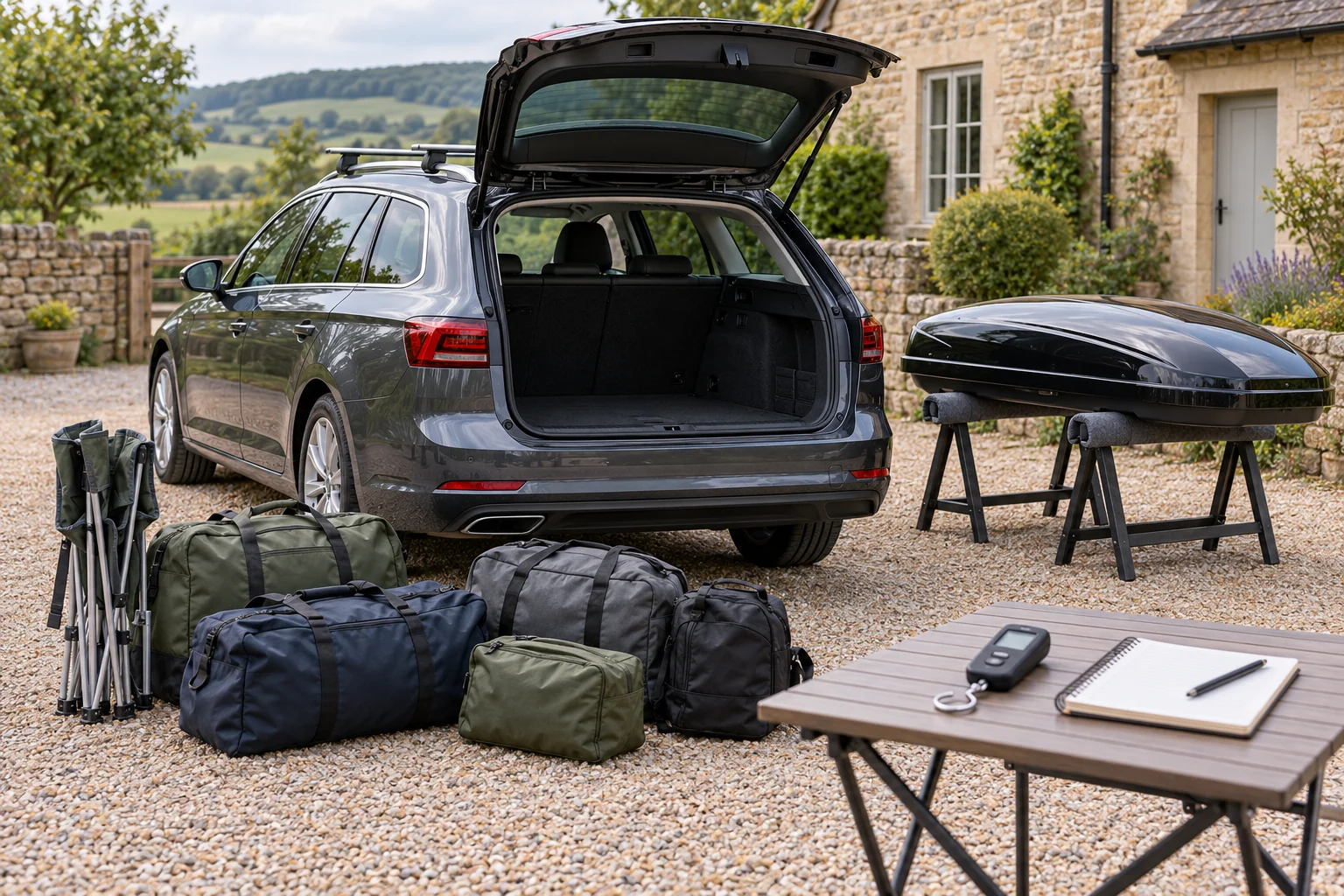
Treat roof, vehicle and axle limits as separate checks
A car can have spare space in its roof box and still be too heavily loaded. The roof limit controls what can be carried at that location, while the vehicle’s maximum authorised mass controls the complete loaded car. Individual axle limits add another check on how that mass is distributed.
Start with the exact vehicle specification. Record its maximum authorised mass, also called gross vehicle weight or permissible maximum weight, the permitted front and rear axle loads and the driving roof allowance. Use the handbook and vehicle plate, resolving any unclear term with the manufacturer.
A large SUV does not automatically have a generous usable allowance after passengers and accessories are included. Optional equipment, towbar systems, occupants, child seats, luggage and fuel can materially change the actual departure state. Work with the car you have, not a lighter brochure version.
Establish a baseline that says what is included
Published kerb weight, mass in running order and payload figures can use different definitions. Some include an assumed driver, a specified fuel level or other equipment. Do not subtract a marketing weight from the maximum and then add or subtract a standard driver mass without checking those definitions.
An actual weighing is useful when the allowance is uncertain or close. Record who was in the vehicle, the fuel or charge state where relevant, installed equipment and the luggage already aboard. Then add only items missing from that baseline. If the roof bars were present at weighing, counting them again would overstate the final mass.
Use a weighing service suitable for the car and ask how total and individual axle measurements will be obtained. Follow its procedure rather than improvising a partially supported vehicle measurement. Retain the results with the exact loaded inventory.
Build one complete departure inventory
List every addition to the recorded baseline: remaining occupants, child seats if absent, boot bags, food, water, tools and sports equipment. Include the complete roof rack, empty box, internal bags and all luggage. Any rear carrier and its platform also count towards the complete vehicle mass.
Use actual packed weights wherever practical. A nominal bag volume does not predict its mass, and a tent bag can conceal heavy poles or pegs. Wet equipment on the return trip may also weigh more than the dry outward load.
Keep a small allowance for uncertainty rather than planning to an exact displayed gram. If the remaining margin is narrow, reduce the load and confirm the real departure weights. A calculation based on estimates is not made more accurate by adding decimal places.
Follow a worked total-vehicle example
The following figures are hypothetical. The departure-ready car weighs 1, 750kg at the chosen baseline, including its driver, fuel and fitted options, but excluding all additions listed below. Its maximum authorised mass is assumed to be 2, 200kg.
| Item absent from baseline | Mass |
|---|---|
| Additional passengers | 150kg |
| Boot luggage and other cabin/boot additions | 100kg |
| Complete roof rack | 5kg |
| Empty roof box | 15.4kg |
| Luggage inside the roof box | 30kg |
| Total added | 300.4kg |
The calculated total is 1,750 + 300.4 = 2,050.4kg, leaving 149.6kg below the assumed 2, 200kg maximum. That is only the total-mass result. It does not confirm the roof allowance, an axle result or the approved fit.
Do not reuse the 150kg passenger assumption for your own occupants. If one additional passenger was already present at weighing, remove that person from the additions list rather than subtracting an arbitrary standard allowance from the result.
Check the roof subset without counting it twice
In the same example, the roof carries 5kg of rack, 15.4kg of empty box and 30kg of luggage: 50.4kg. Against a hypothetical 75kg driving roof allowance, that leaves 24.6kg of roof headroom, subject to the rack and box limits.
Those 50.4kg are already included in the total-vehicle calculation. They are not an extra addition to 2,050.4kg and the 75kg ceiling is not extra vehicle payload. This distinction prevents two opposite errors: forgetting the roof equipment entirely or counting it twice.
Use the roof-load calculator for this roof subset. With vehicle roof limit 75, rack weight 5, rack carried-load limit 75, empty box 15.4, box luggage limit 75 and other roof load 0, it gives up to 54.6kg for box luggage. The actual example carries only 30kg. The calculator does not add passengers or boot bags to a whole-vehicle total.
Compare moving luggage with removing luggage
Moving a bag from roof to boot changes where its mass acts; it does not remove that mass from the vehicle. Comparing several departures against the same recorded baseline makes that distinction visible.
Inputs and assumptions. Hypothetical baseline 1750kg includes driver, fuel and fitted options but none of the additions here. Maximum authorised mass 2200kg; roof allowance 75kg. Add passengers 150kg, a 5kg rack and a 15.4kg empty box. Base boot additions are 100kg and box luggage 30kg. Axle loads are not modelled.
| Illustrative departure | Boot additions | Roof luggage | Complete mass | Total-mass headroom | Roof subset / roof headroom |
|---|---|---|---|---|---|
| Base departure | 100kg | 30kg | 2050.4kg | 149.6kg | 50.4kg / 24.6kg |
| Move 20kg roof → boot | 120kg | 10kg | 2050.4kg | 149.6kg | 30.4kg / 44.6kg |
| Add 180kg in boot | 280kg | 30kg | 2230.4kg | -30.4kg | 50.4kg / 24.6kg |
| Move 40kg boot → roof | 60kg | 70kg | 2050.4kg | 149.6kg | 90.4kg / -15.4kg |
Moving 20kg into the boot keeps complete mass at 2050.4kg while reducing the roof subset to 30.4kg. That can ease a roof constraint, but actual axle distribution and load restraint still need checking.
Adding 180kg in the boot leaves the roof unchanged while exceeding the assumed overall maximum by 30.4kg. Conversely, moving 40kg from boot to roof leaves total mass unchanged but exceeds the roof ceiling by 15.4kg. A single spare-capacity figure cannot describe both checks.
Calculation method and sources
Complete mass = baseline + all additions once. Roof subset = rack + empty box + roof luggage. Subtract those totals from the separate 2200kg and 75kg ceilings. Negative headroom fails that numerical constraint, even if the other remains positive.
- GOV.UK vehicle-weight definitions: Use the actual vehicle maximum and the correctly defined baseline; individual axle limits are additional checks.
- DVSA loading guidance for cars: Position and secure loads using the vehicle and carrying-equipment instructions.
- Force 3 family instructions: PDF pages 14–15: dimensions, spacing, mass and contents limit; model labels must match.
Download the inputs and workings (CSV). Source review: October 2026.
Verify each axle as well as the total
Even a correct 2,050.4kg total does not show how the weight sits on the axles. If an illustrative weighing reports 1, 130kg at an axle whose permitted maximum is 1, 100kg, the setup fails that axle check despite having 149.6kg of overall mass headroom.
Do not add the two axle maximums and treat their sum as a replacement gross limit. They can allow different distributions while the lower total vehicle ceiling remains binding. Both individual results and the total need to pass.
Rear luggage and towbar-mounted equipment deserve particular care. Weight behind the rear axle produces leverage, so a 50kg rear load does not necessarily mean exactly 50kg added to the rear axle. Use the vehicle and carrier guidance and actual axle weighing; do not assume moving luggage from roof to rear solves every limit.
Allocate luggage to suitable places
Keep heavy items appropriately low and restrained in the boot where the vehicle permits. Avoid a tall unsecured stack that can move into the passenger space. Use the car’s specified restraints and respect the permitted seat and load-floor arrangements.
Move light, bulky items to the roof only within the box’s packing instructions. Shifting an item changes distribution and access; it does not change the complete vehicle mass. If total mass is excessive, the load needs reducing or a different approved transport plan.
The camping allocation guide applies this approach to tent fabrics, poles, chairs and sleeping equipment. The rear-carrier comparison adds supported-load, axle and access checks for that alternative.
Recheck for the return journey
Changed passenger numbers, extra shopping, wet kit or a different fuel level can make the return inventory different. Revisit the uncertain items rather than assuming the outward calculation still describes the vehicle. Follow loaded tyre-pressure guidance from the handbook too.
Keep the weight record alongside the pre-journey checklist. Weight compliance, secure packing, correct mounting, visibility and clearance are separate requirements; passing one does not establish the others.
Sources checked October 2026: GOV.UK vehicle-weight definitions, DVSA car and load guidance and Thule roof-box safety. Use the exact vehicle plate, handbook and recorded weighing state for your own calculation.
Frequently asked questions
Is the roof-load allowance extra vehicle payload?
No. Bars, feet, the empty box and its contents are part of the loaded vehicle. A 75kg roof allowance is a separate location-specific ceiling, not another 75kg added to the vehicle’s maximum authorised mass.
Does the published payload already include the driver?
It depends on the mass definition used for that exact vehicle and specification. Check the handbook or manufacturer’s explanation rather than automatically adding or subtracting 75kg. A recorded actual weighbridge baseline can make clear who, what and how much fuel were present.
Can the vehicle be overloaded on one axle but below its total maximum?
Yes. Total mass and individual axle limits must each be satisfied. Heavy luggage or a rear carrier can concentrate load towards the rear. Rear-mounted weight can add more than its own mass to the rear-axle reaction because of leverage, while unloading the front axle.
Can I use a luggage scale instead of a weighbridge?
A luggage scale helps weigh suitable individual bags within its instructions and capacity. It does not measure the complete vehicle or axle reactions. Use an appropriate weighing service and a recorded departure-state inventory when those figures need confirming.
Does the roof-load calculator check vehicle payload?
No. It calculates a roof luggage allowance from the values entered. It does not know passenger mass, boot luggage, vehicle maximum mass or axle distribution. Complete those checks independently and use whichever applicable limit is most restrictive.