
Practical guide / Packing, storage and care
How to Store a Roof Box Off the Car
Store a roof box off the car with a measured handling route, permitted supports and dry indoor conditions. Compare floor, wall and ceiling storage checks.
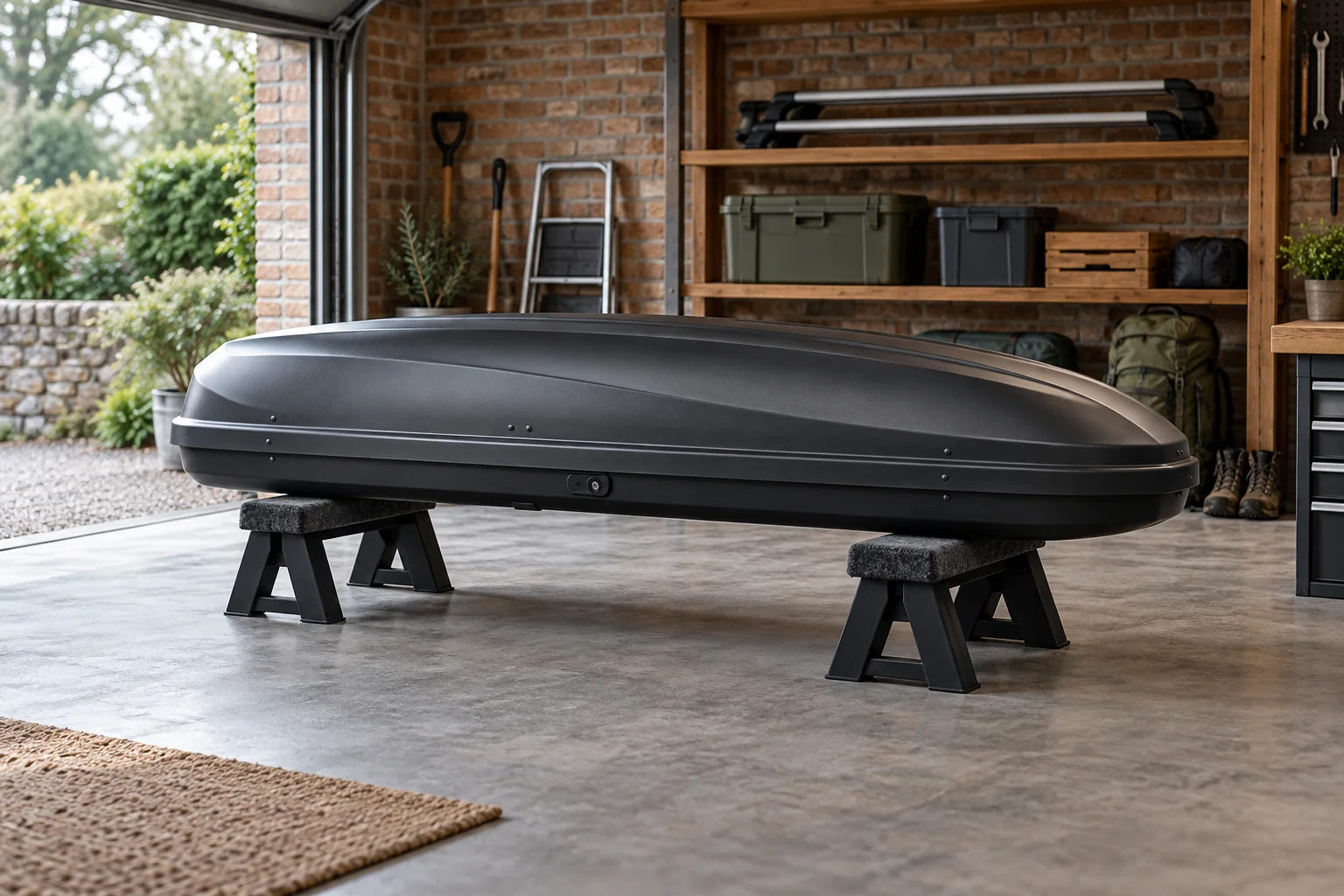
Plan the supports and the route before lifting
Empty, clean and dry the box, then use a storage orientation and support arrangement permitted for that exact model. Choose floor, wall or ceiling storage around the available space, handling route and verified supporting structure. A cover protects a compatible surface; it does not support the shell.
Start with the box instructions and an empty shell
Record the box model, generation, exterior dimensions and empty weight before choosing a storage method. Check the manufacturer’s guidance for orientation, contact points and conditions. A shell that is designed to carry luggage on approved bars does not automatically accept long-term support on any edge or lid surface.
Remove the luggage and loose items, then keep the original mounting and restraint parts together as the instructions direct. Do not leave bags inside simply because the box’s driving payload is large. A storage system must support the complete stored load, and damp contents can make an apparently dry box an unsuitable long-term environment.
If you already have a mount or hoist, confirm that it suits the current box rather than inheriting an arrangement used for a previous shell. A similar length does not establish the same support areas or weight distribution.
Measure the route as well as the final space
Measure door openings, corners and the area needed to turn the box into its stored position. A box can fit along a garage wall but be awkward to carry through the doorway or rotate between a parked car and shelving. Include any mounting hardware that remains attached.
Plan where the people handling it can stand and grip it throughout the move. The empty box can still be bulky, slippery or difficult to control, particularly at shoulder height. Use the assistance required for controlled handling and follow the manufacturer’s removal and lifting instructions.
Mark the final footprint and access space on a simple garage plan. Keep the walking route, door controls, electrical equipment and frequently used shelves accessible. Storage that blocks a safe exit or requires moving an unstable pile of belongings is unlikely to remain practical.
Floor storage needs a permitted support arrangement
Floor-level storage avoids a suspended load and can simplify access, but it still needs the correct support and protection from knocks. Follow the box maker’s contact guidance and use an arrangement that keeps the shell stable without concentrating force on vulnerable points.
Do not rest the box on a protruding clamp, hinge or locking handle. A padded surface can reduce abrasion but cannot turn an unsuitable support location into an approved one. Avoid stacking other equipment on the lid or using the shell as a shelf.
Consider moisture and accidental impact. A low position beside a garage door can be exposed to water or vehicle movement, while a narrow aisle can make a long shell a trip or contact hazard. Check the space in ordinary daily use, not only after temporarily clearing the garage for a photograph.
Wall storage saves floor space but changes the handling task
A wall system needs to match the permitted box orientation and contact areas. Its advertised load rating is only one check: the wall material, fixings, installation geometry and handling access also need to be suitable. Plasterboard, brick, block and timber construction cannot share a single generic fixing prescription.
Rehearse the movement into the mount before selecting its height. You need to control the shell as it is placed and removed, not merely reach the arms. The wall-mount buying guide covers the support, space and fixing questions in more detail.
Ceiling storage needs a complete structural and clearance plan
A hoist can use otherwise empty space above the car, but the full lift path and stored position must be clear. Check the moving garage door and its tracks, lights, beams, shelves and the operating position of the user. A measurement with the door closed cannot establish its complete moving envelope.
A system below its numerical rating can still be unsuitable because the ceiling or box support arrangement is wrong. Where the structure is uncertain, obtain competent assessment. Follow any product-specific professional-installation requirement rather than treating every hoist as the same DIY task.
Clean and dry before covering
Remove loose grit with a method permitted by the box maker, then use the specified gentle cleaning approach. Check the inside, lid edge, mounts and restraint hardware as well as the glossy top. Do not assume a clean-looking lid means the interior is dry.
Allow the shell and its components to dry fully in the permitted position before closing or covering. Do not pack damp bags, straps or cloths inside for the season. The cleaning guide separates washing, inspection and drying.
Keep parts, keys and a simple storage record
Store the correct fitting parts, original restraints and instructions together in a dry suitable place. Label them by box model so hardware from another carrying system is not mixed in. Keep the key code recorded securely and retain a spare separately from the box.
Check the stored arrangement periodically as its instructions require. Look for changed support contact, damp, damaged padding, loose hardware or interference from items added to the garage later. A new shelf or changed garage-door mechanism can alter a previously clear space.
Before the next trip, inspect the shell, mounts, hinges, locks and restraints, then perform the full fitting and load checks again. Storage is not a reason to carry forward an old roof-fit assumption after a vehicle or bar change.
Sources checked October 2026: Thule maintenance guidance, FISCHER wall support, Teal Triangle instructions and cover compatibility. Obtain the exact box’s storage permission.
Frequently asked questions
Can I store a roof box on its side?
Only if the exact box maker permits that orientation and the chosen system supports the specified areas. Do not assume a wall-mount photograph approves side storage for every shell or hinge arrangement.
Can I leave luggage inside while storing the box?
Empty the box unless the exact storage instructions explicitly permit a loaded arrangement. Stored contents change the mass, support loading and moisture risk; a driving payload figure is not storage-system approval.
Can a roof box sit directly on the garage floor?
Follow the maker’s permitted support arrangement and protect the shell from unsuitable point contact, damp and knocks. Consider access and trip hazards; do not assume bare-floor contact suits every box.
Is a ceiling hoist safe above a parked car?
That depends on the entire verified installation, support arrangement and clearance. The hoist’s advertised rating does not establish ceiling capacity. Follow all installation, inspection and operating instructions before using that location.
Does a storage cover make outdoor storage suitable?
No. An indoor lid cover does not create a weatherproof storage system or prevent damp beneath it. Check the box maker’s storage conditions and the cover’s exact intended use.