
Troubleshooting guide / Boxes and accessories
Water Getting into a Roof Box: Finding the Cause and Protecting Your Luggage
Find possible sources of roof-box moisture, separate wet contents from ingress, protect luggage and prepare a useful manufacturer support request without improvised sealing.
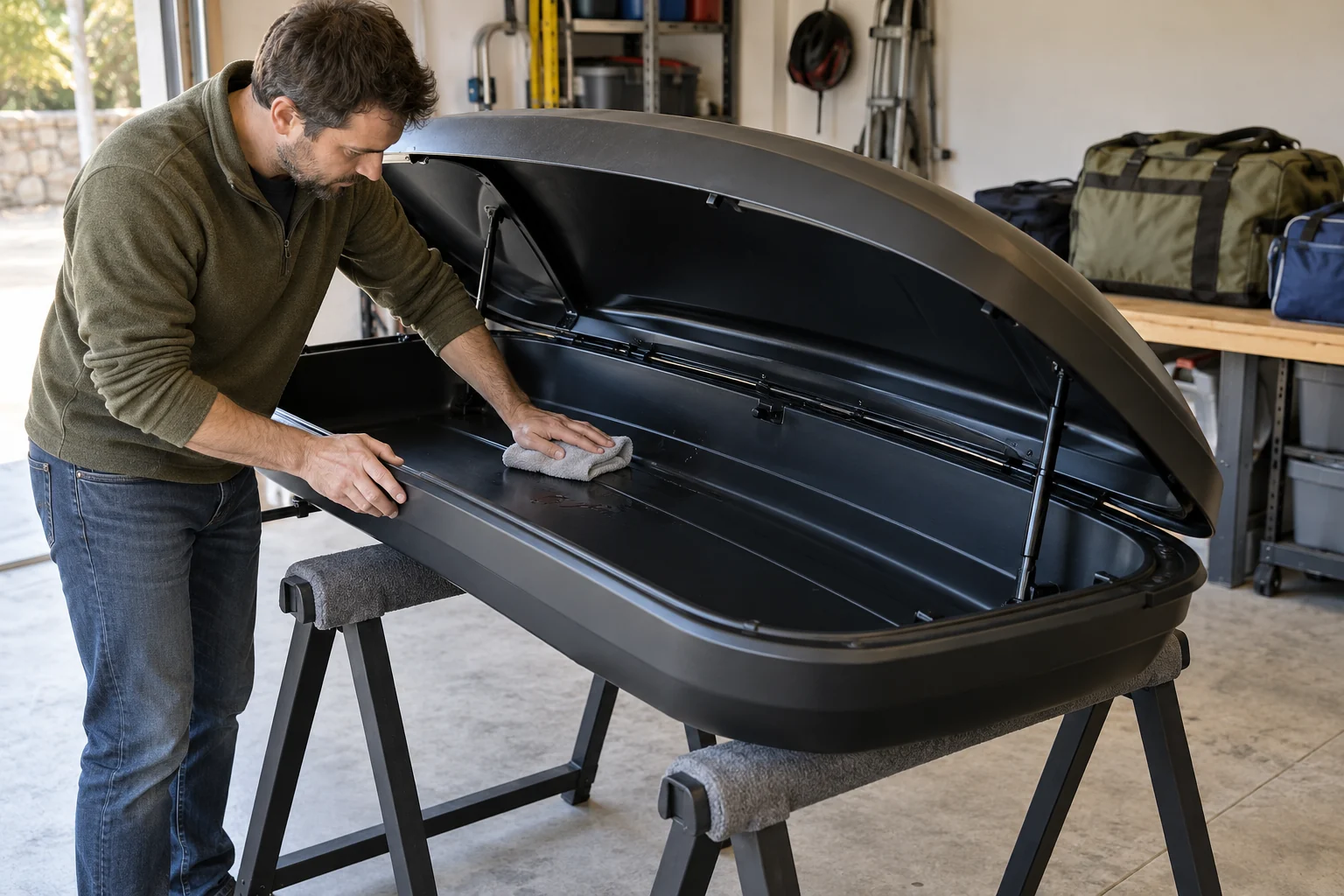
Protect the contents, then establish what happened
Finding a wet sleeping bag after a long drive is frustrating, but replacing a seal immediately can miss the real problem. First move vulnerable luggage to a dry, suitable place. Then record what was wet, where the moisture collected and when the box was last opened, washed or packed with damp equipment.
Treat an obvious crack, failed latch or loose mount as a separate safety fault. A bag inside can protect clothes from some moisture; it cannot make defective carrying equipment acceptable. If the box will not close and lock correctly, use the combined closure and key guide before considering another journey.
Do not assume any roof box is a sealed immersion container. Check what the maker actually claims for your model and the conditions attached to it. Keep essential documents, electronics and items you cannot afford to lose accessible and appropriately protected elsewhere.
Map the moisture before cleaning it away
Photograph the interior and affected luggage while the pattern is still visible. A wet patch near a bag containing swimming kit is a different observation from water gathered below an apparently damaged mounting area. Neither is conclusive on its own, but the location helps a manufacturer assess the report.
Record rain, spray, washing, storage and the last time the lid was opened. Opening a wet lid may let surface water drip inside. A damp garage or wet contents can also complicate the picture. Explain these possibilities rather than claiming a particular seam has failed without evidence.
If practical, record whether the box was packed close to its rim and whether a strap or fabric tail crossed the closing edge. Do not recreate unsafe packing to demonstrate the fault. Photos and an accurate account are more useful than deliberately forcing water into a mechanism.
Unload and inspect the closing edge
Work in a dry, sheltered place with stable access. Remove luggage, loose mats and removable accessories according to their instructions. Keep the lid under normal control; if its supports are unreliable, close it safely and obtain help rather than reaching underneath.
Look for ordinary dirt, fabric or a displaced accessory obstructing the overlap between lid and base. Clear loose debris gently with the maker’s approved cleaning method. Do not scrape a sealing surface with a metal tool or apply a chemical merely because its label says waterproof.
Check whether the lid sits evenly and completes the normal locking sequence when empty. Persistent distortion, a missing component or an unexplained gap needs exact-model assessment. The absence of visible water during a dry inspection does not establish that a suspected fault has been resolved.
Check mounting areas without altering them
Look at the visible floor around mounts and any factory openings or approved covers. Record missing pieces, damage or evidence of an earlier owner’s alterations. Follow the exact manual for what should be present; do not assume an opening shown on another box requires a plug on yours.
Do not drill drainage holes, fill mounting slots with sealant or cover adjustment mechanisms with tape. Those changes can interfere with the approved installation and make later inspection harder. If the box was bought used and the original arrangement is uncertain, ask the manufacturer to identify it from the model label and photographs.
Movement or damaged mounting hardware needs the loose-clamp inspection route. Water protection is secondary until the box can be carried securely. Never tighten an uncertain clamp beyond its prescribed method to try to squeeze a suspected leak shut.
Distinguish wet kit and condensation from ingress
Wet towels, muddy boots and damp tent fabric can bring significant moisture into the box. Separate the return load from clean bedding and clothing. Empty sealed containers and trays carefully after unloading, keeping any collected liquid away from the box’s moving components.
Condensation is another possible source: moisture already inside may collect on cooler surfaces as conditions change. This is a possibility to investigate, not a diagnosis that excuses repeated water entry. Record whether the box and contents were dry at the start of the trip and ask the maker if the pattern remains unexplained.
The wet-equipment packing guide explains containment and drying in more detail. Avoid transporting leaking chemicals, fuel or other unsuitable substances simply because they have been put into an ordinary luggage bag.
Add luggage protection that fits the usable interior
Use protective bags suited to the actual contents and packed orientation. A bag’s nominal litres do not establish its roof-box fit. Allow room to close it correctly without folding a closure against a clamp or pressing it into the lid.
Keep the prescribed luggage straps accessible around the protected bags. A smooth or soft bag can still move if it is not restrained. Avoid relying on a non-slip mat alone, and do not attach loads to the outside of the shell to make space for protected luggage.
Ask for an approved assessment, not a generic seal
Send the manufacturer or appropriate dealer a concise report: exact model, identification label, purchase information where available, photos of the moisture pattern and any recent impact, storage or washing history. Mention aftermarket accessories or earlier alterations honestly.
Ask whether the observed condition needs inspection, a specified replacement part or retirement of the box. If a test is needed, obtain the exact approved procedure. Do not perform a pressure-washer test or submerge components based on a forum suggestion.
Warranty eligibility is a separate question from safe use. A claim being considered does not permit continued driving with an insecure lid or damaged shell. The warranty guide helps organise documents without predicting the manufacturer’s decision.
Dry, recheck and keep a useful record
After approved cleaning, dry the interior, straps and removable accessories separately as instructed. Store the box in a suitable protected location rather than leaving damp luggage enclosed. Record what changed and whether the same symptom returns during normal permitted use.
Before refitting, check closure, locks, supports and mounts, then complete the routine journey inspection. If water reappears without an identified cause, return to the manufacturer with the updated record. Repeatedly drying a box is not a substitute for resolving a fault that affects its safe function.
Sources checked October 2026: Thule roof-box safety and maintenance, Motion 3 instructions, official parts lookup and OverBoard 20L specifications. Moisture patterns suggest questions to investigate; they do not establish a remote diagnosis.
Frequently asked questions
Does water inside prove the roof box is cracked?
No. Moisture may have entered through a closure or mounting issue, arrived with wet kit or formed as condensation. A visible crack is a separate stop-use concern. Record the pattern and circumstances, then seek model-specific assessment rather than diagnosing from one damp bag.
Can I seal the lid shut with tape for the drive home?
Do not treat tape as a repair or a replacement for correct closure and locking. It can conceal a fault, affect surfaces and obstruct operation. Protect the luggage separately and arrange a safe carrying alternative if the box cannot meet its instructions.
Should I test for leaks with a pressure washer?
No. A concentrated jet creates conditions that may not represent road use and can damage or force water into components. Ask the manufacturer for an approved diagnostic method; follow its washing instructions and the separate car-wash restrictions.
Will a dry bag make a faulty roof box safe?
No. A correctly closed, suitably sized dry bag can add protection for ordinary luggage, but it cannot secure a damaged shell, restore a lock or approve loose mounts. Roof-box condition and internal load restraint remain separate requirements.
Can I leave wet bags inside the closed box after a trip?
Unload promptly and dry the bags and box separately in suitable conditions. A liner or roll-top bag does not remove the need to manage trapped moisture. Do not store the box with damp contents or close it for prolonged storage before the approved drying routine is complete.