
Buying guide / Packing, storage and care
Choosing Roof Box Packing Bags: Dimensions, Shape and Access
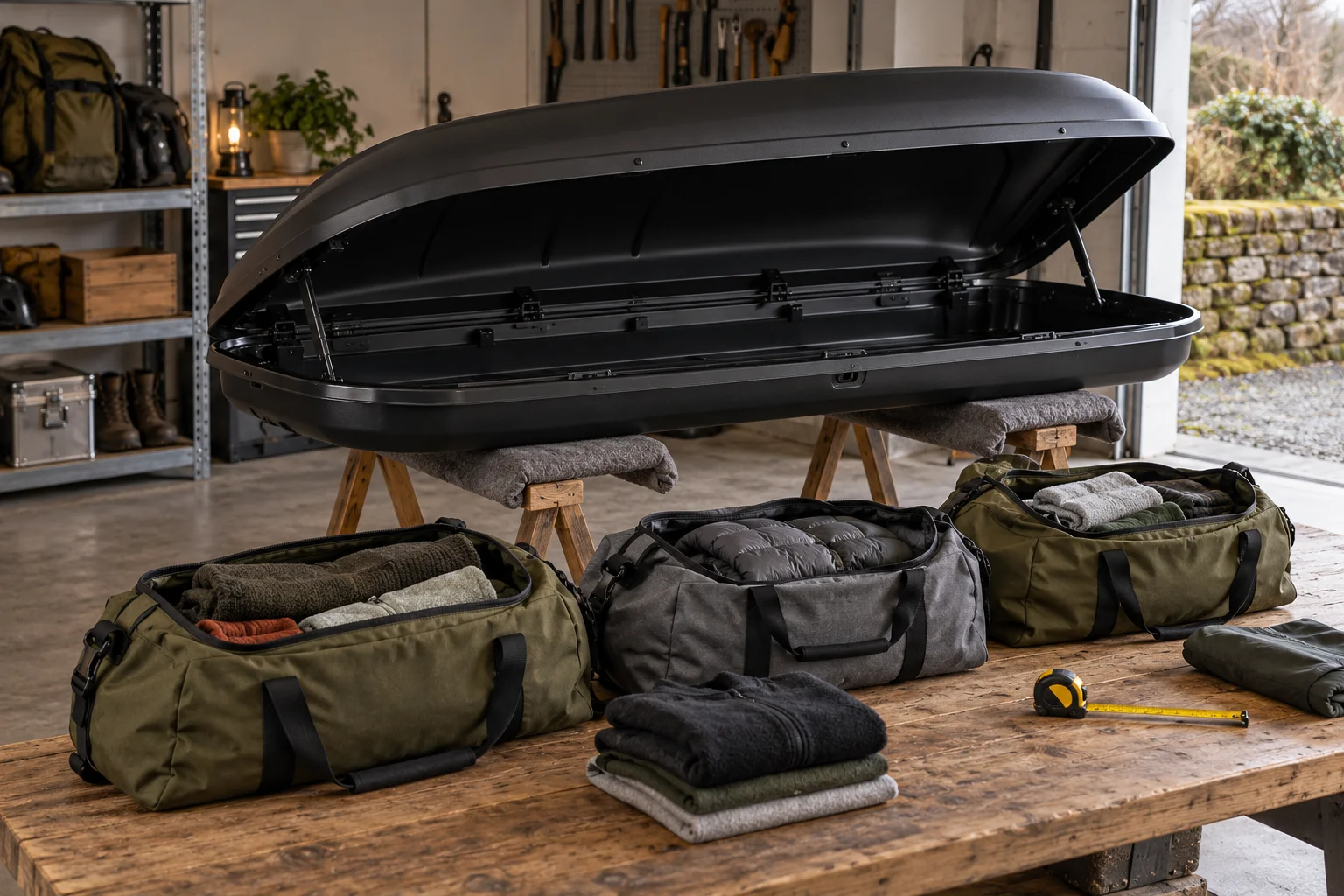
Choose roof-box packing bags by packed dimensions, taper, opening access and weight. Compare a four-bag set with a smaller individual duffel and plan the layout.
Quick answer
Choose bags by their actual packed shape, the box’s usable interior and the space needed to insert and restrain them. A four-bag set can simplify organisation; smaller individual bags can suit a more flexible layout. Matching litre totals do not establish fit.
A matched set or a smaller individual bag
Jump to the full specs table ↓Thule GoPack 75L duffel set — four bags
- 4 × 75L bags
- 75 × 37 × 32cm per bag
- Storage roll included
For organising luggage in a roof box or boot after measuring the packed bags. The combined 300-litre nominal capacity does not prove the whole set fits every 300-litre box.
View on Amazon UK ↗Read the full comparison ↓Osprey Daylite Duffel 45 — black
- 1 × 45L duffel
- Approx. 53 × 36 × 24cm
- Approx. 0.6kg empty
For a measured packing plan in a suitable box or boot. It has a structured base and does not mould into every taper. It is not a weatherproof external roof bag.
View on Amazon UK ↗Read the full comparison ↓| Option | Package | Published size | Still establish |
|---|---|---|---|
| Thule GoPack 800604 | Four 75L bags and storage roll | 75×37×32cm per bag | How many packed bags fit the actual box |
| Osprey Daylite 10006142 | One 45L black duffel | Approx.53×36×24cm | Packed shape, access and restraint space |
Published bag dimensions are planning figures. Packed pockets and straps can increase the envelope, and a structured base may not conform to the shell. Neither option is a universal box fit.
The packing options in detail
Thule GoPack 75L duffel set — four bags
Four 75-litre soft duffels with a storage roll for between trips. Each bag is listed at 75 × 37 × 32cm; packed shape and access to the box mounts still determine how many you can use.
For organising luggage in a roof box or boot after measuring the packed bags. The combined 300-litre nominal capacity does not prove the whole set fits every 300-litre box.
- 4 × 75L bags
- 75 × 37 × 32cm per bag
- Storage roll included
Why consider it
- Four separate duffels with identifying handles
- Wide openings for packing
- Storage roll keeps empty bags together
Keep in mind
- 300 nominal litres does not prove a complete box fit
- Packed height can conflict with low lids
- Bag mass and contents use the luggage allowance
Osprey Daylite Duffel 45 — black
A single 45L duffel rather than a dedicated roof-box set. Published dimensions are approximately 53 × 36 × 24cm; measure the packed shape, including straps and bulging pockets.
For a measured packing plan in a suitable box or boot. It has a structured base and does not mould into every taper. It is not a weatherproof external roof bag.
- 1 × 45L duffel
- Approx. 53 × 36 × 24cm
- Approx. 0.6kg empty
Why consider it
- Smaller nominal size than the 75L bags
- Wide opening and separate pockets
- Useful away from the roof box too
Keep in mind
- Structured base still limits shape
- Packed dimensions can increase
- No universal box fit or waterproof roof-bag claim
Start with the usable interior and the opening
A useful roof-box bag fits the place where it will actually sit and can pass through the opening without forcing the lid. Begin with the exact box model, its instructions and a sketch of the usable interior. Mark the tapered ends, mounting mechanisms, hinges, strap anchors and any other areas that the load must leave clear.
Do not use the box’s exterior length or marketed litres as a bag template. The lid can slope down above the ends, while a mount can interrupt an otherwise wide floor. Check height at the planned bag position rather than applying the tallest centre measurement to the whole shell.
The interior-dimensions guide explains those shape changes. Use it before ordering a set around a nominal volume that happens to match the number printed on your box.
Compare a set with smaller individual bags
A matched set can make family packing easier: separate people’s luggage, carry one bag at a time and identify the item needed at an overnight stop. It can also leave you with more bags than fit the actual box, especially when the packed height or base shape is wrong.
A smaller ordinary duffel offers a different approach. You can combine one or two with existing luggage and keep a short-stop bag in the boot. Its structured base and pockets still have dimensions, so “soft” does not mean it can take any shape or be compressed without limit.
The two options above illustrate different bag shapes and packages. Compare their published dimensions and contents, then choose the bag arrangement around your measured equipment.
Measure the travelling bag, not its empty fabric
Pack a representative load before taking measurements. Include shoes, rolled clothing and toiletry pouches that create a bulge, and close every zip normally. Record the maximum length, width and height, plus where the highest part occurs. A soft bag can be low at the ends but tall around a central bundle.
Keep all dimensions in a consistent orientation. The Daylite example is published at approximately 53×36×24cm; retailer tables may list the same axes in another order with different rounding. These are planning figures, not a promise that your overfilled bag remains within a rectangular envelope.
| Record | What to measure | Practical consequence |
|---|---|---|
| Bag envelope | Packed maximum length, width and height | Reject an oversized candidate before buying a set |
| Base shape | Structured panels and rounded ends | Check the floor position it can occupy |
| Opening route | Bag through the actual box opening | A bag can fit inside but be awkward to insert |
| Restraint access | Space for anchors, buckles and straps | Organisation must not block securing the load |
| Handling | Actual bag weight and grip | Split luggage into manageable units |
If you cannot trial the exact bag before purchase, keep the uncertainty visible in your plan and check the retailer’s current return terms. Do not resolve an uncertain fit by assuming the bag will compress under the lid.
Draw a complete multi-bag arrangement
Start with a plan view of the box, then add the measured bags. Check both the floor layout and the lid height above each one. A row of bags can fit on paper while a taller pocket reaches into the taper or a strap buckle becomes inaccessible.
For a hypothetical interior bay 190cm long, two bags each 75cm long occupy 150cm before any required gaps or obstructions. That leaves a numerical 40cm, not a verified space for another bag. Width, taper, mounts and restraint routing remain unresolved by the subtraction.
Likewise, adding four 75L labels gives 300 nominal litres without proving the four packed shapes fit a 300L shell. Thule’s own accessory matrix includes bag-fit caveats for particular box shapes. Follow the exact model guidance and confirm the complete travelling arrangement rather than treating a family-wide accessory name as a universal guarantee.
Screen the bag arrangement against the smaller manual dimensions
Four nominal 75L bags describe 300L of labelled capacity, not a packing layout. A dimensional screen can reject an arrangement before the litre total makes it look convincing.
Inputs and assumptions. Use the published GoPack 800604 individual envelope 75 × 37 × 32cm. Two bags in one straight row occupy an assumed 150 × 37 × 32cm rectangle; four bags in a two-by-two layout occupy 150 × 74 × 32cm. Manual maximum interior dimensions are used below. No compression, stacking, gaps or tapered ends are modelled.
| Exact box / assumed arrangement | Manual maximum interior | Assumed bag envelope | Length remainder | Width remainder | Height remainder |
|---|---|---|---|---|---|
| Force L Sport / two along | 182.8 × 51.2 × 36.5cm | 150 × 37 × 32cm | 32.8cm | 14.2cm | 4.5cm |
| Motion Sport / two along | 177.4 × 50.1 × 35.2cm | 150 × 37 × 32cm | 27.4cm | 13.1cm | 3.2cm |
| Motion XL / two along | 202.4 × 73.6 × 35cm | 150 × 37 × 32cm | 52.4cm | 36.6cm | 3cm |
| Motion XL Low / two along | 202.4 × 73.6 × 27.6cm | 150 × 37 × 32cm | 52.4cm | 36.6cm | -4.4cm |
| Motion XL / four in two rows | 202.4 × 73.6 × 35cm | 150 × 74 × 32cm | 52.4cm | -0.4cm | 3cm |
The standard XL manual’s 73.6cm maximum width is 0.4cm less than two nominal 37cm bags side by side. A rounded 74cm page width would hide that difference. The actual soft packed shape needs checking against the permitted arrangement; the arithmetic does not turn four bags into a confirmed set fit.
For XL Low, even two in one row exceed the manual’s 27.6cm maximum height by 4.4cm if each packed bag keeps a 32cm height. Rotating or compressing a bag changes the other dimensions and must be assessed again rather than assumed from its fabric construction.
Calculation method and sources
Subtract the assumed rectangular bag arrangement from each manual maximum dimension, axis by axis. Any negative result rejects that rigid rectangular envelope in that orientation. Positive results only avoid this simple rejection; maxima may occur at different points and mounts, bag bulges, openings and restraint access use space.
- GoPack 800604 specifications: Published individual bag envelope 75 × 37 × 32cm. Packed dimensions and exact box accessory guidance still matter.
- Force 3 family instructions: PDF pages 14–15: dimensions, spacing, mass and contents limit; model labels must match.
- Motion 3 family instructions: PDF pages 14–15: exact Sport, XL and XL Low rows; maximum dimensions do not describe the whole packing envelope.
Download the inputs and workings (CSV). Source review: October 2026.
Leave room to operate the restraints and lid
Arrange the luggage so the specified internal straps can be routed and tightened as intended. Do not bury an anchor under a rigid bag base, trap a buckle against a mount or rely on a bag’s handles as an improvised attachment point. Bag organisation and load restraint are separate jobs.
Keep handles and backpack straps clear of hinges, seals and locks. Close the lid without pressure from the luggage and confirm its locking sequence normally. If a bag makes closure difficult, repack within the permitted arrangement or reduce the load; the key and lock are not tools for pulling an overfilled shell shut.
Our luggage-strap guide covers replacement identification and explains why a general external load strap is not automatically an internal-box substitute.
Count bags and contents in the roof allowance
The weight of the bags belongs with their contents in the luggage total. Choose a weighing method suited to the actual load and keep the units consistent. A more organised set can still exceed the available roof allowance, and a partially filled large bag can weigh more than a smaller tightly packed one.
Use the roof-load calculator with verified vehicle, rack and box inputs. Reserve capacity for all other roof equipment, and allow for weighing uncertainty rather than filling precisely to a theoretical maximum.
Plan access at stops and the return journey
Put the items needed first where you can reach them through the permitted opening. A small overnight bag can be easier to remove than unpacking every large duffel on a wet motorway stop. Keep necessary journey essentials in a suitable accessible place inside the car rather than making routine stops depend on opening the roof load.
Think about dirty or wet equipment on the return journey. Separate it using an arrangement appropriate for the equipment and bag, then dry everything before long-term storage. Do not assume a textile duffel is waterproof or suitable as an exposed roof bag just because it travels inside a weather-resistant box.
When the trip ends, empty and clean the bags as their own instructions require, then store them dry. Keep the box’s original straps and hardware with the box so the next journey begins with a complete restraint system.
Sources checked October 2026: Thule GoPack 800604, Osprey Daylite Duffel 45 and Thule accessory matrix. Confirm the actual packed bags and exact box instructions.
Frequently asked questions
Do I need a dedicated roof-box bag set?
No. Existing soft bags can work if their packed dimensions, shape and restraint arrangement suit the actual box. A dedicated set can improve organisation, but cannot guarantee a fit from litre figures alone.
Will four 75L bags fit a 300L roof box?
Not necessarily. Bag volumes do not describe how their packed shapes fit a tapered shell with mounts, straps and a moving lid. Measure each bag and test the permitted complete arrangement.
Should I measure a duffel empty or packed?
Measure it packed as you intend to travel, including bulging pockets, handles and any projecting straps. Keep space for the box restraints and normal lid closure rather than assuming the bag will squash flatter.
Can I leave bag handles outside the lid?
No. Keep all bag parts inside the permitted loading envelope and clear of the lid, seals, hinges and locking points. A trapped handle can interfere with proper closure even when the main bag fits.
Do packing bags replace roof-box luggage straps?
No. Bags organise the contents, while the box’s specified restraints secure the load. Follow the exact loading instructions and use the correct original or approved replacement restraint parts.