
Travel guide / Loading, driving and travelling
Taking a Roof Box on LeShuttle: Booking and Height Checks
Check LeShuttle roof-box declarations, the 1.85m allocation rule, fitted height and booking changes. Includes current operator links and practical trip checks.
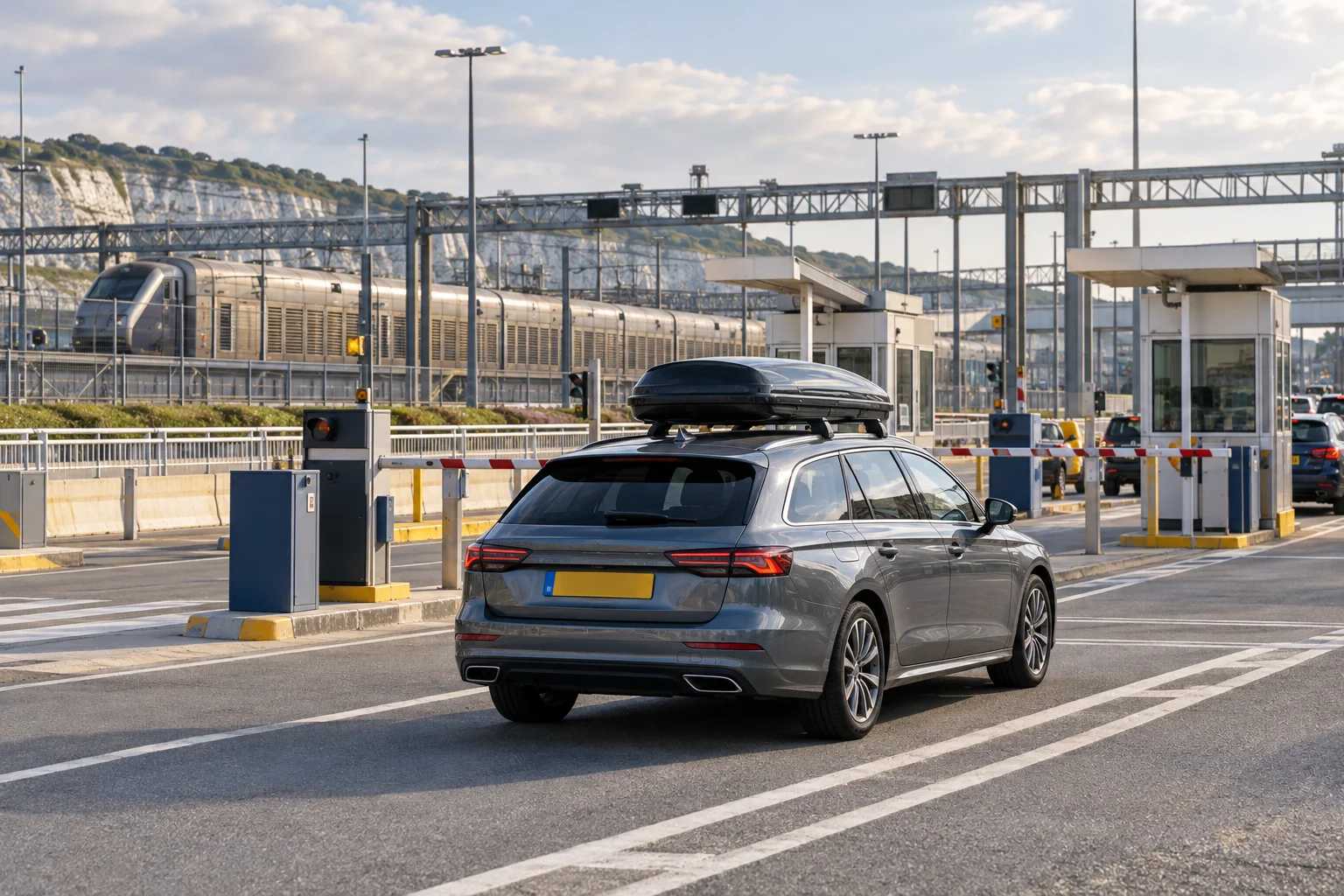
Declare the box, not just the height
LeShuttle’s current guidance allocates vehicles over 1.85m, and vehicles with anything on the roof, to its single-storey section. Declare the actual roof box and complete vehicle details even if the measured height is lower. Confirm the correctly declared quote and update an existing booking if the setup changes.
Understand the two separate allocation triggers
LeShuttle, the cross-Channel vehicle train service often still searched for as Eurotunnel, asks about the vehicle and its accessories. Its roof-box guidance states two triggers for single-storey allocation: a vehicle over 1.85m, or anything carried on the roof. Do not treat that as a height-only test.
A lower-profile box does not remove the accessory declaration if the whole car happens to remain below 1.85m. Likewise, a tall vehicle without a box still needs its actual dimensions entered. The operator uses those details to allocate suitable space; guessing a lower category can undermine that allocation.
The 1.85m figure is a section-allocation threshold, not the overall maximum height accepted by the passenger service. It also does not describe a car-park clearance or a driving roof-load allowance. Keep those different checks separate throughout the planning.
Measure the complete travelling setup
Measure the actual car with its approved rack, box and any other roof equipment installed. Include whichever component is highest; a bicycle can stand above the box lid. If a rear carrier or trailer is included, provide the other dimensions and details requested by the operator as well.
Use the height-measurement guide for the level-ground method and clear units. A registration lookup can help identify the base vehicle but is not a substitute for declaring accessories. Do not infer the final height from the box’s external dimension alone.
If the equipment is hired or borrowed, obtain the actual model and a reliable fitted-height plan early enough to resolve the booking. Do not rely on a seller’s statement that it is “fine for Eurotunnel” as a substitute for the operator’s current requirements and your actual details.
Check overall dimensions and the correct service
LeShuttle’s current vehicle-types guidance lists a 4.2m maximum height for its passenger carriages. That ceiling is separate from the 1.85m allocation question and is not an assurance that every load below it is accepted. Other dimensions, vehicle category, accessories and carriage conditions still matter.
| Check | Current guidance | What it does not mean |
|---|---|---|
| Roof accessories | Declare the actual roof equipment; anything on the roof triggers single-storey allocation | A low box can be left undeclared |
| Section height allocation | Vehicles over 1.85m use the single-storey section | 1.85m is the whole service’s maximum height |
| Overall passenger-carriage height | The vehicle-types page lists 4.2m | Every arrangement below 4.2m is automatically accepted |
| Quote and booking | Use the actual vehicle, accessories and journey details | A headline bare-car fare is necessarily your fare |
Use the passenger-service information for this kind of car journey rather than applying a freight-service dimension table. If the vehicle or load does not fit the ordinary booking choices, contact LeShuttle to establish the correct process. Keep any response with the confirmation.
Confirm the fare with all accessories declared
The operator says single-storey space can sometimes cost more than two-storey space. Its ticket information also explains that the actual vehicle and accessory details can affect the quote. Do not assume a roof box always travels free, always costs a fixed amount or always leaves the original bare-car fare unchanged.
Enter the actual configuration for the chosen dates and ticket, then inspect the final confirmation. Check both directions, especially if the return journey carries a different load or uses another vehicle. Booking accuracy concerns the setup that actually travels, not the equipment owned when the ticket was first purchased.
Keep the allocation and driving decisions independent. A valid transport booking does not check your roof load, component compatibility or luggage restraints. Use the load calculator and the complete compatibility guide for those separate questions.
Update an existing booking when the setup changes
LeShuttle’s current vehicle-amendment guidance says adding accessories or changing the booked vehicle requires the booking to be updated through its permitted process. A change can involve a fare difference, subject to the relevant exceptions and ticket conditions. Check the actual booking rather than relying on an old price example.
Do this before travel when adding a roof box, bike carrier or other relevant accessory. If a hired shell changes, confirm the revised dimensions and declaration rather than assuming all roof boxes occupy the same space. Save the updated confirmation and any operator clarification.
Do not build a plan around removing an undeclared box in the terminal queue or transferring luggage onto another part of the vehicle. Any final configuration still needs correct operator information, an approved carrying arrangement and properly secured contents. Ask the operator to resolve an uncertain change before approaching the boarding process.
Choose a box around the whole trip
A different box can change empty weight, useful luggage shape and hatch clearance. Check those before purchase, particularly if trying to share the roof with a bike. A smaller or lower shell is a practical equipment choice, not a way to bypass the operator’s stated allocation rule.
For a family trip, also consider how easily bags can be loaded and accessed at appropriate stops. The size guide helps match the luggage to the box without treating nominal litres as a guaranteed fit.
Keep journey essentials accessible
Prepare the items needed for check-in and the crossing before entering the boarding lanes. Keep documents, keys and appropriate family essentials accessible in the car, rather than assuming the box can be opened wherever the queue stops. Follow the operator’s current instructions about movement and boarding.
Check current rules for any restricted goods rather than treating a roof box as ordinary permission to carry fuel, cylinders or unusual equipment. Follow the exact operator guidance and conditions for those items; this roof-box guide does not establish their acceptance.
Follow the allocated route and repeat checks afterwards
Use the check-in timing, travel updates, signs and staff directions relevant to your actual booking. Do not choose a lane or carriage route because another car of similar size uses it. If accessories or dimensions are wrong in the confirmation, raise the issue with the operator before approaching an uncertain clearance.
Complete the pre-journey checklist before leaving and follow the equipment recheck guidance at suitable stops. Keep the complete height in mind after the crossing, when selecting parking and accommodation. The return trip needs the same attention if holiday purchases or equipment changes alter the load.
Operator guidance checked October 2026: roof accessories and allocation, vehicle types and sizes, amending vehicle details and ticket information. Recheck the current requirements before booking and travel.
Frequently asked questions
Must I declare a roof box below 1.85m on LeShuttle?
Yes. LeShuttle’s guidance says vehicles with anything on the roof are allocated to the single-storey section, as are vehicles over 1.85m. Declare the actual accessories even if the complete height is lower.
Is a roof box always carried for the same fare?
No. LeShuttle says single-storey space can sometimes cost more, and the actual quote depends on vehicle details, accessories and the chosen journey and ticket. Check the correctly declared booking.
What is LeShuttle’s published passenger-carriage height maximum?
The current vehicle-types guidance lists 4.2m, but that is an overall ceiling rather than a promise to accept every load. Confirm the full dimensions, accessories and conditions for the actual vehicle.
Can I add a roof box to an existing booking?
Use the operator’s permitted booking-change process and confirm the updated vehicle and accessories before travel. Ticket conditions, space availability and a fare difference can affect the change.
Can I remove the box just before boarding to use a lower category?
Do not build a booking around an undeclared or improvised configuration. If the travelling setup changes, give LeShuttle the correct vehicle and accessory details and follow its allocation and staff directions.