
Fit guide / Roof bars and compatibility
Will a Roof Box Fit My Car? A Complete Compatibility Checklist
Work through car, rack, mounting, load, hatch and height checks before buying a roof box. Includes practical examples and a complete compatibility checklist.
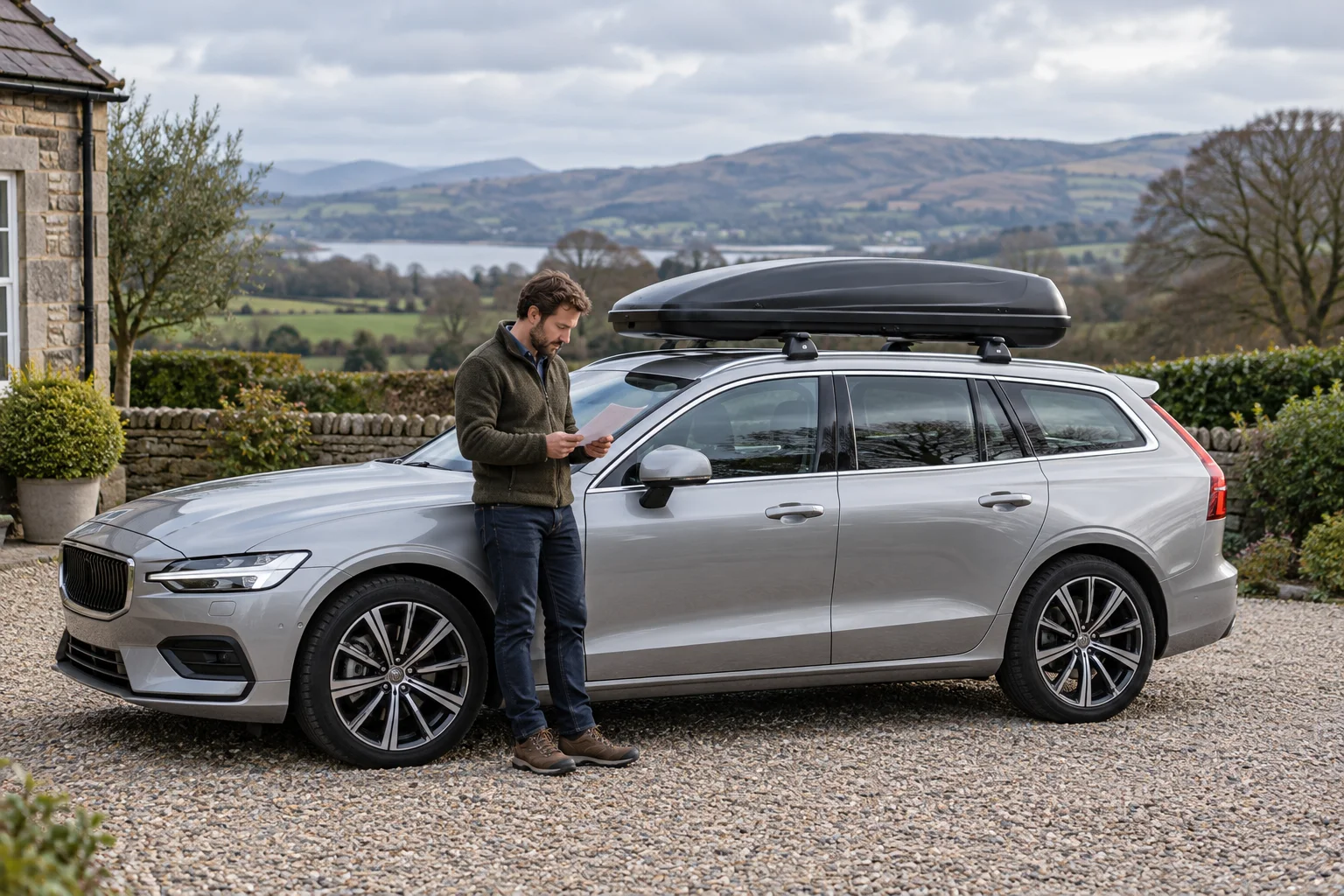
A complete fit has several separate answers
A roof box fits only when the car permits the complete rack, the mounts accept the bars and their spacing, the load stays within every applicable limit, and the shell and fittings clear the hatch, roof and other equipment. Capacity and overall length cannot answer those questions alone.
Begin with permission to carry on the exact vehicle
Record the vehicle’s make, model, body, generation, year and roof option. Find its dynamic roof-carrying allowance and any restrictions in the handbook. An electric or hybrid variant, glass-roof option or different body style can require separate information. Do not infer a limit from another version with the same badge.
Use the rack maker’s selector to identify the approved system for that roof. Save every bar, foot and kit code along with the fitting notes. If the exact combination is unlisted or the handbook does not permit the intended use, resolve it before buying a box. No box mounting system can compensate for an unapproved vehicle-to-rack connection.
Our roof-type identification guide helps start that search. It does not approve a kit from a picture, and decorative rails or an apparent mounting cover should not be treated as load-bearing without confirmation.
Check that you have a complete rack rather than bar components
Check package quantities, component generation and the condition of any reused parts. A used rack that fitted a previous car needs a new fit result for the current one. A retailer bundle named after a model still needs to match body style and roof configuration.
Obtain the rack’s weight including feet and kit. You will need it for the luggage calculation later. Keep the fitting instructions accessible because they also establish the available bar positions, which can decide whether a particular box is suitable.
Compare the box mounts with the bar profile
Identify the exact box model and supplied mounting system. Check the bar width, height and shape it accepts, together with the required space underneath. A quick clamp does not automatically fit every aerodynamic bar. An older bracket may have a different approved range from a current jaw system.
If using T-track mounting, obtain the exact approved adapter for the box generation and bar channel. Do not replace clamps with generic bolts or enlarge shell holes to make them reach. The adapter must preserve the designed interface and instructions, not merely hold the shell during a stationary trial.
Compare available bar spacing with the box range
Measure the centre-to-centre distance between front and rear bars using the box maker’s diagram. Start with the locations prescribed or permitted by the vehicle kit. On a fixed-point car, those positions can leave little or no longitudinal choice.
Compare the measured spacing with the exact box’s minimum and maximum. The overlap must satisfy all the rack and vehicle instructions as well. Do not use the box’s adjustable mounting slot as permission to relocate the bars beyond their approved locations. Our spacing guide gives worked examples and explains why “70cm fits everything” is unreliable.
Record the units and reference points. Measuring the gap between bar edges instead of their centres can produce a misleading pass or failure. Recheck any borderline measurement before ordering, particularly where the shell would also sit close to the hatch.
Check the boot, spoiler and roof obstructions
For a Thule front-clearance check, measure from the front crossbar centre to the specified roof-to-hatch junction and compare it with the exact model’s published requirement. Follow the maker’s method; overall shell length does not tell you how much box sits behind the front bar.
Check antennae, roof contours, glass and the lowest part of the mounts. A spoiler follows an arc as the hatch opens; a gap with the boot shut does not prove a gap throughout that movement. Read the hatch measurement guide before attempting an opening where contact is uncertain.
Calculate luggage allowance and usable packing space
The car’s dynamic roof limit includes the full rack, adapters, empty box and luggage. The rack or kit can impose a lower carried-load limit, while the box has its own luggage limit. Apply each to the right items. Use the calculator with confirmed weights and limits rather than treating the largest advertised rating as the answer.
A family’s folded pushchair, travel cot or rigid suitcase needs a separate shape check. Measure the actual folded object and allow for lid taper, mount intrusions and restraint. A 400L label does not prove a tall item fits under a shallow lid. Keep items needed during the journey accessible in the car where practical.
Keep this compatibility record before purchase
| Check | Record before ordering |
|---|---|
| Vehicle permission | Actual roof option, dynamic allowance and exclusions |
| Rack | Both bars, all feet, exact kit and mounting instructions |
| Box interface | Exact model, hardware and accepted bar profile |
| Spacing | Measured bar centres and overlapping permitted ranges |
| Clearance | Hatch/spoiler path, roof/glass, antennae and total height |
| Load and luggage | Full equipment weights, lowest applicable allowance and actual packed shape |
Any unresolved row means the carrying plan needs more work. A smaller box, different approved rack option or another carrying method may help, but each change needs the affected checks repeated. Keep the completed record and supplied manuals for installation and future vehicle changes.
Guidance and product details checked October 2026 using the Thule vehicle selector, Force 3 instructions and Motion 3 fitting tables. Use the actual vehicle handbook and supplied model instructions to confirm the complete arrangement.
Frequently asked questions
Does roof-box length have to be shorter than my roof?
Overall length alone is not the deciding measurement. The approved mounting position, front clearance, hatch sweep, antennae, visibility and manufacturer instructions determine whether the exact box can be used.
Can I put any brand of roof box on my bars?
Brand matching is not sufficient or always necessary. Confirm the exact box mount’s approved dimensions and bar profile, spacing and clearance, together with the rack’s approval for the car.
What if only the hatch clearance check fails?
The complete setup still needs resolving. Consider another box or a specifically approved adjustment, then repeat the mounting and load checks; do not treat a smaller opening as automatic permission.
Does the load calculator confirm vehicle compatibility?
No. It helps calculate luggage allowance from limits and weights you supply. It cannot approve the vehicle fit, hardware, glass-roof permission, mounting spacing or physical clearances.
Can I carry a pushchair in a roof box?
Only if its actual folded shape fits, its weight fits the remaining allowance and it can be restrained as instructed. Keep essential travel items accessible and check the opening and mounting obstructions.