
Comparison / Packing, storage and care
Soft Bags vs Hard Suitcases in a Roof Box
Compare soft duffels and hard suitcases in a roof box by packed shape, taper, wheels, access, restraint and weight. Includes a practical fit worksheet.
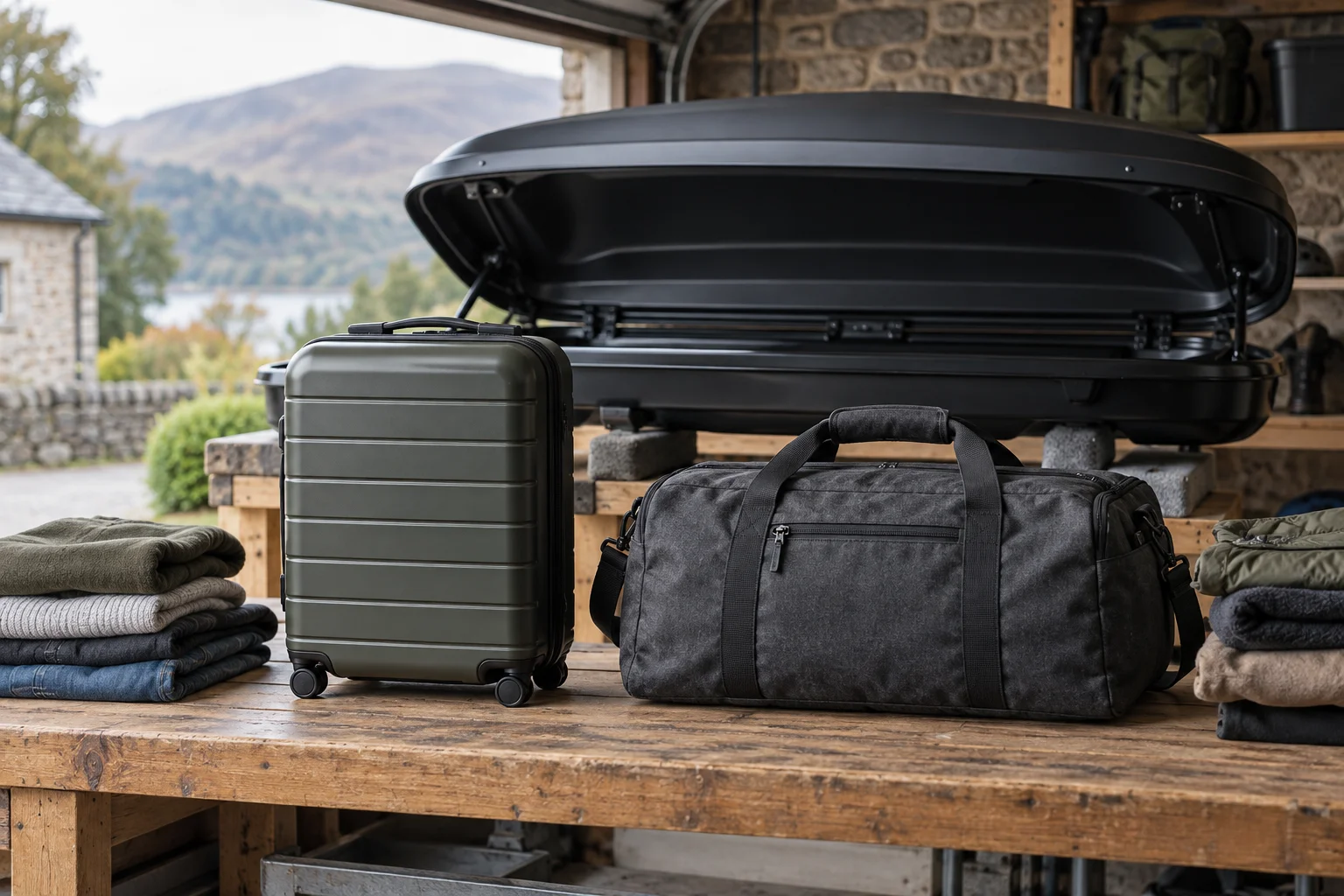
Compare the packed shape, not the luggage label
Soft bags often offer more freedom around a tapered interior, while hard cases retain their dimensions and projecting hardware. Either can fail the opening, height or restraint checks. Measure the actual luggage and keep the lid free to close normally.
Begin with the luggage you already own
Before buying special roof-box bags, lay out the cases and duffels you normally use. A smaller existing bag may solve the problem more neatly than a large matched set. Record the actual packed dimensions and weights, then compare them with the box’s permitted load arrangement.
Treat each piece as a three-dimensional shape. A suitcase can be short enough on its long axis while its wheels make it too tall. A duffel can have flexible sides but a broad structured base that will not sit in the tapered nose. Neither the box’s litres nor the luggage’s cabin-size label settles those questions.
Start with our internal-dimensions guide if you have only exterior box measurements. Fit the luggage to the usable interior rather than buying a larger shell to match an unsuitable case without checking the car.
Where soft bags can help
A partly filled textile bag can sometimes follow the available space better than a rigid case. Separate bags also let you divide luggage into manageable units and remove one person’s belongings without taking everything out. That can be useful at an overnight stop or when the box opening is awkward.
The flexibility has limits. Dense contents, shoe compartments, piping and padded panels create their own shapes. An overfilled duffel does not become low-profile because its fabric is soft, and pushing the lid down is not an acceptable way to compress it.
Check the loading route too. A large soft bag may fit the floor footprint yet be difficult to lower through a narrow side opening without disturbing the mounting hardware or leaning on the hinge.
Where hard suitcases need extra measurement
A rigid case gives its contents a defined shape, but that same shape cannot normally adapt to a sloping lid. Measure the maximum envelope including wheels, fixed handles, feet, locks and any expanded section. Do not use the advertised body size if the protrusions sit outside it.
Check the intended orientation with the case packed. A handle or wheel can become a concentrated contact point against the shell, while a case resting across a mount may not have stable support. Keep it within the box’s approved loading arrangement and protect contact surfaces only as the instructions permit.
Do not assume a hard case protects the box from the load. It can transmit force through its corners and hardware, and its own shell does not secure it to the box. If the case prevents the original straps from working or the lid from locking normally, choose another item of luggage.
Compare both options in the same usable bay
Use the same reference points and clearances when comparing a case and a duffel. Check the height above the planned location, not the highest point anywhere in the box. Leave the prescribed space for mounts and restraint hardware.
| Question | Soft bag | Hard suitcase |
|---|---|---|
| Maximum envelope | Measure packed bulges, pockets and straps | Include wheels, handles and expanded sections |
| Base and support | Structured panels can remain rigid | Check corners and projecting hardware |
| Tapered lid | Some shape flexibility when partly filled | Fixed dimensions must clear the slope |
| Access | Can the loaded bag pass through the opening? | Can the complete case enter and be positioned? |
| Restraint | Use the box’s prescribed system | Use the box’s prescribed system |
| Closure | No fabric or handle trapped | No corner or wheel pressing on lid |
A hypothetical bay 75cm long can accept a bag or case only if its whole required shape fits the available width and height too. An item 74cm long is not automatically suitable merely because there is 1cm left along that one axis. This is a screening exercise, not a rule for the clearance required by every model.
Mix luggage only around a complete restraint plan
A small case with softer bags beside it can be a practical layout, but fill the box deliberately rather than using loose clothing to hide an unsecured object. Keep the original anchors and buckles accessible. A snug fit between other bags does not replace the restraint instructions.
Avoid using bag handles or suitcase pull handles as improvised restraint anchors. Follow the box maker’s route and contact guidance, and do not pass straps over sharp hardware or leave a buckle pressing into the lid. Our luggage-strap guide covers the replacement checks if parts are missing.
Compare the travelling weight, including the luggage itself
A lightweight-looking soft bag can hold a very heavy load, while a partly empty hard case still contributes its shell and wheels. Weigh each complete item and include all luggage in the available roof-load calculation. Moving the same contents between bags does not remove the need to recheck the total.
For example, if the calculated box-luggage allowance were 30kg and the combined empty luggage weighed 4kg, only 26kg would remain for contents under that allowance. Those are illustrative figures, not a recommendation to use any particular case or fill to the limit without allowing for uncertainty.
Use the worked roof-load guide to establish the allowance first. Dense heavy items may need a suitable secure location inside the vehicle rather than being assigned to the roof simply because they fit.
Perform a stationary packing and closure check
Position the luggage as the box instructions permit, complete the specified restraint sequence and inspect the hinges, lid edge and locking points. Close the lid normally. Do not use the key to pull the shell down, sit on the lid or squeeze a case into a tapered corner.
Rehearse removing the item you will need first. A layout that works on the garage floor may be impractical at roof height beside another accessory. Plan the return journey too, when clothing may be less neatly packed and wet equipment needs separation.
For detailed bag selection, continue to packing-bag dimensions and access. Confirm both luggage and box cleaning guidance before putting anything away for the season.
Sources checked October 2026: GoPack specifications, Daylite Duffel 45 and Thule load and maintenance instructions. Check the exact box and luggage, including any expansion mode.
Frequently asked questions
Are soft bags always better in a roof box?
They can offer more packing flexibility, but structured bases, pockets and overfilling still create fixed dimensions. Choose around the actual packed shape, restraint arrangement and opening rather than the word soft.
Can I put a hard suitcase in a roof box?
Only if its full envelope, including wheels and handles, fits the permitted loading arrangement with correct restraint and normal closure. The suitcase being cabin-sized does not establish roof-box fit.
Should I put a suitcase on its side to gain room?
Use only an arrangement that fits the box instructions, keeps the case supported and allows the specified restraints to work. Check contents and projecting hardware; do not force a case under the lid.
Do bags or suitcases need straps inside the box?
Follow the roof box’s exact load-restraint instructions for either type. A hard shell, snug fit or bag handle does not replace the approved internal restraint system.
Can I mix soft bags and hard cases?
A mixed layout can work if each item is supported, restrained and clear of mounts, hinges and closure points. Check weight distribution and avoid placing heavy rigid hardware against vulnerable parts of the shell.