
Configuration guide / Watersports carrying
Carrying Two Kayaks on Roof Bars: Carrier Layouts, Width and Load Limits
Plan a two-kayak roof load with stacker versus separate carriers, usable bar width, full roof mass, independent restraints and loading access.
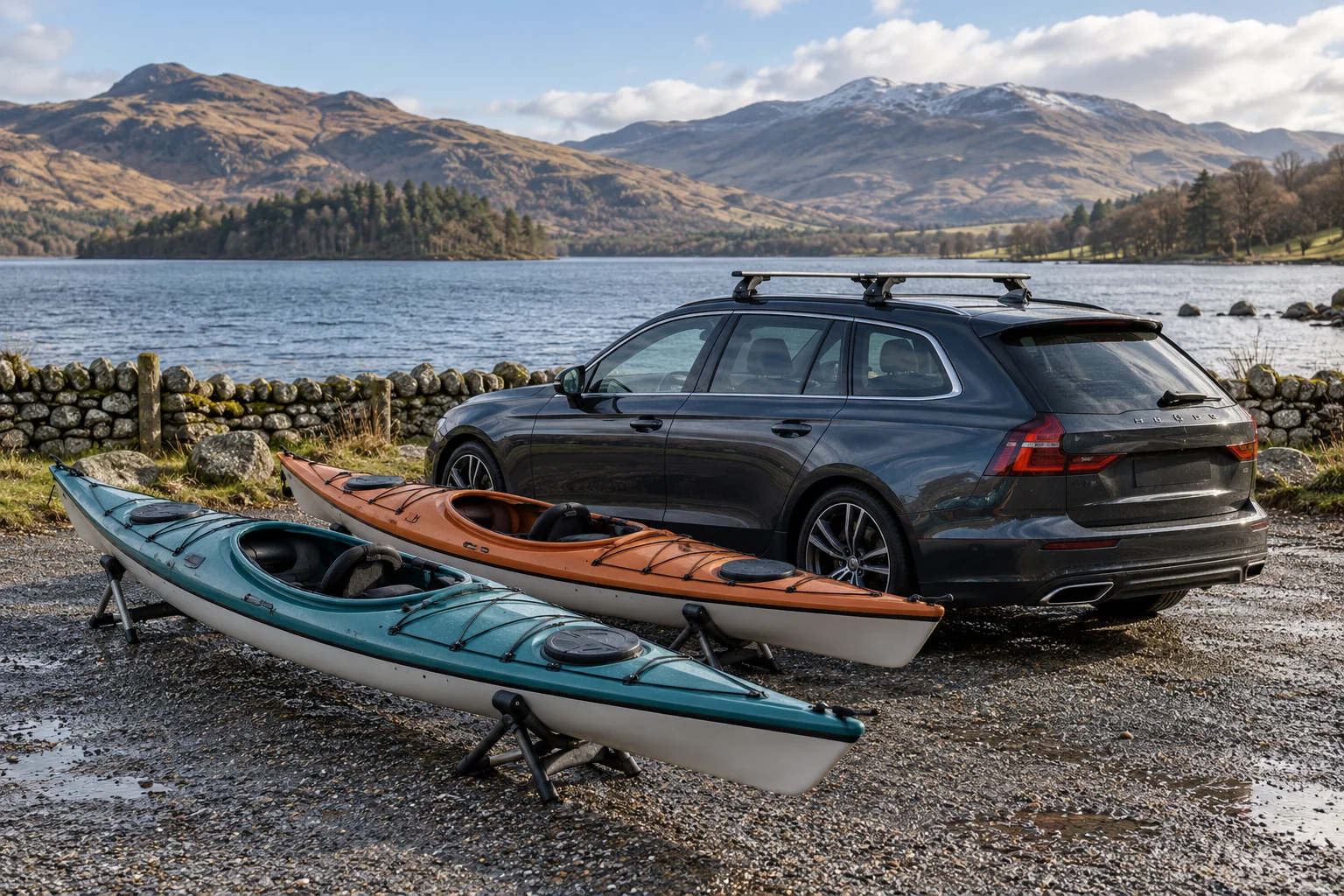
Two kayaks need one verified roof layout and a complete restraint arrangement for each craft. A two-boat carrier rating does not prove that the hulls fit, the straps supplied cover both boats or the finished roof load is within the car’s allowance.
Start with the actual kayaks. Record travelling weight, length, widest beam, hull construction and the support orientation each maker permits. Then compare the complete layout, including how you will reach and secure the second boat after the first is loaded.
Choose between a stacker and two separate support sets
A two-boat stacker holds suitable kayaks in the positions shown by its manufacturer. That can use roof width differently from two horizontal boats, but it also changes the contact areas, lifting movement and required restraint routes. A kayak that can sit upright on saddles is not automatically approved to travel on its side.
Two separate horizontal carrier sets give each hull its own specified supports. They can require considerably more width than the individual saddle bases suggest, because the full hull extends above and beyond those bases. Check both craft at the front and rear support positions.
Read the general kayak-carrier guide if you are still choosing the support style. A second boat adds its own space, load and access checks even when the first carrier already fits.
Calculate the whole roof load
Use the complete vehicle-approved rack mass, every carrier and both kayaks, with accessories that remain on the roof. Remove fishing equipment, loose seats or other items only as the craft maker permits, and decide where those pieces will travel securely inside the car.
For a hypothetical 5kg rack, 5.6kg XTR and kayaks weighing 24kg and 26kg, the total is 60.6kg before any additional roof-mounted hardware not already included. The kayaks themselves total 50kg, below the XTR’s 59kg combined ceiling, but roof and rack limits, hull permission and width still need to pass.
For the same two boats on two DockGrip sets planned at 3.1kg each, the illustration becomes 5 +6.2 +24 +26 =61.2kg. Check each carrier’s own limit as well as the overall roof allowance. The worked load guide explains how the separate ratings interact.
Compare the boat limit with the complete roof total
Two boats can satisfy the car’s roof mass calculation while exceeding the carrier’s combined-craft ceiling. Separating craft mass from carrier mass prevents a spare-looking vehicle allowance from hiding that failure.
Inputs and assumptions. Illustrative rack 5kg and 2kg of additional roof equipment not already included in carrier mass. Compare XTR in its prescribed two-boat configuration at 5.6kg with two complete DockGrip sets at a conservative 3.1kg each. Boat pairs are hypothetical 24+26kg and 29+31kg. Actual hull permission, extra restraint masses and width remain separate.
| Support arrangement | Boat pair | Complete roof mass | Headroom at 60kg | Headroom at 75kg | Carrier craft-weight screen |
|---|---|---|---|---|---|
| XTR two-boat mode | 24kg + 26kg | 62.6kg | -2.6kg | 12.4kg | Below 59kg combined |
| Two DockGrip sets | 24kg + 26kg | 63.2kg | -3.2kg | 11.8kg | Each below 40kg; verify each craft |
| XTR two-boat mode | 29kg + 31kg | 72.6kg | -12.6kg | 2.4kg | Exceeds 59kg combined |
| Two DockGrip sets | 29kg + 31kg | 73.2kg | -13.2kg | 1.8kg | Each below 40kg; verify each craft |
The 29kg + 31kg pair totals 60kg of craft. On XTR it produces a 72.6kg roof total in this model, below 75kg, yet exceeds the two-boat carrier ceiling by 1kg. The arrangement must change despite the positive vehicle headroom.
The lighter boat pair gives roof totals of 62.6kg and 63.2kg with the declared extras. Neither fits a 60kg roof allowance. Do not use a carrier’s boat count as proof of vehicle capacity or split one one-craft saddle set between two boats.
Calculation method and sources
Total roof mass = rack + carrier sets + both boats + separately counted extras. XTR’s two-craft ceiling is 59kg combined; DockGrip requires each craft to satisfy its own 40kg ceiling, not a transferable pooled allowance.
- Hull-a-Port XTR 848004 instructions: PDF page 3: 5.6kg carrier, 34kg one-boat and 59kg combined two-boat configurations.
- DockGrip 895000 specifications: 3.1kg page mass and 40kg craft ceiling. The older manual gives 2.5kg; retain at least 3.1kg for planning.
- Thule roof-rack safety guidance: Exact vehicle-kit positions and applicable accessory instructions take precedence over general spacing advice.
Download the inputs and workings (CSV). Source review: October 2026.
Measure the usable mounting areas on both bars
Measure where the approved attachments can sit, excluding feet, unusable track ends and any prohibited zones. Record front and rear bar measurements separately. A bar’s overall length is not an unrestricted mounting span.
Hull-a-Port XTR’s instructions specify at least 610mm between bar centres and a defined bar-profile range. Keep the car’s bars in their approved positions; do not move vehicle-specific feet to create extra separation. Confirm the exact profile, hardware and clearance beneath the attachment.
Draw each hull’s position above those mounts. Check the widest part, the angled sidewall and projecting handles or fittings. A gap between the carrier bases does not prove that the kayaks will remain separate in the required orientation.
Keep each boat’s restraints complete
Follow the two-boat diagram for the actual carrier. Main load straps and required bow/stern lines have different roles, and each craft must have the restraint arrangement specified for it. Do not run an improvised single strap over both boats and assume it distributes the load correctly.
Rehearse a loading order with reachable controls
Prepare the straps and supports before lifting. Agree who controls each end of the kayak and where it will rest while the prescribed restraints are applied. A long boat can be difficult to rotate beside a car, particularly in wind or a crowded launch car park.
There is no universal first side or heaviest-first sequence. Choose an order consistent with the carrier instructions that lets you secure and inspect the inner interfaces before the next craft blocks access. Do not lean an unsecured second kayak on the first as a temporary support.
If you cannot reach a buckle or the far support while maintaining control, revise the layout or loading method. The loading-aid guide compares sliding and assisted-lift approaches without assuming that every aid fits every roof.
Check height, projection and the return journey
Measure the highest point of the completed load, including an angled kayak and its carrier. Check hatch travel, rear spoiler clearance and the full length of both craft. Plan parking and route restrictions using those actual dimensions.
At the water, allow space to unload in the reverse order and keep the waiting boat supported securely. After paddling, drain and remove loose equipment as the craft instructions require before reloading. Do not treat retained water or extra wet kit as weight that can be ignored.
Complete the departure checks and prescribed journey rechecks. If either boat moves or a restraint cannot remain correctly engaged, stop safely and resolve the arrangement before continuing.
Sources and selected Amazon packages checked October 2026: XTR instructions, DockGrip, DockGrip instructions and QuickDraw. Confirm each kayak’s own transport guidance.
Frequently asked questions
Does a carrier rated for one 34kg kayak take two 34kg kayaks?
No. The selected Hull-a-Port XTR permits one kayak up to 34kg or two totalling no more than 59kg in its different stacker arrangement. Those are separate configurations. The vehicle, rack, craft support and complete restraint requirements still have to pass.
Do two kayaks need two complete carrier sets?
It depends on the approved configuration. A purpose-designed two-boat stacker can use its specified shared support arrangement. Two horizontal kayaks normally need the separately specified supports for each craft. Do not make a two-boat layout by sharing parts intended for one.
Are the straps supplied with Hull-a-Port XTR enough for two boats?
Thule describes the included load straps and bow/stern tie-downs as equipment for one boat. Obtain the additional specified restraints for the second kayak and follow the two-boat diagram. Do not make two boats share one boat’s restraint set.
Can I put a heavier kayak next to a lighter one?
Only if the carrier and rack instructions permit the arrangement and each craft can be supported and restrained correctly. Add both masses and follow prescribed distribution and mounting positions. A combined rating alone does not approve every imbalance or hull shape.
Can I carry two wide fishing kayaks on an ordinary car?
There is no general approval. Measure both hulls in their permitted orientations, add every support and restraint, and check roof/rack limits and loading access. Their mass and width can rule out an arrangement that works for narrower touring kayaks.