
Buying guide / Watersports carrying
Choosing a Surfboard Roof Carrier: Board Size, Padding and Mounting
Choose surfboard roof supports by actual width, length, rocker, fins and approved contact. Compare padded bars with Board Shuttle and check what each package includes.
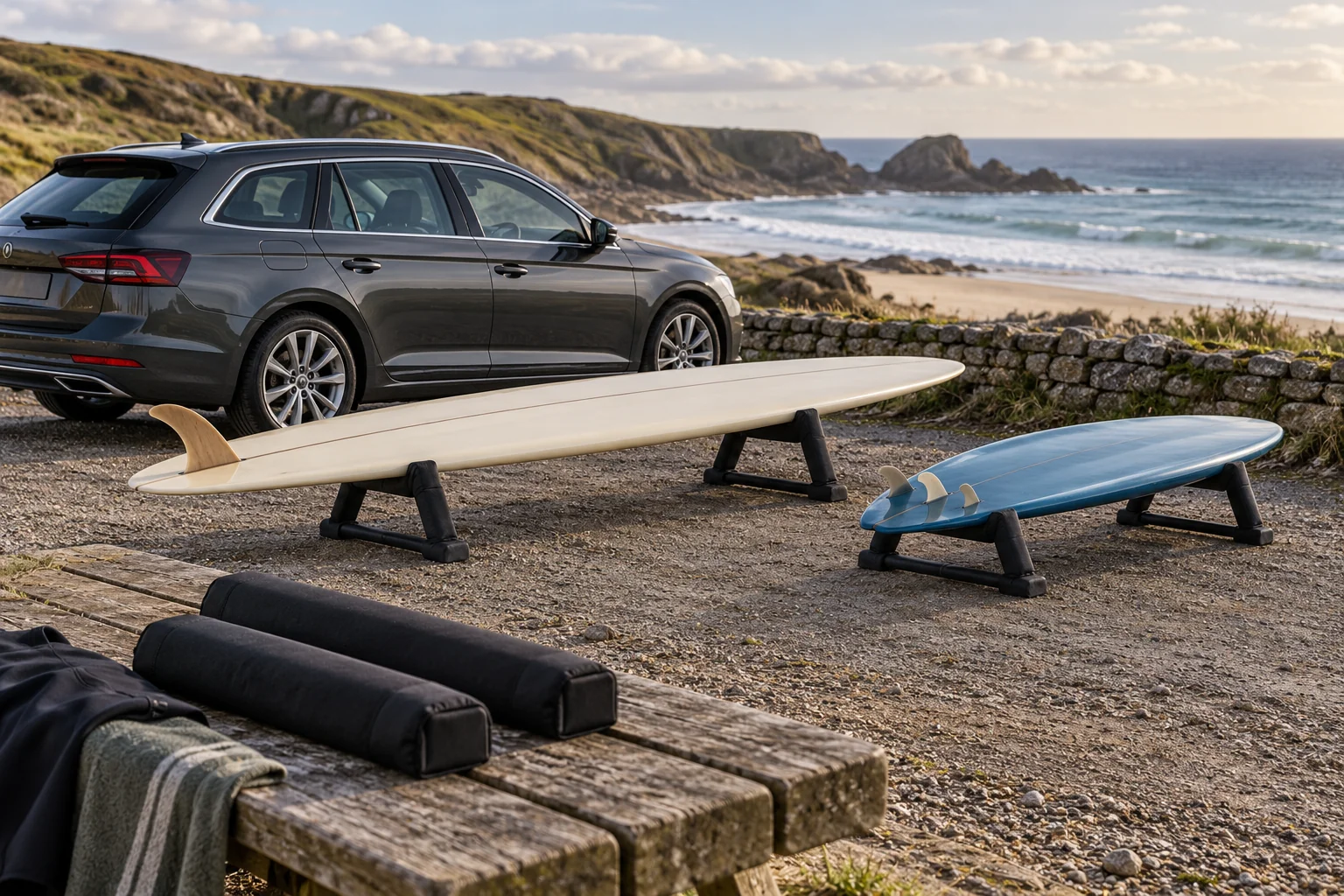
Quick answer
Measure the board and confirm its support instructions first. Padded crossbars need compatible separate restraints; an adjustable carrier has a defined board-width range. Board Shuttle’s 70cm minimum width can exclude a narrow surfboard regardless of its low weight.
Padded bars or a dedicated width-adjustable carrier
Jump to the full specs table ↓Dakine Aero Rack Pads 28in — black
- Pair of 71cm pads
- 14–20cm bar circumference
- Load straps separate
For an approved board support arrangement on bars that match the pad closure and circumference. Check usable bar span, board contact and separate compatible load straps.
View on Amazon UK ↗Read the full comparison ↓Thule Board Shuttle — model 811000
- 70–86cm board width
- 50kg combined; up to 2boards
- 2.7kg planning mass
For board-maker-approved support and stacking, minimum 610mm bar centres and the exact bar attachment. Narrow surfboards below 70cm are outside the stated range.
View on Amazon UK ↗Read the full comparison ↓| Option | Package role | Dimensions to check | Restraints | Main limitation |
|---|---|---|---|---|
| Dakine Aero Pads 28in | Pair of top-of-bar pads | 71cm pad length; 14–20cm bar circumference | Separate approved board restraints | Pads are not a complete rack or restraint kit |
| Board Shuttle 811000 | Adjustable board carrier | 70–86cm board width; 610mm minimum bar centres | Specified load straps included | 50kg combined; up to 2 approved boards |
| Both | Part of a complete vehicle setup | Board shape, rocker, fins and usable bar area | Follow exact board/carrier routing | No universal board or vehicle fit |
Selected Dakine package: two 71cm pads for 14–20cm bar circumference, straps separate. Board Shuttle 811000: 70–86cm boards, 50kg combined, up to 2 boards, minimum 610mm bar centres; plan 2.7kg from the manual.
What each selected package provides
Dakine Aero Rack Pads 28in — black
A pair of 71cm top-of-bar foam pads for compatible crossbars. Dakine specifies 14–20cm bar circumference; these pads provide cushioning rather than a complete restraint system.
For an approved board support arrangement on bars that match the pad closure and circumference. Check usable bar span, board contact and separate compatible load straps.
- Pair of 71cm pads
- 14–20cm bar circumference
- Load straps separate
Why consider it
- Long padded top contact
- Hook-and-loop attachment
- Pair covers front and rear bars
Keep in mind
- Pads do not restrain the board
- Bar circumference is not bar width
- Board and rack approval still required
Thule Board Shuttle — model 811000
An adjustable carrier for up to two approved boards with 70–86cm widths and a 50kg combined load ceiling. Plan 2.7kg for the carrier from its manual rather than the page’s 2.6kg.
For board-maker-approved support and stacking, minimum 610mm bar centres and the exact bar attachment. Narrow surfboards below 70cm are outside the stated range.
- 70–86cm board width
- 50kg combined; up to 2boards
- 2.7kg planning mass
Why consider it
- Two-board configuration shown in manual
- Padded supports and specified load straps
- Adjustable board width
Keep in mind
- Minimum 70cm width can exclude surfboards
- 50kg is combined, not per board
- Stacking and fins need separate checks
Choose the support around the actual surfboard
A useful surfboard roof carrier supports the board where its maker permits and keeps the complete load restrained without damaging rails, fins or the deck. Begin with the real board dimensions, not a broad label such as shortboard, longboard or SUP carrier.
Measure length, widest width, thickness and the curved shape often described as rocker. Record the fins and any bag that will remain fitted. Check the board maker’s transport guidance for orientation, support span, padding and strap contact before selecting equipment.
The two options here do different jobs. A pad pair cushions approved crossbars and needs separate restraints; Board Shuttle is a dedicated adjustable carrier with its own board-width range. Neither is a universal fit for every surfboard.
Check board width before choosing an adjustable carrier
The selected Board Shuttle 811000 lists a 70–86cm board-width range. That can suit some broad boards, but many narrower surfboards fall outside the stated minimum. A 62cm board does not become suitable because its mass is low or because the carrier’s name includes surfboards.
Compare the actual support geometry with the board shape. The widest point is useful for an initial check, but the prescribed contacts also need to meet the board correctly at the bar positions. Do not narrow the carrier beyond its approved adjustment or add blocks to make a smaller board appear to fit.
The 50kg Board Shuttle limit is a combined equipment ceiling for its permitted arrangement, not a reason to ignore those dimensions. Its manual shows up to two boards and a minimum 610mm bar-centre spacing. Board-maker permission and the whole rack fit remain separate requirements.
Understand what a pad pair provides
Pads wrap around compatible crossbars and cushion the board at its intended support areas. The selected Dakine Aero Rack Pads 28in package is a pair of approximately 71cm top-of-bar pads. Their hook-and-loop fastening holds the pads in position; it does not secure the board to the car.
Dakine specifies 14–20cm bar circumference for this package. Circumference is the distance around the bar profile, not its top width. Measure the correct dimension and check the closure can engage as designed without interfering with the rack feet or carrier hardware.
The 71cm pad length also needs room within the usable bar area. A long foam section should not be forced over feet, end fittings or an unsupported area simply to keep the pack’s nominal length on the roof. Confirm the actual board contact and support span after fitting.
Compare the full package rather than the first component
For padded bars, include the complete approved rack, the correct pad pair and the separately specified load straps. Check whether the board maker permits that strap type and routing. A soft pad does not prevent damage if an unsuitable strap is overtightened.
For a dedicated carrier, verify the package inventory, bar hardware and any optional adapter. Some photographs show accessories that are not included. Keep pad attachment, carrier attachment and board restraint as distinct checks when comparing the total purchase.
Account for rocker, fins, rails and the bag
A board’s curve changes where it meets its supports and how far its nose or tail rises above the car. Check the actual supported position and orientation specified by the board maker. Do not assume that a straight length measurement describes the full travelling shape.
Protect the approved rail and deck contact areas. Keep grit out of pads and the board bag, and inspect vulnerable edges before loading. A bag can reduce surface contact and dirt, but it can also change strap grip or conceal a poorly seated support.
Check fin clearance at the car and between boards. Remove a fin only where the board instructions permit it, and keep all screws and components secure. Do not use the fin, leash plug or bag handle as an improvised tie-down point.
Verify the rack and the full restraint route
Confirm the exact vehicle-approved bars, feet and kit, then the support system’s bar interface. A pad that closes around a profile does not establish the bar system’s vehicle fit. A dedicated clamp likewise needs the actual profile and permitted mounting areas.
Keep the bars within their vehicle-approved positions. Check that the resulting separation suits both board and carrier. If those requirements cannot agree, choose another approved method rather than moving the rack feet to suit the board.
Apply the specified main straps and any required end restraint. Keep buckles protected and accessible, and manage loose tails as instructed. The end-line guide explains why required end restraint cannot replace main load straps.
Check the roof weight and travelling dimensions
Count the complete rack, supports, boards and roof-mounted accessories. Use at least 2.7kg for the selected Board Shuttle because its manual figure is higher than the product page’s 2.6kg. For pads and separate hardware, establish the actual assembled mass rather than inventing a negligible allowance.
Check the whole vehicle envelope, including the highest part of the board, its fins and any bag. Confirm hatch and spoiler clearance in the permitted loaded position. Roof length and a low board weight do not by themselves approve a long projection beyond the bars.
Where two boards are proposed, use the two-SUP stacking guide for the additional combined-load, separator and restraint checks. Do not interpret a two-board carrier as permission to stack every pair of boards together.
Make the loading routine part of the buying decision
Choose a level working area with room to control the full board length. Prepare the pads or carrier and the restraints before lifting. Wind can make a broad board awkward even where its mass is easy to carry.
Rehearse loading and unloading on the actual car. You should be able to support the board, complete every fastening and inspect the far-side contact without an unstable stretch. A second person can help with control, but cannot make an incompatible support arrangement acceptable.
After securing the board, complete the pre-journey checks and follow the prescribed journey inspections. If contact, strap engagement or the loading method remains uncertain, resolve it before travelling.
Sources and selected Amazon packages checked October 2026: Dakine pad specifications, Board Shuttle 811000, Board Shuttle instructions and Starboard’s board-specific transport guidance. Use your own surfboard’s instructions for its permitted contacts and orientation.
Frequently asked questions
Will Board Shuttle fit a narrow surfboard?
The selected 811000 lists 70–86cm board widths. A 62cm-wide surfboard is outside that range even if its weight is well below 50kg. Investigate a different board-approved support arrangement instead of assuming the adjustable arms can close farther.
Are surf pads a complete roof rack?
No. The selected Dakine pack contains two foam pads for compatible crossbars. You still need the complete vehicle-approved rack, the board maker’s permitted support arrangement and suitable load restraints. The pad’s hook-and-loop closure attaches the pad, not the surfboard.
Does 28in describe the board width these pads accept?
It describes the selected pad length: approximately 71cm across the bar. Dakine separately specifies 14–20cm bar circumference for the closure. Neither measurement alone establishes the permitted surfboard width or support geometry.
Should I remove surfboard fins for roof transport?
Follow the actual board and carrier instructions. Fins affect clearance, stacking and handling, and a removable fin may need secure separate storage. Do not force two boards together around fins or assume one orientation suits every board.
Can I use the board bag’s handles as tie-down points?
Only where the bag and complete transport instructions approve that role. A carry handle, zip or leash cord is not automatically a load restraint. The board must be supported and secured through the prescribed load path even when it is inside a bag.