
Comparison / Bikes and sports equipment
Roof Box vs Ski Carrier: Which Suits Your Equipment?
Compare a roof box and exposed ski carrier for ski length, bindings, weather protection, luggage space, roof weight and loading, with relevant Amazon options.
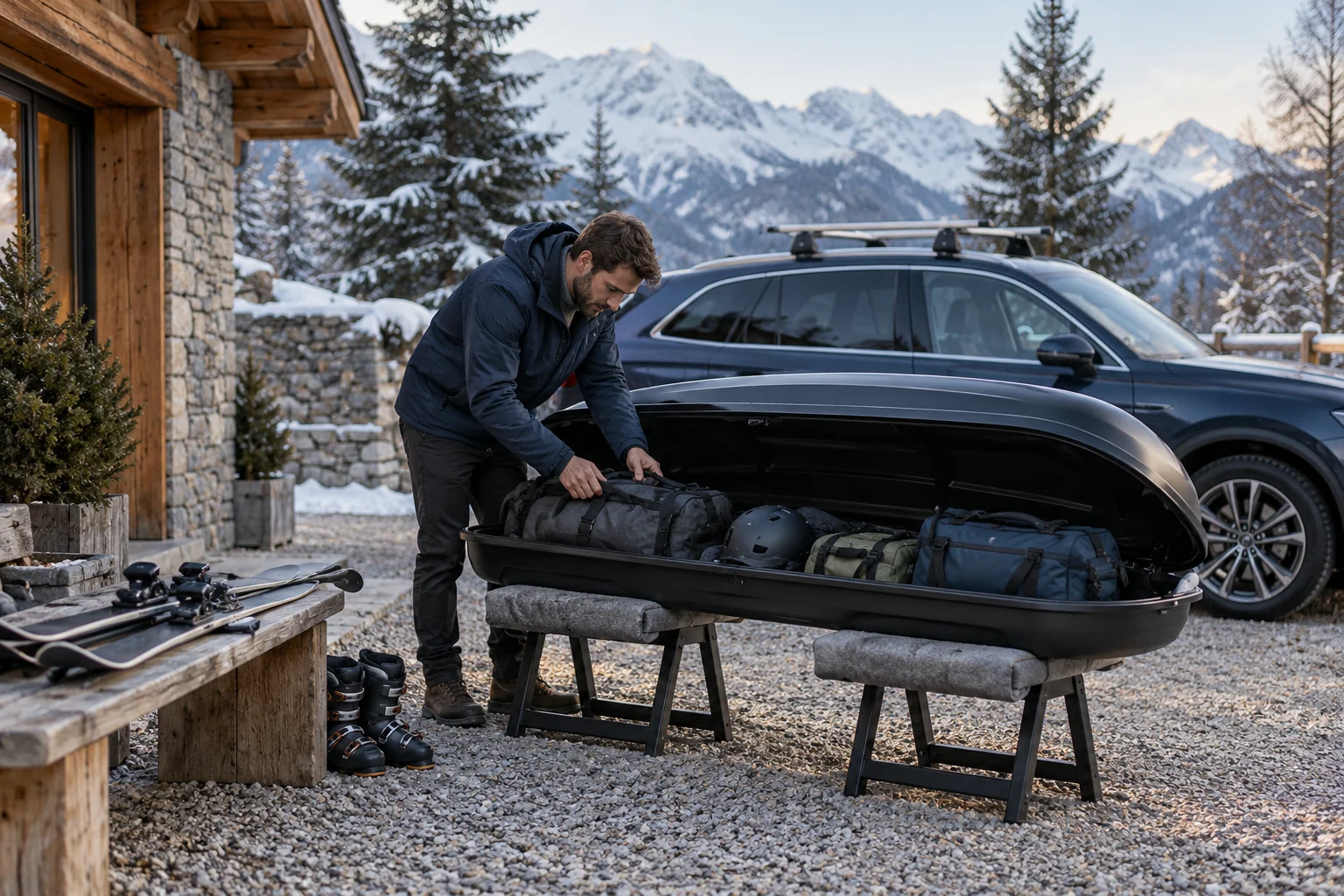
Choose around the winter kit and the rest of the trip
A roof box encloses equipment and can carry other luggage when its usable space and restraint system suit. An exposed ski carrier avoids the box shell but needs enough loading width, binding clearance and permitted clamping space. Start with the actual skis and vehicle limits, then compare the practical costs.
List the equipment before choosing the container
Lay out the skis, snowboards, poles, bags and other luggage you intend to take. Record the longest item, widest packed sections, binding height and travelling weight. A family’s mixture of short children’s skis, broad adult skis and a snowboard is a different fit problem from four identical narrow pairs.
Decide what really needs to travel on the roof. Boots and dense equipment can consume the roof allowance quickly, while some items may be more suitable in a secure position inside the vehicle. Do not choose a large box first and assume its volume means all the ski equipment can be added afterwards.
A box encloses the load and offers other uses
A box separates the equipment from direct road spray and creates space for suitable luggage on non-ski trips. It can be useful where soft bags would otherwise fill the cabin. The tradeoff is the shell’s own weight, storage space at home and the need to fit long, awkward equipment around the interior shape and mounts.
A box is not permission to leave skis loose, and it is not a substitute for drying wet kit afterwards. Follow the loading instructions and fit any required model-compatible ski support. A bag can protect equipment from contact, but adds length and bulk and still needs to be secured by the approved arrangement.
A narrower box may suit a smaller winter load
A long, narrow shell can be an alternative where you want enclosed equipment and hope to keep some roof width available. Check actual ski length first; the shell’s exterior length is not its permitted ski length.
For example,180cm skis fail that published 175cm maximum even though the exterior shell is longer. Moving them diagonally or forcing the tips into a tapered corner is not a way to expand the maker’s rating. Use the ski-length measurement guide to distinguish the published limit from the actual packed envelope.
An exposed carrier solves a different loading problem
An exposed ski carrier holds permitted equipment between its supports rather than inside a shell. It can leave more roof-load allowance because the carrier itself is lighter than a large box. It also exposes skis and bindings to the journey and provides no enclosed luggage space for soft bags.
Check whether the jaws can close and lock normally with the permitted equipment in place. Do not put bindings under a clamp unless the instructions expressly show that arrangement. Included extension feet can create specified additional roof clearance, but they are not permission to use improvised risers or ignore a contact problem.
Reach can matter as much as capacity
A fixed carrier may require reaching towards the middle of the roof to place or remove equipment. A sliding model can bring the loading section towards the side, but needs clear space to operate. A roof box also needs room for its open lid and access to the actual load, particularly beside another accessory.
Try the relevant operation beside the actual vehicle in winter clothing. A control described as glove-friendly does not prove you can reach it from the ground or maintain control of long equipment on an icy surface. Investigate an approved alternative if the loading routine is impractical.
Compare the roof-load budget with a worked example
Suppose an illustrative vehicle permits 75kg on the roof and its complete rack weighs 5kg. A 23.2kg empty box leaves 46.8kg under the vehicle limit before skis or other luggage. A 4.2kg exposed carrier instead leaves 65.8kg under that same vehicle-side calculation.
Those figures show why empty equipment matters; they are not carrying permissions. The complete rack, individual accessory and any vehicle-specific restrictions may be lower. A nominal ski count is not a payload rating, and a box’s own 75kg luggage rating cannot restore the allowance consumed by the shell.
Add the actual winter equipment and all separate adapters, then compare every relevant limit. Use the worked roof-load guide and calculator for a box setup. Repeat the calculation if you add a bike carrier, change bars or switch to a heavier support.
Compare the complete ownership cost
Include the correct roof bars, fitting kit, accessory adapters, required ski supports and restraints in the purchase comparison. The lowest headline price can be misleading if it describes an incomplete package or a regional variant with different mounting pieces.
Think about off-car storage too. A large box needs suitable support and room to handle it; a ski carrier is smaller but still needs clean, dry storage and protection for its rubber contact surfaces. Existing roof equipment may reduce the extra cost, provided its exact fit remains approved.
There is no dependable universal fuel-use winner for every car and load. Drag depends on the equipment and its position as well as the vehicle and conditions. Remove unnecessary equipment as its instructions advise, and compare actual practical requirements rather than assigning a generic fuel-saving percentage to one type.
Finish with the fitted outline and departure checks
Measure total height with the final equipment, including bindings or other parts above the main carrier. Check boot opening and the route’s parking and crossing arrangements. An exposed carrier can sit low while a binding remains the highest point.
Before setting off, confirm every required fastening, restraint and lock in the exact sequence. Clear snow and ice as directed, investigate any obstruction to closure, and never force a lid or jaw to overcome packed equipment. The winter carrier buying guide develops the width and binding checks.
Sources checked October 2026: Motion 3 XL, Force 3 L Sport, SnowPack instructions and UK Extender 732500.
Frequently asked questions
Is a roof box better than a ski carrier?
Choose around the actual skis, bindings, other luggage and vehicle limits. A box encloses equipment and may serve other trips; an exposed carrier avoids the shell but has width, thickness and restraint limits.
Can skis go loose inside a roof box?
No. Follow the box’s loading and restraint instructions, including any required compatible ski adapter. A closed lid and spare interior length do not replace the specified restraint arrangement.
Does a ski carrier take the number of pairs in its name?
The advertised count is an upper indication, not a guarantee for every ski shape. Measure the actual loading arrangement, widest sections and bindings, and check thickness and complete closure.
Can I use an exterior ski carrier for snowboards too?
Only where the exact carrier permits the boards and their arrangement. Check board count, width, thickness, bindings, roof clearance and closure using the relevant snowboard instructions.
Will a roof box or ski carrier use less fuel?
There is no universal ranking for every vehicle and load. Shape, position, equipment and driving conditions affect drag. Compare verified information for the actual setup rather than relying on a generic percentage.