
Comparison / Hard shell or soft carrier
Roof Box vs Roof Bag: Which Should You Choose?
Compare hard roof boxes and soft roof bags for mounting, luggage, weather protection, access and home storage before choosing a carrying system.
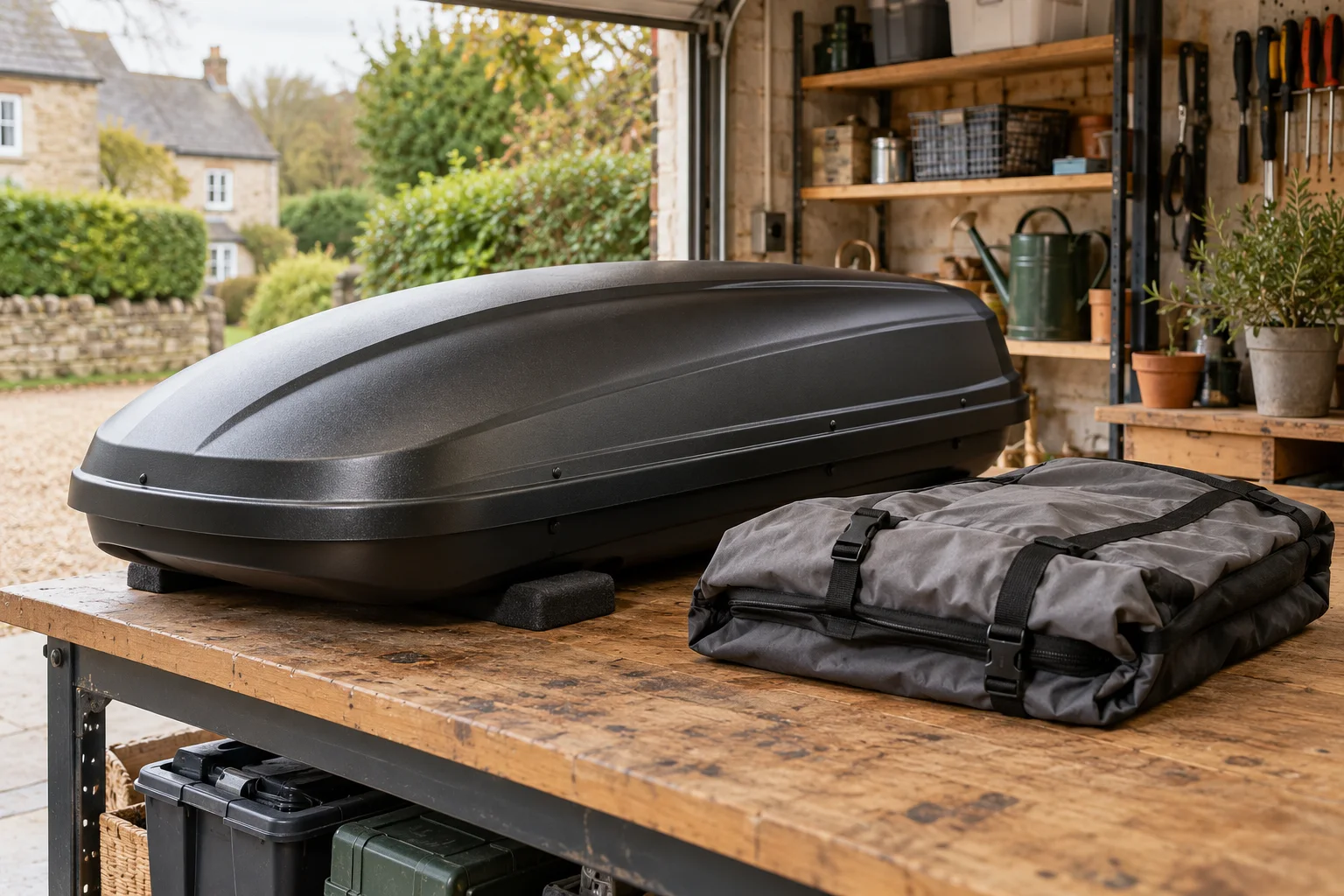
The practical choice
A hard box suits luggage that benefits from a shaped shell and repeatable access. A roof bag can fold away when storage is limited. Choose only a system whose support and attachment method are approved for your exact vehicle; a bag is not automatically suitable for a roof without bars.
Compare the whole carrying method
A hard box and a soft roof bag solve the same broad problem—extra luggage space—but they do not necessarily attach to the car or support their contents in the same way. The shell is only the most visible difference.
Start with the vehicle's permitted carrying arrangement. Check its roof type, restrictions, load allowance and whether suitable crossbars can be fitted. Then read the exact carrier instructions for support, attachment points and load restraint. Do this before considering capacity or price.
A claim that a bag fits “all cars” does not establish permission to put it on your roof panel, panoramic glass or door seals. An anti-slip mat is not proof that a particular contact surface or strap route is permitted. If the vehicle and bag instructions do not give a clear approved method, resolve that with the manufacturers before buying.
Where the practical differences show up
| Decision | Hard roof box | Soft roof bag |
|---|---|---|
| Off-car storage | Rigid shell needs supported space | Can usually fold away; dry and store as instructed |
| Support and attachment | Normally mounts to compatible crossbars | Varies: confirm support surface and exact attachment method |
| Loading shape | Fixed interior with taper and obstructions | Shape depends partly on the packed load; do not overfill |
| Access | Model-specific lid and locking arrangement | Typically zipped or rolled access; check the supplied design |
| Protection | Rigid shell; still check weather and security limits | Fabric, seams and closure need their own checks |
These differences are useful questions, not universal performance scores. A poorly matched box can be less convenient than a well-matched bag, and a folding bag can be unsuitable for a vehicle even when it is physically possible to strap it on.
When a hard box makes sense
A hard shell gives a defined interior and an opening arrangement you can assess before loading. That can suit regular trips, luggage you want to organise in repeatable positions, or a preference for a rigid lid. A lock can deter casual access, but it does not make the contents safe to leave unattended.
Choose the shell around the load. A short box can be convenient for compact bags but unsuitable for long equipment. Check the interior, loading opening and closing path rather than assuming that the shell will protect a case forced under its lid.
A rigid box also needs a realistic home. Measure the storage footprint, supports and handling route. Carrying a box upstairs or through a tight doorway between every trip may change the ownership decision more than a small difference in purchase price.
When a folding bag is worth investigating
A bag can be appealing for occasional use when a rigid shell would be difficult to store. Its folded size and ability to be put away between trips can be practical benefits. The exact installation and permitted support remain the first checks.
Look at how the closure must face, how the packed shape is maintained and how loose strap ends are managed according to the instructions. Check whether loading can be completed without trapping straps in doors or interfering with seals, airbags or controls. Do not improvise a route because the supplied straps appear long enough.
Be precise about weather protection and security
Hard shells, fabric coatings, seams and zips have different possible water-entry points. Product descriptions such as waterproof or weather-resistant need to be understood for the exact carrier and correctly closed arrangement.
Protect moisture-sensitive contents using suitable internal packaging and follow the manufacturer's guidance on closures and maintenance. Check the load after a journey if the conditions or equipment instructions call for it. Neither class of carrier removes the need to pack equipment sensibly.
A roof bag's lock or a box's central lock should not be treated as secure storage for valuables during an unattended stop. Consider what you can take inside with you and whether the luggage can be removed conveniently. Convenience and theft resistance are different questions.
Compare usable space, not two capacity labels
A nominal 400L soft bag is not automatically more useful than a 320L hard box. The bag's final shape depends on the load and support arrangement, while the hard box has a fixed tapered interior. The space occupied by closures, mounts or restraints also matters.
Measure packed bags, then assess the complete arrangement. Rigid cases can be awkward inside either carrier if they create pressure points or prevent a proper closure. Softer luggage may be easier to arrange, but it must not hide restraint points or encourage overfilling.
Include the carrier and fittings in the roof load
For a hard box, include the complete rack, empty box, other roof equipment and contents. For a bag, establish the weight of the exact support and attachment arrangement as well as the bag and luggage. Do not assume the bag's empty weight from a shipping-weight field.
Apply the vehicle and equipment limits according to their definitions. A soft carrier that weighs less may leave more allowance, but it does not raise the car's limit. Roof contact, support suitability and secure attachment remain requirements even for light loads.
Use the load calculator once you have reliable component figures. If weight, support or fit cannot be confirmed, choose another carrying arrangement rather than treating a small load as an exception.
Decide around your actual trips
For frequent use, compare loading access, repeatable fitting and maintenance as well as initial cost. For one holiday, compare a folding option and hiring a suitable box with the practical cost of ownership and storage.
Choose the hard box when its shape, access and approved mounting solve the problem and you have somewhere to keep it. Investigate a bag when folding storage is valuable and you can confirm the exact support and attachment method. Neither choice should depend on a claim of universal fit.
Specifications checked October 2026 using VonHaus product information, the COSTWAY branded listing shown above and Thule’s cargo-box safety instructions. Before choosing the bag, confirm the exact supplied manual and the vehicle permissions.
Frequently asked questions
Can I use a roof bag without roof bars?
Only where the exact vehicle and bag instructions approve the support and attachment method. Broad rackless-fit wording is not permission to load a roof panel, glass roof or door seals.
Is a hard roof box waterproof?
Do not assume complete protection in every condition. Check the exact manufacturer’s description, closures and instructions, and protect moisture-sensitive contents appropriately.
Does a soft bag carry more because it can expand?
No. Keep to the intended shape and loading instructions. Overfilling can affect closure, support and restraint; advertised litres do not establish a safe expanded load.
Can roof-box packing bags go directly on the roof?
No. Ordinary luggage and box-specific duffels are not rooftop carriers. They belong inside a suitable box or another approved storage space.
Which option is better for occasional holidays?
A folding bag may suit limited storage if its attachment is approved. Hiring a suitable hard box can also avoid long-term storage. Compare the full fitting, packing, collection and ownership arrangements.