
Product comparison / Boxes and accessories
Thule Force 3 vs Motion 3: Comparing Equivalent Sizes and Useful Features
Compare Thule Force 3 and Motion 3 in equivalent narrow and XL sizes. Check usable dimensions, empty mass, access, mounting and manufacturer specification differences.
Compare the carrying job before the range name
The useful Force 3 versus Motion 3 comparison starts with two boxes that could carry the same luggage. A narrow Sport box and a full-width XL solve different problems. Comparing their price or litres as though they were direct substitutes hides the roof space, lifting and packing decisions that determine a successful purchase.
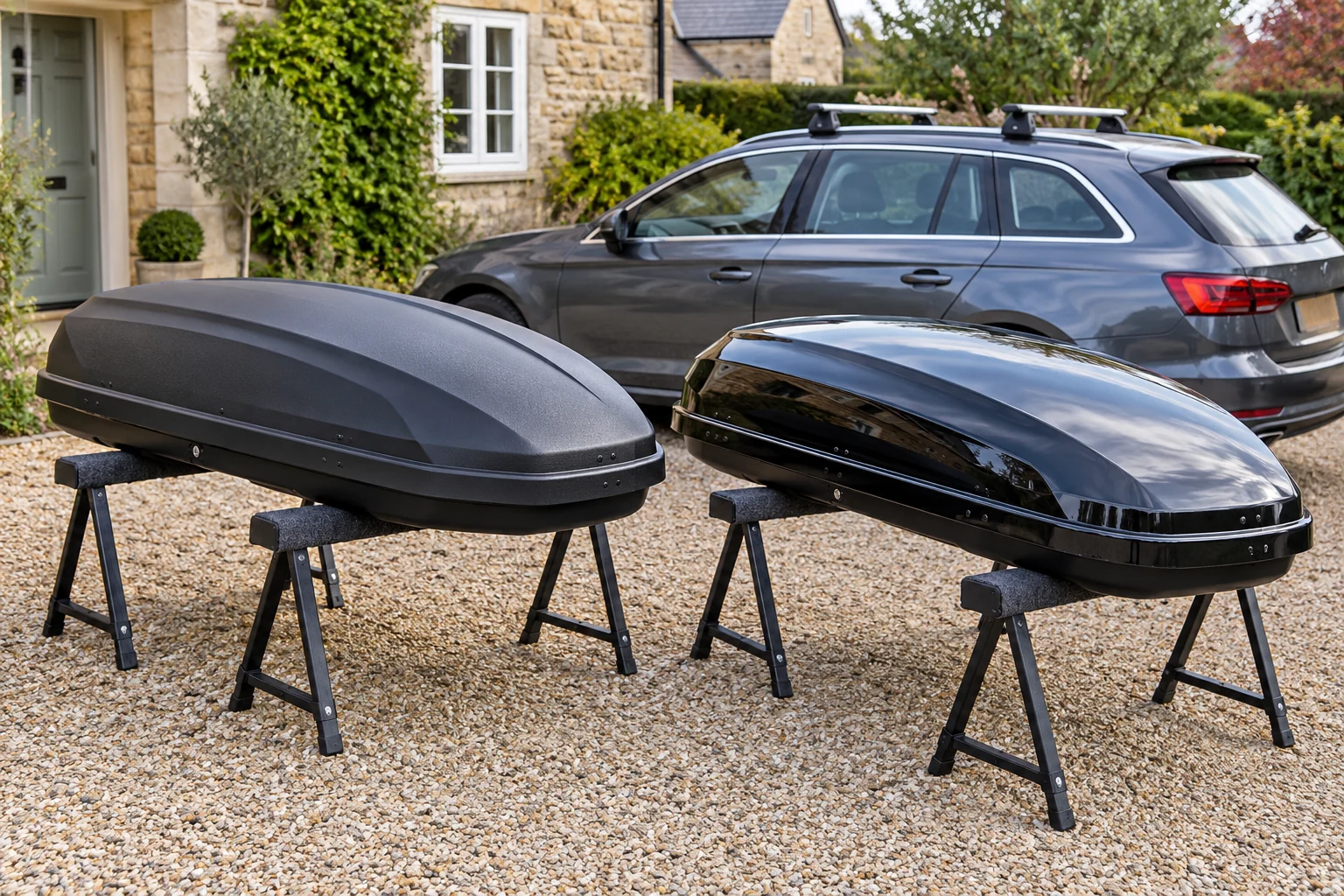
This guide compares a narrow pair with 300L product-page labels, then a full-width XL pair. The figures are published specifications, with differences between manufacturer pages and manuals identified. The hero photograph illustrates the comparison; the shopping cards identify the actual models.
Start with the complete vehicle compatibility checklist. An attractive specification is only useful once your car, bars, mount positions, hatch and load allowance support it.
Narrow pair: Force 3 L Sport and Motion 3 Sport
These are candidates for longer, narrower luggage or a roof layout that might also carry a bike. Neither creates permission for a second carrier. The box’s outside width is only one part of the required space: the bar feet, underside clamps, moving lid and neighbouring equipment all need room.
| Published figure | Force 3 L Sport 645600 | Motion 3 Sport 639600 |
|---|---|---|
| Product-page capacity | 300L | 300L |
| Rounded external size | 191 × 63 × 42cm | 188 × 65 × 42cm |
| Product-page interior | 183 × 51 × 36.5cm | 178 × 50 × 38cm |
| Conservative empty mass | 15.4kg | 15kg |
| Front-clearance reference R | 1265mm | 1244mm |
The current Force family manual lists 312L for L Sport, rather than the 300L marketing label. Motion Sport’s manual interior is approximately 177.4 × 50.1 × 35.2cm, so a rigid bag that depends on the page’s 38cm height needs a physical fit check. Maximum interior dimensions still do not describe every tapered corner or the space occupied by mounts.
Full-width pair: Force 3 XL and Motion 3 XL
These suit a different packing task: bulkier bags distributed across a wider floor. Their similar exterior length does not make the interior, shell height or hatch reference identical. A model called XL in one range is not a promise of the same usable rectangle in another.
| Check | Force 3 XL 645800 | Motion 3 XL 639800 |
|---|---|---|
| UK page capacity | 500L | 490L |
| Rounded page exterior | 215 × 87 × 43cm | 215 × 89 × 43cm |
| Current manual exterior height | 47cm | 42.8cm |
| Page interior | 207 × 75 × 37cm | 203 × 74 × 37cm |
| Manual interior | 207.1 × 74.9 × 37.3cm | 202.4 × 73.6 × 35cm |
| Conservative planning mass | 22kg | 23.2kg |
| Front-clearance reference R | 1347mm | 1324mm |
Force XL’s current manual also lists 515L and 21.5kg. Until the supplied unit is confirmed, use the greater 22kg mass for load planning and do not select it for a tight entrance using only the page’s lower height. Motion XL’s page rounds mass to 23kg; the manual gives 23.2kg. Keep the page and manual figures together when confirming the exact supplied unit.
Mounting still needs a model-specific fit check
PowerClick is a tightening indication within a prescribed installation, not a universal bar adapter. Check bar profile, underside contact, approved spacing and any required T-track hardware in the exact manual. Neither box should be moved beyond its permitted mounting range simply to clear the boot.
The current full-width manuals show a 555–930mm spacing range for the XL models. Vehicle bar positions must also allow it. See bar spacing and box fit for measuring the intersection of those requirements. A shared range does not prove identical clamp clearance on every bar.
Use the manufacturer’s defined R measurement for hatch planning, rather than treating it as a general distance from the windscreen. Then open the hatch carefully in the verified installation and check the spoiler and aerial. The hatch-clearance guide explains that separate measurement.
Calculate what is left for luggage
For an invented example with a 75kg vehicle roof ceiling and a 5kg complete rack, a 22kg box leaves 48kg before any lower component restriction. A 23.2kg box leaves 46.8kg. The difference is 1.2kg of arithmetic, not proof that either car can use the box’s advertised 75kg luggage ceiling.
The roof-load calculator keeps these allowances separate. Include feet, fitting kit and any neighbouring carrier in rack or other-equipment mass. Passengers and boot luggage remain part of the separate vehicle-payload check.
Calculate the differences within each size pair
A range name does not tell you how much extra roof allowance or luggage height a particular size will use. Compare the narrow pair separately from the XL pair, using the same hypothetical car and rack for each calculation.
Inputs and assumptions. 75kg total driving roof allowance; 5kg complete rack; 75kg rack carried-load ceiling; no other roof load. Force L Sport uses 15.4kg; Motion Sport 15kg; Force XL 22kg; Motion XL 23.2kg. These are conservative planning inputs from the page/manual comparison above.
| Pair | Force / Motion shell width | Motion minus Force empty mass | Force luggage ceiling | Motion luggage ceiling | Motion minus Force luggage |
|---|---|---|---|---|---|
| Narrow: 645600 / 639600 | 63 / 65cm | -0.4kg | 54.6kg | 55kg | 0.4kg |
| XL: 645800 / 639800 | 87 / 89cm | 1.2kg | 48kg | 46.8kg | -1.2kg |
The mass comparison reverses between sizes: Motion Sport leaves 0.4kg more calculated luggage than Force L Sport, while Motion XL leaves 1.2kg less than Force XL. There is no single range-wide payload winner.
Keep the source discrepancies visible rather than averaging them. Force XL’s 43cm page height versus 47cm manual height is a 4cm disagreement to resolve before a tight clearance decision. A four-centimetre discrepancy is not extra clearance. The source dimensions and practical loading requirements still decide the shortlist.
Calculation method and sources
Calculated luggage is the smallest vehicle, rack and box allowance. Each pair difference is Motion minus Force for shell width and mass; the luggage difference is the difference between the resulting ceilings. Model-specific mounting and access checks remain outside this arithmetic.
- Force 3 family instructions: PDF pages 14–15: dimensions, spacing, mass and contents limit; model labels must match.
- Motion 3 family instructions: PDF pages 14–15: exact Sport, XL and XL Low rows; maximum dimensions do not describe the whole packing envelope.
- Force 3 XL 645800 UK specification: The page and family manual differ; retain the larger mass and height for preliminary planning.
- Motion 3 Sport 639600: 15kg page mass, 175cm ski maximum and model-specific hatch reference.
Download the inputs and workings (CSV). Source review: October 2026.
Choose from a measured shortlist
Choose the narrow pair when the actual luggage and shared-roof plan need that footprint. Compare the XL pair when a wider interior is useful and the roof mass, handling and clearance remain acceptable. If neither carries the measured luggage without pressing on the lid, change the packing plan or choose another approved shape.
Compare the final basket price, delivery, exact size, returns and spare-parts route on Amazon. Check whether any light, liner or bag is actually included; a family accessory photograph is not a package promise. Use the warranty and ownership checks before ordering, especially where page and manual figures need clarification.
Specifications checked October 2026: Force 3 XL page, current Force manual, Motion Sport page and Motion family manual. Confirm the supplied unit where published figures differ.
Frequently asked questions
Does Motion 3 have SlideLock while Force 3 does not?
Both current ranges list SlideLock, PowerClick mounting and dual-side opening. Advice comparing an earlier Force generation with Motion 3 should not be transferred to Force 3. Compare the exact model numbers and supplied equipment.
Are Force 3 XL and Motion 3 XL the same capacity?
Their UK product pages label them 500L and 490L respectively. The current Force 3 family manual also lists 515L for XL. These differing published specifications need checking against the supplied model; actual luggage shape, clearances and load allowance matter more than a small headline difference.
Which narrow model leaves more room for a bicycle?
Force 3 L Sport has a 63cm rounded external width and Motion 3 Sport 65cm. That difference alone cannot prove a shared fit. Measure usable bar width, feet, clamps, lid travel and the bicycle carrier’s required spacing, then check the combined load.
Is Force 3 XL 43cm or 47cm high?
The UK page gives 43cm while the current linked family manual gives 470mm external height for XL. Confirm the actual supplied unit before buying for a tight clearance; plan with the greater figure meanwhile. Measure installed vehicle height separately because the bar position also matters.
Is the more expensive box guaranteed to use less fuel?
No vehicle-specific efficiency result follows from its price, finish or aerodynamic description. Compare a permitted fit and usable luggage space first. Published fuel or EV-range evidence needs the tested vehicle, setup and conditions; it is not a guaranteed percentage for either selected box.