
Practical guide / Watersports carrying
Carrying a Canoe on Roof Bars: Supports, Position and Restraints
Plan canoe roof transport with approved gunwale supports, load and position checks, main straps, bow/stern lines, controlled lifting and the complete vehicle envelope.
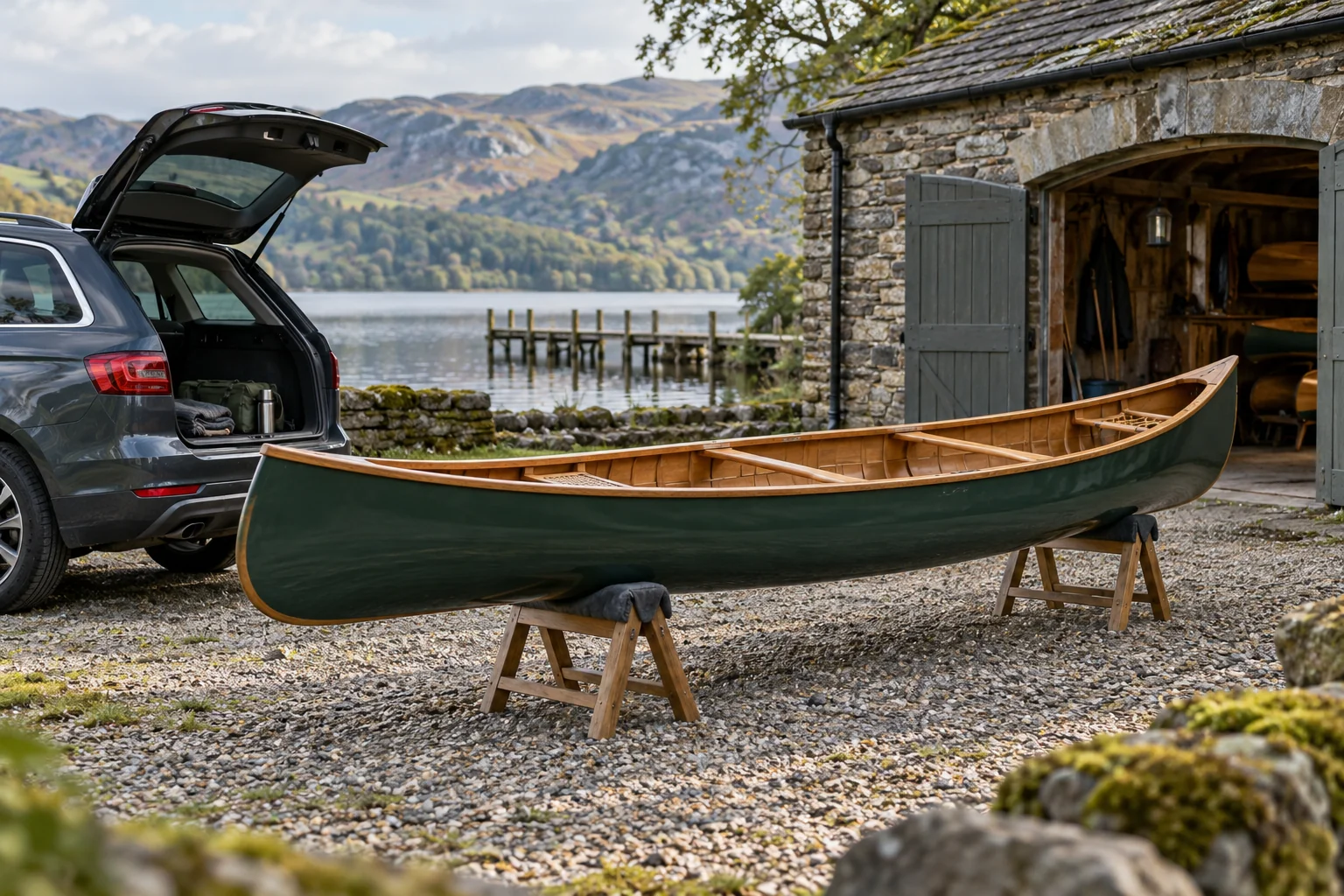
Carry a canoe using the support areas, orientation and restraint arrangement approved for that craft and rack. A padded pair of crossbars is not enough information to choose contact points, and a long boat’s low weight does not remove the need to check its complete travelling envelope.
For a conventional gunwale-support system, start with the canoe maker’s guidance about inverted transport. Record the actual ready-to-travel mass, gunwale construction, hull length and width at the intended supports. Then match those details to the complete vehicle-approved rack.
Establish the permitted gunwale contact
Gunwales are the upper edges of the canoe’s sides. A dedicated system such as Portage positions its padded supports against the approved gunwale areas of an inverted canoe. The contact must suit the actual material, shape and structural condition.
Check for repairs, distortion, damaged wood or loose fittings at the intended support areas. Do not hide a poor contact under additional foam or transfer the load to a seat, thwart or carrying yoke without craft-maker permission.
The correct arrangement can differ for composite, plastic, wood-trimmed and specialist canoes. An online photograph of a similar hull does not approve the support span or pressure points on your boat. Resolve those details before buying supports or tightening straps.
Match supports to the bars and approved positions
Begin with the exact car, roof variant and complete bar system. Use the vehicle-approved mounting positions, then check the canoe carrier’s permitted bar interface and the craft’s required support separation. A long canoe does not justify moving feet outside their prescribed locations.
Position every support as the carrier diagram requires, with full contact and access to its fastenings. Check the bar’s actual usable areas rather than its overall length. Feet, end fittings and other equipment can reduce the available support span.
Do not split a four-support package between two boats or add another maker’s bracket to complete it. The supports, bars, hardware and straps must form an approved arrangement for the one canoe being carried.
Check the canoe’s mass and the complete roof load
Weigh the canoe as it will travel, accounting for fittings and anything the maker permits to remain attached. Remove loose paddles, buoyancy equipment or other kit only according to the craft instructions, then stow them securely elsewhere in the vehicle.
Add the full rack, carrier and any other roof load. For example, a 5kg rack, 1.9kg support system and 30kg canoe total 36.9kg before additional hardware not included in those figures. That arithmetic does not prove the carrier fit or the relevant vehicle and rack allowances.
A 40kg canoe is below the Portage manual’s 45kg figure but above the product page FAQ’s 34.1kg figure. Do not choose the higher statement simply because it allows the purchase. Obtain exact-unit clarification or use another approved arrangement with unambiguous capacity.
Place the canoe without losing support or clearance
Follow the craft and carrier instructions for longitudinal position and balance. Check that the permitted support areas land on both bars with the required separation. A boat’s visual midpoint is not automatically the correct rack position.
Check the complete hull against the hatch, spoiler, aerials and any opening roof panel. Include the canoe’s curve and depth rather than judging only a straight side view. The ends can extend well beyond the bars even where the gunwale contacts are compact.
Plan the full vehicle length and any load projections for the actual journey. Keep required lights, registration and the driver’s view clear, and check applicable route and destination requirements. Do not use the empty car’s dimensions for a covered parking entrance or booking.
Keep main straps and end lines separate
The main straps secure the canoe to its prescribed supports. Bow and stern lines add the required restraint at approved end points. Old Town’s transport guidance, for example, describes two belly straps plus front and rear guide ropes; that is an example to check against the exact craft and carrier, not a universal knot diagram.
Protect the craft and vehicle from buckle contact as the instructions require. Apply the prescribed tensioning method without crushing a vulnerable hull or distorting the gunwales. Do not assume that a ratchet device approved for an end line is permission to use heavy ratchet straps across the canoe.
Use the bow and stern line guide to establish the complete anchor chain. A loop on the car or a carrying handle on the canoe is not automatically suitable merely because a hook can reach it.
Rehearse a controlled loading and unloading routine
Prepare the supports and restraints before lifting. Provide firm, level working space and agree who controls each end. A long canoe can catch the wind and become awkward to turn even where both people are comfortable with its static weight.
Keep the boat clear of unapproved vehicle surfaces. If the intended method involves sliding, verify every contact along that path. A soft-looking trim piece remains a trim piece unless the maker approves it as part of the loading method.
Inspect the final arrangement and plan the return
Check all vehicle-to-rack, carrier-to-bar and canoe-to-carrier interfaces. Confirm the canoe is seated at its approved support points, the main straps follow their prescribed routes, and end lines cannot contact moving or hot parts. Secure loose strap tails as directed.
Measure the loaded vehicle height and follow the pre-journey checklist. Allow for the prescribed checks during the trip; stop safely if any movement or new noise appears.
After paddling, remove loose or retained water and reload according to the same instructions. Keep wet equipment separate and stow it securely. A different return load, extra passengers or kit added to the roof requires the load calculations to be checked again.
Sources and selected Amazon packages checked October 2026: Portage specifications and FAQ, Portage instructions, Old Town transport FAQ, QuickDraw and WaterSlide 839000.
Frequently asked questions
Should a canoe travel upside down on roof bars?
Many canoe-support systems, including the selected Portage arrangement, show an inverted canoe supported at its gunwales. Confirm the exact canoe’s material, gunwale contact and support positions with its maker. Do not apply a general orientation rule to every canoe or use a seat or yoke as an improvised support.
What is the selected Portage 819001 weight limit?
Its specifications and linked manual state 45kg, but the same product page’s FAQ states 34.1kg. Use 34.1kg as the conservative planning ceiling and obtain confirmation for the actual supplied unit before relying on the higher figure. Vehicle and rack limits still apply.
Are bow and stern lines a substitute for the straps over the canoe?
No. The main load straps and required end lines have different jobs. Follow the exact craft and carrier arrangement, and confirm suitable craft points and vehicle anchors. Do not omit a prescribed restraint because another line looks tight.
Can I attach an end line to the canoe’s carrying handle?
Only if the canoe maker approves that point for the intended transport restraint. A handle, a decorative deck fitting or a carrying yoke is not automatically an end-line anchor. Establish the permitted attachment and load path for the actual canoe.
Can I slide a canoe across a rear spoiler with a protective mat?
A mat does not make a spoiler, glass or trim an approved support. Check the complete loading path and permitted contacts. Use controlled help or another approved loading method if the canoe cannot clear the vehicle safely.