
Damage assessment guide / Boxes and accessories
Cracked or Damaged Roof Box: When to Stop Using It and Contact the Manufacturer
What to do after a roof-box crack, impact or damaged mounting point. Record the evidence, obtain manufacturer advice and assess repair or replacement without unsupported DIY fixes.
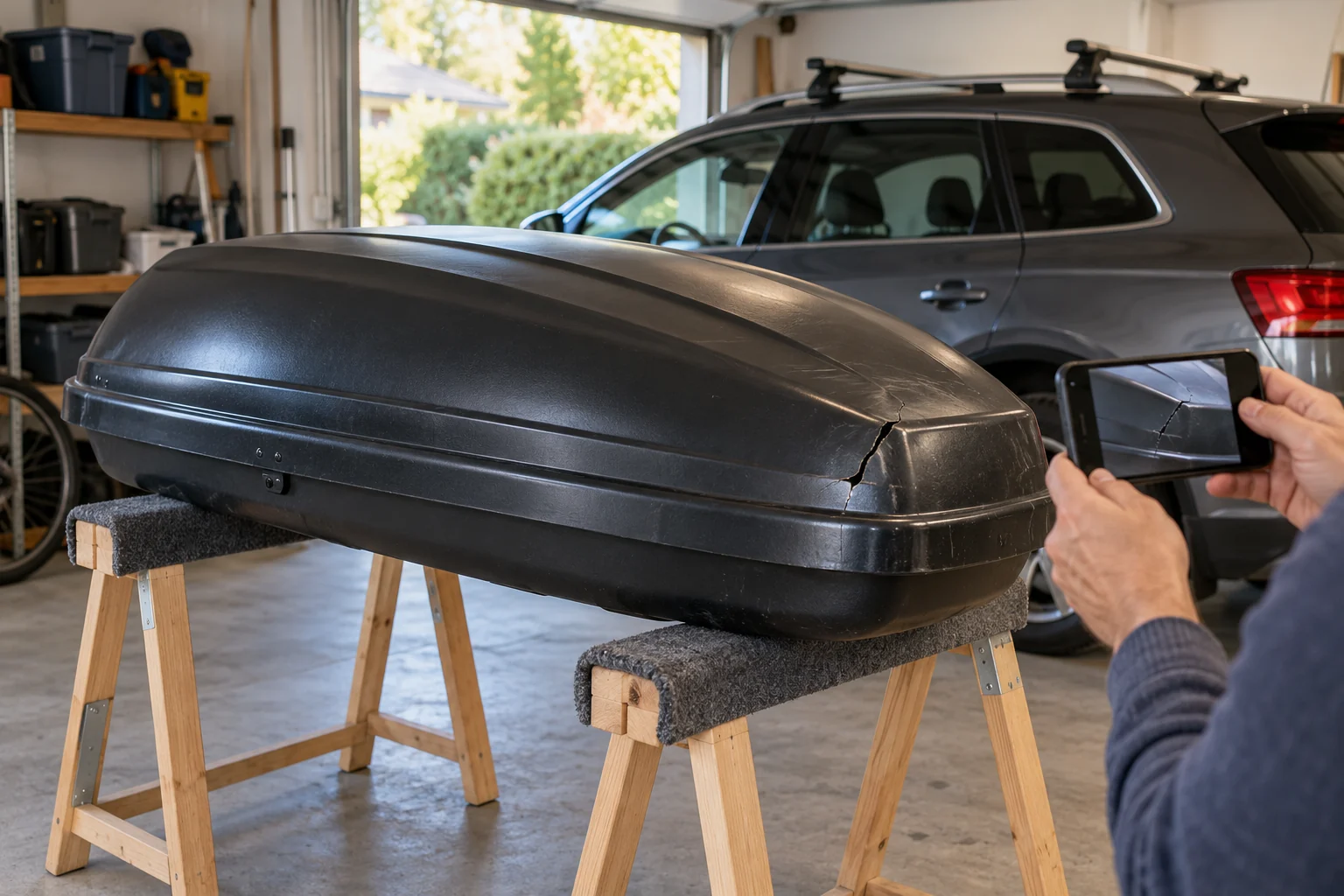
Stop using the box while the damage is assessed
A crack, distorted mount or impact-damaged lid is a reason to pause roof-box use. The important question is whether the complete assembly can perform its intended job, including keeping the shell, lid and load securely attached in travel. Being able to turn the key does not answer that question.
If damage occurs on the road, find a safe place to stop and follow the appropriate road or breakdown assistance advice. Do not try to remove a large box beside moving traffic or continue with a temporary patch because the destination is close. The safe alternative may be assistance, a different vehicle or a changed luggage plan.
Remove the box only where the task can be controlled and its instructions allow safe handling. A damaged assembly can behave differently during lifting. Keep people clear of sharp edges and moving parts, and do not use the damaged box as a work platform or seat.
Record the incident before altering the surface
Take clear photographs showing the whole box, the damage location and the affected area in context. Include accessible identification labels, mounts and the vehicle installation where safe. Record whether the box struck a height barrier, was dropped, fell from storage or suffered an unknown previous impact.
Do not sand, heat, drill or glue the area before seeking advice. Those changes can obscure the original condition and complicate assessment. Avoid repeatedly flexing a crack to show how far it opens; that can extend the damage without providing a useful measurement of remaining strength.
Keep purchase and service records where available. For a used box, say what is known and what is uncertain. An honest incomplete history is more useful than assuming there was no prior impact because the seller did not mention one.
Distinguish appearance from structural function
A light surface scuff can be cosmetic, while a crack near a hinge, mounting floor or reinforcement can affect the structure. There is no universal safe crack length or photograph-based test that applies to every shell material and design.
Look for displaced components, persistent distortion, torn fastening areas or a lid that no longer aligns normally. Do not probe the damage with a screwdriver, press a reinforcement back into shape or test it by adding luggage. Record the observation and let the manufacturer specify the next inspection.
A box may have more than one affected area. An impact at the front can transmit load to mounts and brackets elsewhere, so do not limit the report to the most visible scratch. Equally, avoid claiming hidden damage has definitely occurred; describe the incident so the appropriate assessor can decide.
Inspect the affected carrying system as a whole
After a collision with an overhead obstruction, the roof box is only one part of the review. Bars, feet, fitting kit and vehicle attachment areas may also need assessment. Follow each manufacturer’s instructions; a new shell does not automatically approve reuse of the existing rack.
Record any shifted mount, bent bar, missing fastener or change in door, hatch or roof clearance. Do not move the box back into its previous position and treat the restored appearance as proof that nothing else happened.
The loose-clamp guide covers identifying the interface that moves. The hatch-clearance guide and height-measurement guide help with a later approved installation; they do not clear impact-damaged parts for reuse.
Ask the manufacturer specific questions
Provide the model, size, identification reference, photographs and incident description. Ask whether use must remain suspended, whether a physical inspection is needed and whether the manufacturer supports repair of that location and material.
If a replacement part is proposed, confirm what it includes and how it is installed. A lid, hinge bracket or mounting assembly can be a model-specific part with associated hardware and checks. Do not infer that a part from another size is suitable because the external shape looks similar.
Ask who may perform the work and what confirms completion. A manufacturer-approved service route is different from an unverified online repair method. If the answer is retirement, keep the box out of use and plan an alternative rather than shopping for stronger glue.
Avoid unsupported structural repairs
Resin, fibreglass, plastic welding, drilled stop-holes and metal patches may appear in repair videos. Their appearance alone does not establish the material match, strength, fatigue behaviour or effect on the original design. This guide does not prescribe them for a travelling roof box.
Tape may hide an opening without restoring the shell’s load-bearing function. Exterior straps can also introduce unapproved forces and do not replace the prescribed mounts and locks. Do not use either as evidence that a cracked box is safe for a short trip.
Keep water protection separate from structural condition. A bag inside may protect clothes from ordinary moisture, but it cannot secure a damaged lid or floor. Use the water-ingress guide only after recognising any damage-related stop-use concern.
Compare authorised repair with replacement
Consider the approved repair cost, spare availability, condition of the remaining components and the actual luggage requirement. A repair quote should be assessed as a complete route back to permitted use, rather than the price of one visible component.
If replacement is necessary, start the fit check again. A new box can have different mass, clamp range, hatch clearance and usable space even at the same advertised capacity. The existing-bars upgrade guide explains what must be rechecked.
Do not let a sale price decide whether old bars are retained after an impact. A replacement box’s 75kg luggage ceiling also does not enlarge the car’s roof allowance. Use the load calculator with the actual approved new equipment masses.
Keep warranty and disposal decisions separate
A warranty claim concerns the applicable terms and circumstances; it is not permission to continue using damaged equipment. Keep the product and evidence available while the manufacturer considers the request, following any handling instructions it gives.
If the box is retired, ask the manufacturer and local waste service about appropriate disposal for its materials and size. Do not label removed structural parts as serviceable without an approved assessment. If transferring damaged equipment for another purpose, disclose its condition accurately and avoid a roadworthy claim.
For the replacement setup, review storage support and actual loaded height to reduce avoidable repeat damage. A visible height reminder inside the car and a checked route are useful habits, but they complement careful driving and do not guarantee clearance at every entrance.
Sources checked October 2026: Thule roof-box safety, Force 3 instructions, Motion 3 maintenance instructions and manufacturer support. Inspection and manufacturer assessment govern reuse; no structural repair recipe is offered.
Frequently asked questions
Can I drive with a small crack in a roof box?
Do not judge continued use from crack length alone. Location, attachment points, hidden damage and the impact history matter. Stop using the box and obtain the manufacturer’s assessment before another journey; tape over the crack does not establish safety.
Can I repair the shell with fibreglass, resin or plastic welding?
This guide does not prescribe structural repairs. Material, thickness, reinforcement and load paths vary, and a neat-looking patch does not prove roadworthiness. Ask the manufacturer whether an approved repair exists and who may carry it out.
Does a scratch mean the box must be replaced?
A superficial mark and structural damage are different, but a photograph cannot always distinguish them. Record the mark and any impact history without flexing or sanding it. Ask for assessment if it is deep, spreading, distorted or near a structural attachment.
Should I check the bars after hitting a height barrier?
Yes. An impact can involve the box, mounts, bars, feet and vehicle attachment areas. Do not clear the whole setup solely because the shell still closes. Follow the relevant manufacturers’ assessment routes for every affected component.
Can I sell a damaged box for someone else to fix?
Do not describe it as usable or roadworthy without an appropriate assessment. Disclose damage and history accurately, and follow the manufacturer’s advice on retirement and disposal. Keep unverified structural parts out of an assumed serviceable spares supply.