
Comparison / Bikes and sports equipment
Wheel-Holding vs Frame-Clamping Roof Bike Racks
Compare wheel-holding and frame-clamping roof bike racks by contact points, mudguards, wheel sizes, lifting and roof weight, with relevant Amazon products.
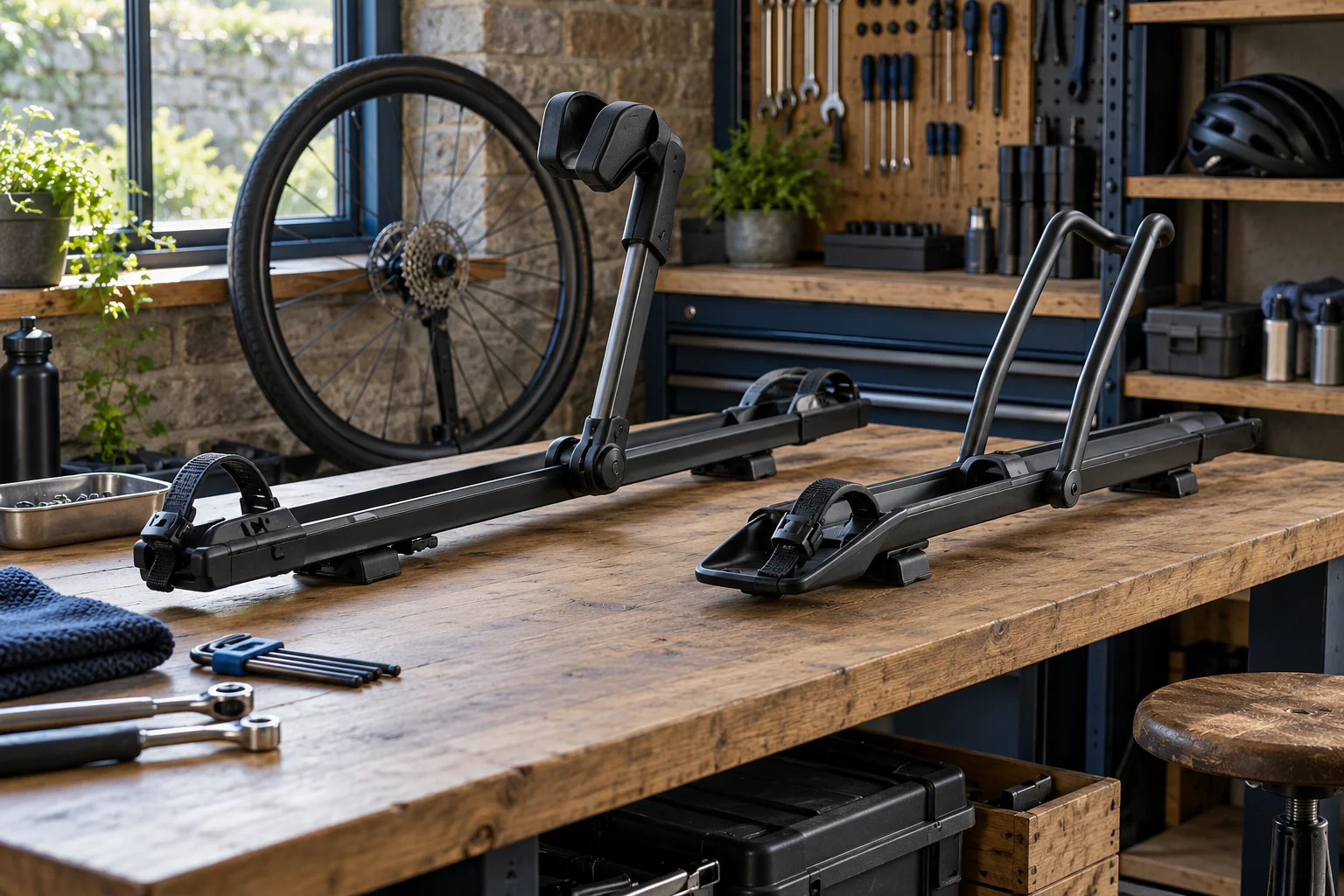
Start with what may touch the bike
A wheel-holding rack avoids a frame clamp, while a frame-clamping rack needs an approved tube contact point. Both still have wheel, tyre, wheelbase and weight limits. Mudguards, carbon parts and loading reach can settle the choice before price does.
Compare the whole holding arrangement
These names describe the main stabilising method, not the only points touching the bicycle. A frame-clamping rack normally also secures the wheels. A wheel-holding rack may press on the front tyre and retain the rear wheel with a strap. Read the complete attachment sequence so you know which components carry, stabilise and restrain the bike.
First ask the bike maker which contact methods it permits for your exact model. Then inspect the carrier instructions for the corresponding surfaces and dimensions. An aluminium bike can still have carbon wheels or a carbon fork; a material label on the frame does not describe every component the carrier will touch.
Frame clamping suits some conventional bikes well
For a permitted frame tube within the jaw range, this arrangement keeps the front wheel fitted and gives a familiar loading routine. You position the wheels in the tray, support the bike as instructed and close the frame arm before completing the wheel restraints. Access to the correct tube matters more than whether the bike looks conventional from the side.
Check the tube’s cross-section where the jaws will close, rather than measuring an easier point somewhere else. Cables, hydraulic hoses, integrated batteries, bottle cages and suspension linkages can obstruct that contact area. Do not move the clamp to a convenient but unapproved tube or tighten it harder to compensate for an imperfect fit.
Wheel holding removes one contact point, then adds other checks
Avoiding the frame tube can help with unconventional shapes or a frame maker’s clamp restriction. It does not make every wheel acceptable. Identify the front-wheel retaining position and the rear strap’s contact area, then check the wheel and bicycle guidance for those loads. Deep rims, unusual tyres and removable accessories deserve particular attention.
Measure wheelbase between axle centres with the bicycle assembled for travel. Use the actual tyre width and wheel diameter rather than assuming the bike’s marketing category establishes the dimensions. A fatbike adapter addresses a named dimensional issue; it does not increase the load rating or establish rim and mudguard compatibility.
Treat mudguards as a fit question
A front mudguard can sit exactly where a wheel hook needs direct tyre contact. The UpRide manual illustrates this conflict. Do not close a hook over the mudguard, crush a stay or move the retaining arm to an improvised position. The wheel may appear secure while the mechanism is bearing on a part not designed for that load.
If the bicycle maker permits mudguard removal, consider whether doing so is realistic before every trip and whether all removed parts can be restored correctly. Otherwise choose a carrying method that accepts the complete bike. A frame-clamping or fork-mounted design may be worth investigating, but each needs its own compatibility check.
Use a comparison worksheet
Record a result for each candidate before deciding which features are convenient. A missing measurement is an unresolved question, not a tentative pass.
| Check | Frame-clamping candidate | Wheel-holding candidate |
|---|---|---|
| Main permission | Frame tube may be clamped | Wheels and tyres accept specified support |
| Obstructions | Cables, cages, battery or linkage | Front mudguard, tyre accessories, rim details |
| Dimensions | Tube range plus wheel limits | Wheel diameter, width and wheelbase |
| Practical operation | Reach frame arm and wheel straps | Reach front holding arms and rear strap |
| Common requirement | Exact bike limit and approved bar mounting | Exact bike limit and approved bar mounting |
Keep photographs and dimensions for your own reference, but use written instructions to establish approval. Ask the maker a focused question about the exact contact area if the bicycle manual does not answer it. “Will it carry a road bike?” is less useful than a model, wheel specification and description of the proposed restraint points.
Compare lifting and the roof-load budget
A lighter carrier can leave more capacity for other equipment, but cannot make an overweight bicycle compliant. ProRide and UpRide each have an individual 20kg bike limit. A 22kg travelling bike fails that limit on either carrier even if the vehicle roof has capacity remaining.
For a hypothetical 14kg bicycle, a 5kg complete vehicle rack and one carrier, the totals are 23.2kg with the 4.2kg example and 26.7kg with the 7.7kg example. That 3.5kg difference matters when another bike or a box shares the roof. Use the load calculation guide for the separate vehicle and rack checks.
Also compare how long you must hold the bicycle upright while reaching a control. Practise beside the actual vehicle on stable ground. If you cannot control the bike throughout the loading sequence, a compatible rack on paper is not a workable choice for that journey.
Look at a fork mount when both upright methods fail
A fork-mounted carrier avoids a down-tube clamp and a front wheel-holding hook. It introduces different requirements: permitted fork transport, a matching axle interface, front-wheel storage and correct reassembly. It is a separate option to assess rather than a universal solution to carbon or mudguard restrictions.
Finish the decision with the bike rack buying guide and, where relevant, the carbon contact-point guide. Recheck the choice when wheels, mudguards or other bicycle components change.
Sources checked October 2026: ProRide manual, UpRide manual and FastRide specifications.
Frequently asked questions
Is a wheel-holding rack always better than a frame clamp?
No. It avoids a frame-tube clamp but can conflict with mudguards, tyres, wheel construction or wheelbase. The better option is the one explicitly compatible with your actual bicycle and roof system.
Can UpRide hold a bike with a front mudguard?
Its manual shows a front mudguard as unsuitable because it obstructs the wheel holding arrangement. Do not trap the mudguard under a hook or move the hook to an unapproved contact point.
Does a torque limiter make a frame clamp suitable for carbon?
No. It controls the specified carrier operation, but the bike maker still needs to permit the contact method. Thule’s required protector and carrier instructions cannot override a frame maker’s prohibition.
Why does the weight of the empty bike rack matter?
It uses some of the car’s driving roof allowance before you add the bicycle. Count the complete vehicle rack, each carrier and every bike, plus any box, luggage and separate adapters.
What if neither mounting style fits my bike?
Consider an approved fork-mounted or alternative vehicle carrying system. Check the new method independently rather than adapting an incompatible frame or wheel holder with extra padding, straps or improvised hardware.