
Choosing a roof box / Size and capacity
What Size Roof Box Do You Need? Capacity, Luggage and Practical Fit
Choose roof-box capacity around your actual luggage. Compare shapes, packed dimensions, weight allowances and storage before ordering.
Start here
Choose the smallest box that comfortably carries the luggage you cannot sensibly put inside the car, while meeting the vehicle, rack and box limits. Litres help you shortlist; the packed shape of your bags decides whether the space works.
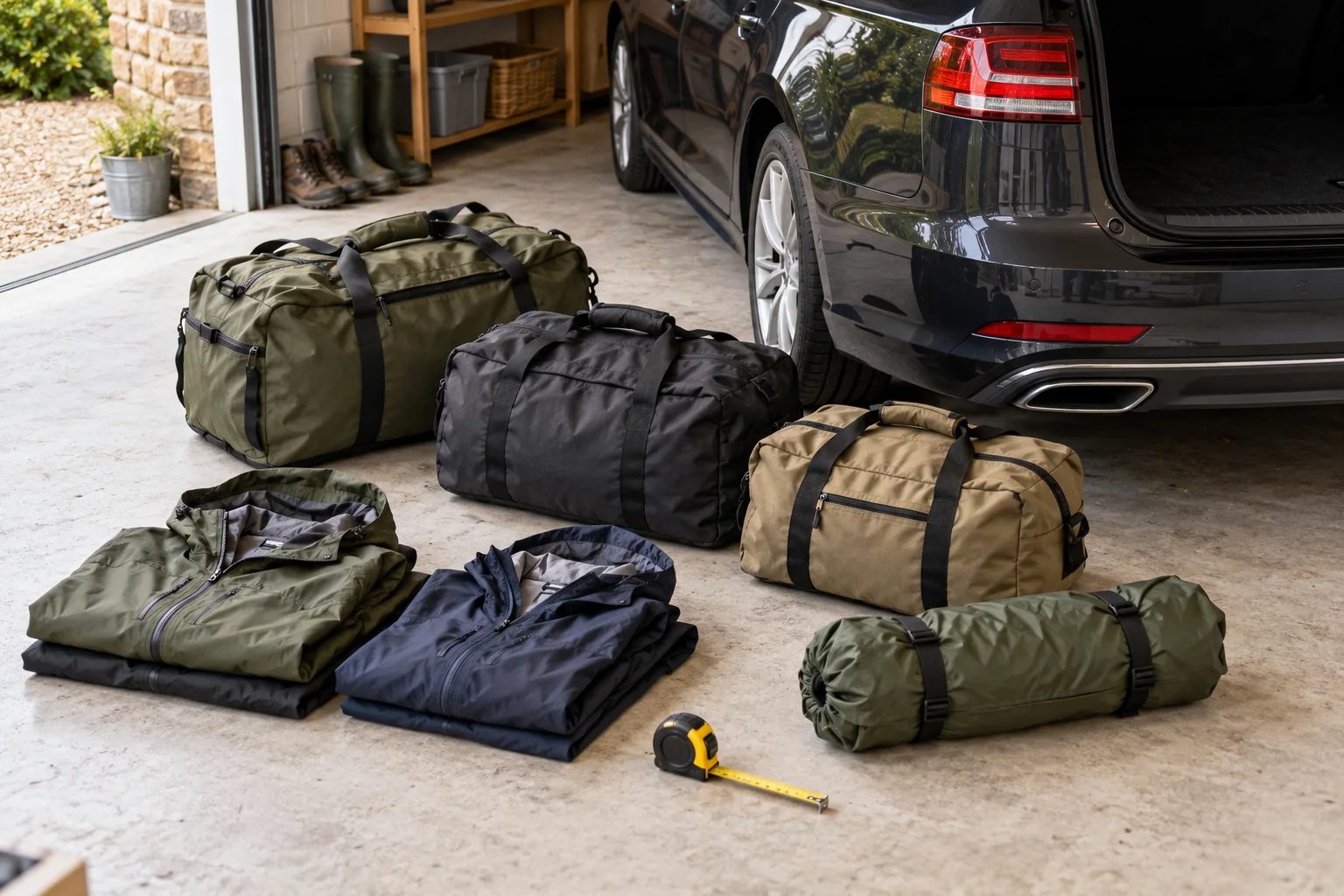
Start with the luggage that needs to go upstairs
A roof box is most useful when it solves a particular space problem. That might be a tent bag that fills the boot, bulky clothing for a winter trip, or soft luggage displaced by a dog crate. Start with that load, rather than a rule about litres per person. The same family may need very different boxes for a weekend in a cottage and a camping holiday.
Pack the actual bags you intend to use. Put the items that will remain in the cabin or boot to one side, accounting for the vehicle's payload and secure storage there too. Lay out the remaining bags and note which must stay upright, which can change shape and which need protection from other equipment. A large empty duffel tells you very little about the dimensions it will have once filled.
Make a short inventory with packed length, width, height and weight. Include wheels, handles and protruding buckles on rigid items. For long equipment, record the overall packed length rather than just the length of its main component. This inventory is more useful than somebody else's claim that a particular capacity is enough for four people.
Use capacity bands as a shortlist, not a packing promise
Boxes around 300 litres can be useful for compact luggage or a narrow roof layout. A larger box gives more room for bulky bags, but capacity alone cannot tell you which items will fit. Compare a short, wide shell with a longer, narrow shell before moving up a capacity class.
| Example | Marketed capacity | External shape | Useful question |
|---|---|---|---|
| VonHaus 320L | 320L | 132 × 78 × 35cm | Are the bags short enough for its interior? |
| Force 3 L Sport | 300L | 191 × 63 × 42cm | Can the load work within a narrow box? |
| Motion 3 XL | 490L | 215 × 89 × 43cm | Does bulky luggage justify its size and empty weight? |
These examples are different shapes, not three consecutive upgrades. The VonHaus has a published 122 × 69 × 33.5cm interior, while the Force has a much longer, narrower interior. A bag could fit one shape and fail the other even though their capacity labels are close. Use the internal-dimensions guide when a suitcase, tent or sports bag is a tight fit.
Check length, width and height in the right order
Begin with your least flexible item. A rigid case that is too tall under the lid will not become suitable because the box has spare volume beside it. Lay that item in the proposed orientation, then add the other bags around it. Keep mounting housings, restraint points and the lid's closing path clear.
Published internal dimensions are usually maximum measurements. A rounded nose and sloping lid leave less room towards the ends and sides. Do not draw a full rectangular cuboid using the three maximum dimensions and assume that every corner is available. If the fit is close, ask for the manufacturer's dimension drawing or arrange a physical packing check with the exact box.
Allow for the loading opening as well. A bag may be smaller than the longest internal measurement but too awkward to pass through the opening and turn into position. This is especially relevant to long rigid cases and boxes mounted on tall vehicles.
Decide whether the roof must carry anything else
A broad box may take the luggage easily and still be the wrong choice if you also want a bike carrier. Compare the complete layout: approved usable bar width, the box's mounts, the bike carrier's mounts and the space needed to open and load both accessories.
The narrow Force 3 L Sport is one possible starting point, not a guarantee of a shared layout. Its product-page width is 63cm, and its published interior is only 51cm wide. A large suitcase can become the limiting item even when the external roof arrangement looks promising. Read the narrow-box buying guide before buying equipment separately.
Calculate the luggage allowance before choosing a bigger box
A box's luggage rating is not the amount every car can carry. The vehicle roof allowance has to cover the complete rack, the empty box, other roof equipment and the luggage. The rack and box may impose lower limits too.
For an illustrative 75kg vehicle roof allowance, a 5kg complete rack and a Motion 3 XL planned at 23.2kg leave 46.8kg under the vehicle calculation. That result still has to satisfy the rack's definition of capacity and the box's own luggage limit. A bigger shell does not increase this allowance.
Weigh the intended luggage and use the roof-load calculator with verified vehicle and equipment figures. If you run out of weight allowance before space, compare a lighter suitable box or reduce the load. If you have weight allowance left but the bags will not fit, changing their shape or choosing a better interior layout may help more than chasing litres.
Compare soft bags with the cases you already own
Soft bags can adapt to a tapered interior more easily than hard suitcases, provided you do not overfill them. They still need to be restrained and kept clear of mounts and locks. Buying a matching bag set is optional; first measure the bags you already have.
Keep the equipment needed at overnight stops easy to identify. If one person has to empty half the box to reach a wash bag, a large capacity has not necessarily produced a convenient setup. A trial pack at home shows whether the arrangement works for your journey.
Include the car and your home in the size decision
Check hatch opening, approved bar position, box-to-bar spacing and the total fitted height. A shorter car does not automatically require a short box, and a large car does not automatically have a generous roof allowance. Those answers come from the exact vehicle and equipment instructions.
At home, measure a storage space for the entire shell and the route used to reach it. A 215cm-long box needs more than a theoretical rectangle drawn behind a garage door. Consider lifting help, padded support and the clearance needed to manoeuvre it. If you have nowhere suitable to keep a hard box, compare hire and ownership before ordering.
If the remaining obstacle is where to keep a rigid shell, compare roof boxes with soft roof bags. The bag's own attachment and support permissions still matter; a flexible shape does not establish that it can sit directly on your car's roof.
Make the final choice with a trial layout
- List and weigh the actual packed luggage that needs roof space.
- Compare the largest items with the interior drawing and loading opening.
- Check whether another roof carrier will share the bars.
- Verify the complete load allowance, hatch clearance and fitted height.
- Confirm the mounts and a realistic off-car storage arrangement.
Our main roof-box comparison explains three contrasting starting points. This guide uses manufacturer figures from VonHaus, Force 3 L Sport and the Motion fitting instructions. Specifications checked October 2026. Manufacturer page and manual differences should be resolved for the supplied unit before relying on a close fit.
Frequently asked questions
Is a 300-litre roof box enough for a family?
It can be enough for a compact load, but the number of travellers does not establish the capacity needed. Measure and weigh the luggage that will actually go on the roof, then check its packed layout.
Should I buy the biggest roof box that fits the bars?
Only if the extra space is useful and the complete setup meets the load, clearance and storage requirements. A large shell can consume weight allowance and make handling harder without solving your particular packing problem.
Can I put normal suitcases in a roof box?
Yes, when their packed dimensions, loading route and restraint arrangement work. Include wheels and handles, check the sloping lid and never force the box closed over a case.
Does the box capacity include the weight of the roof bars?
Litres describe volume. Weight limits are separate: the vehicle roof allowance normally has to account for the complete rack, box and load, using the definitions in the relevant instructions.
What should I measure first?
Start with the largest or least flexible packed item. Then check the remaining luggage, interior taper and loading opening before completing the vehicle, rack, hatch and height checks.