
Measurement guide / Roof bars and compatibility
Roof Bar Spacing for a Roof Box: Checking the Permitted Range
Measure crossbar centres and compare vehicle-approved positions with the exact roof box range. Includes worked examples, model figures and mismatch checks.
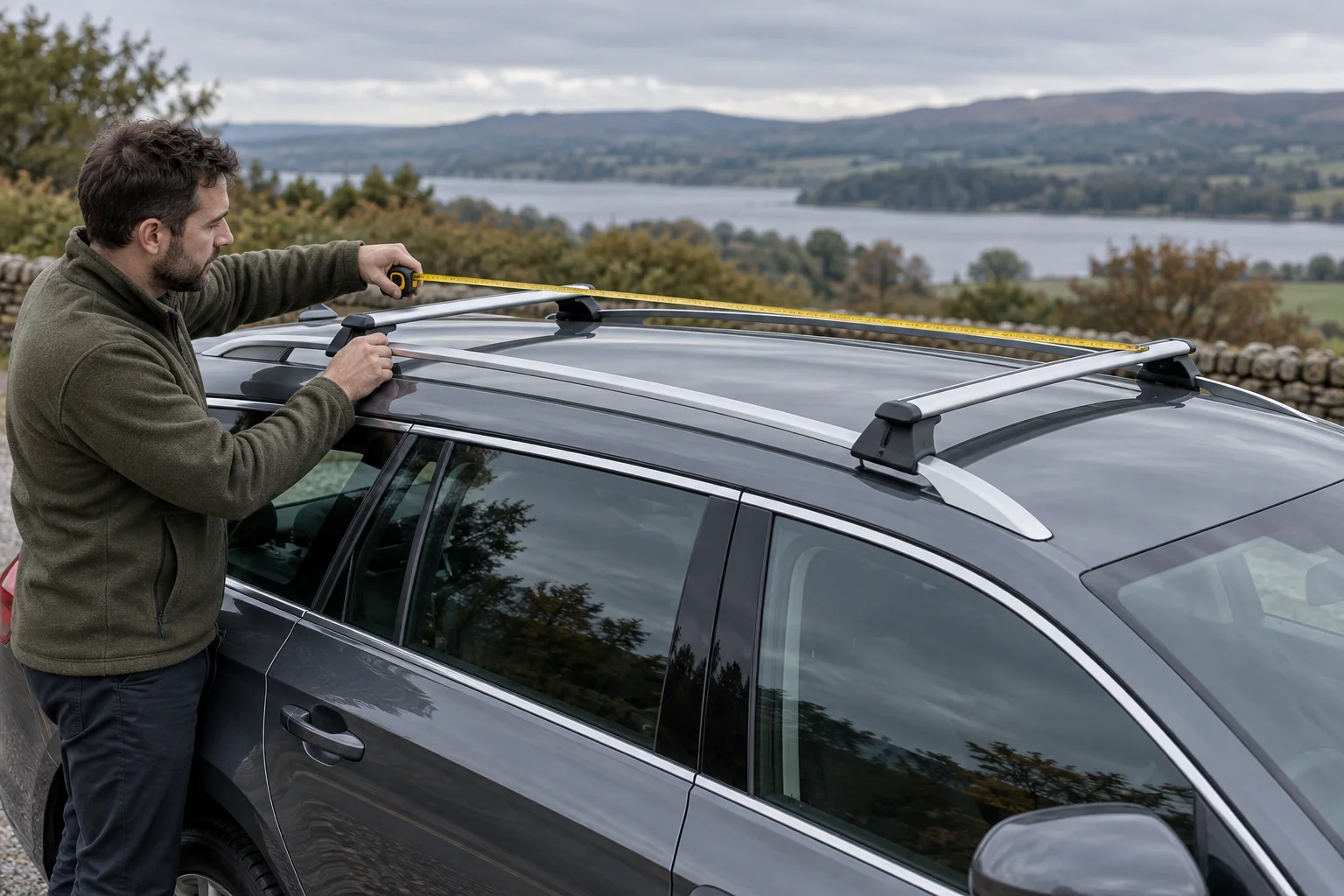
Use bar centres and overlapping permissions
Measure front-to-rear crossbar spacing centre to centre, following the exact box diagram. That spacing must satisfy the vehicle’s approved rack positions, all applicable rack instructions and the box’s permitted range. A box’s maximum adjustment is a boundary, not permission to move the bars anywhere on the roof.
Understand the three sets of instructions
The vehicle and its fitting kit establish where the rack may attach. The rack instructions govern the assembled bars and any general spacing requirements. The roof-box instructions give the mounting range for that exact shell and hardware. A usable position has to satisfy all of them together.
This distinction matters on fixed-point cars and naked-roof clamp systems, where a prescribed location may leave little choice. Raised rails can appear more adjustable, but the maker may still specify a mounting zone or other limits. An open stretch of rail is not permission to clamp anywhere along it.
Start with the exact car, roof option, rack components and box model. Download the current supplied instructions and record which measurement each diagram uses. Do not mix a vehicle-fitting distance measured from a door edge with the box’s bar-centre spacing: they are different dimensions that serve different purposes.
Measure from crossbar centre to crossbar centre
With the rack in its approved position, identify the longitudinal centre of each bar and measure the separation along the vehicle. Follow the box diagram’s method. Avoid measuring diagonally, between the nearest bar edges or between left and right feet across the roof.
For a simple hypothetical example, two bars each 80mm wide along the car with a clear edge-to-edge gap of 620mm have centres 700mm apart: 620 plus half of each bar’s 80mm width. A direct centre measurement is preferable; the example shows why the visible gap alone gives the wrong result.
Measure at corresponding points and check both sides if the instructions require it. Resolve skew or an uncertain reference before interpreting the result. Use stable access and protect the vehicle; do not rest a tape on glass or stand on trim to reach the far bar.
Compare exact box ranges rather than a generic number
| Selected box | D min to D max | What the range does not establish |
|---|---|---|
| Force 3 L Sport / 645600 | 555–930mm | Permission to move bars outside the vehicle fit |
| Motion 3 Sport / 639600 | 555–930mm | Bar-profile or hatch-clearance compatibility |
| Motion 3 XL / 639800 | 555–930mm | Approval for every car with a spacing in this range |
The range belongs to the exact mounting system and model. An older box, different generation or alternative adapter can have different instructions. Do not transfer the numbers because the shell looks similar or the retailer describes all the products as quick fit.
If the supplied manual differs from the information you planned around, stop and resolve the model or revision before fitting. It is better to discover that mismatch while the box is still returnable than to treat the wider of two ranges as convenient permission.
Find the overlap in a worked example
Imagine a hypothetical approved rack arrangement that allows 700–800mm centre spacing, a box that permits 555–930mm and no other tighter applicable restriction. Their numerical overlap is 700–800mm. That does not mean every point within the interval is automatically suitable: any prescribed positions, clamp clearance and other instructions still apply.
Now imagine a fixed-point arrangement producing 980mm centres with that same box. The box’s 930mm maximum is exceeded. The setup has no numerical overlap. Moving the feet away from the designated points or drilling a new mounting hole in the shell is not a remedy.
A third example is a rack fixed at 650mm with a box range that includes it. The box number alone looks acceptable, but the complete rack guidance still needs checking. If another applicable instruction requires a different spacing and the vehicle instructions do not resolve it, ask the maker before proceeding. Do not decide which booklet to ignore.
Find the overlap before choosing a bar position
A box can accept the spacing while a second applicable restriction rules it out. Checking the intersection of all ranges exposes that problem before anyone moves a vehicle-specific foot.
Inputs and assumptions. The named Force/Motion box examples permit 555–930mm centres. Vehicle ranges, fixed points and the additional 700–900mm accessory range in this worksheet are hypothetical. An interval describes numerical overlap, not permission to choose arbitrary bar positions.
| Vehicle arrangement | Box range | Other assumed restriction | Numerical intersection | Why the result matters |
|---|---|---|---|---|
| 650–850mm permitted range | 555–930mm | 700–900mm | 700–850mm | 150mm intersection; exact authorised positions still needed |
| 500–600mm permitted range | 555–930mm | 700–900mm | None | Greatest lower bound 700 exceeds upper bound 600 |
| Fixed 580mm | 555–930mm | 700–900mm | None | Box number passes; the other range fails |
| Fixed 700mm | 555–930mm | 700–900mm | 700mm only | Numerically common, not a complete fit result |
| Fixed 980mm | 555–930mm | None | None | 50mm beyond the box maximum |
The first arrangement has 150mm of mathematical overlap, not 375mm from the box range alone. In the fixed-580mm example, buying a box that includes 580mm still cannot satisfy the assumed second accessory.
Do not solve an empty intersection by shifting a fixed-point foot, omitting an instruction or modifying the box. Choose equipment with a compatible approved arrangement. Keep centre spacing distinct from the visible edge gap between wide bars.
Calculation method and sources
The lower intersection is the greatest lower bound; the upper intersection is the smallest upper bound. If lower exceeds upper there is no common value. For fixed positions, check membership in every range. Separately follow prescribed kit positions, profiles, clearances and fitting instructions.
- Force 3 family instructions: PDF pages 14–15: dimensions, spacing, mass and contents limit; model labels must match.
- Motion 3 family instructions: PDF pages 14–15: exact Sport, XL and XL Low rows; maximum dimensions do not describe the whole packing envelope.
- Thule roof-rack safety guidance: Exact vehicle-kit positions and applicable accessory instructions take precedence over general spacing advice.
Download the inputs and workings (CSV). Source review: October 2026.
Understand why “70cm” is not a universal answer
General rack guidance can include a default spacing where no special mounting positions are specified. Thule’s general safety booklet refers to aiming for at least 700mm in that situation. It also contains other load-specific requirements. That conditional guidance is not a replacement for the exact vehicle kit or a rule that every roof box must be installed at 700mm.
Read the complete relevant instructions together. A prescribed vehicle position may need specific clarification rather than adjustment to a remembered default. If the documents appear inconsistent, obtain an answer for the actual car, rack and box. A forum recommendation for another setup cannot resolve the conflict.
The same caution applies to the widest available setting. Maximum spacing in a box table defines the end of a permitted range; it is not a recommendation to move bars apart until they reach it. Follow the complete system’s location and loading instructions.
Check the bars and a second box example
Consider the available mounting width across the bars as well. The feet can obstruct a clamp at a chosen side-to-side position, especially with a box beside a bike. Longitudinal spacing, lateral mounting width and total bar length are three different measurements; passing one does not answer the others.
Recheck clearance after any approved repositioning
Moving the front bar within a permitted range can change hatch clearance and the box position. Moving the rear bar can change clamp engagement or support. Repeat the complete hatch and spoiler check after any adjustment rather than keeping a measurement from the earlier layout.
Inspect the lowest parts of the mounts above the roof and any glass. Check antennae, lid operation and access to all controls. If a T-track adapter is proposed, use only the exact approved conversion and its instructions; changing the interface does not automatically extend the box’s longitudinal range.
Secure the box using the specified sequence only after the positions are confirmed. A tightening click or a closed lever cannot prove that a bar lies within the correct mounting area. Inspect every required fitting and follow the maker’s security checks before loading.
Resolve a mismatch before purchase or travel
If the measurement fails, first confirm the reference points, units and exact model table. Then check whether the manufacturer offers a documented alternative rack arrangement, accessory adapter or box. Any alternative must satisfy all the original vehicle permissions and its own instructions.
Keep a record of the final bar centres, vehicle positioning references and approved component codes. Recheck after removal and refitting, changing vehicles or replacing rack parts. Finish with the load calculation and complete fit checklist; correct spacing is essential, but it is only one part of a usable carrying setup.
Measurements and guidance checked October 2026 against Force 3 fitting tables, Motion 3 fitting tables and Thule rack safety guidance. Follow the actual vehicle kit and supplied model instructions.
Frequently asked questions
How is roof-bar spacing measured for a roof box?
Use the centre-to-centre distance between front and rear crossbars along the car, following the exact diagram. Do not measure between the nearest edges or between the left and right feet.
Is 70cm the correct spacing for every roof box?
No. Vehicle-specific positions, general rack instructions and the exact box range all apply. A commonly quoted number does not override prescribed locations or establish a compatible arrangement.
What if fixed roof points are outside the box range?
Do not relocate factory points or drill the box. Confirm the measurement and exact model instructions, then choose a documented approved alternative or a box that supports the available arrangement.
Can a T-track adapter fix the wrong bar spacing?
Only if the exact approved adapter instructions explicitly change the permitted arrangement. A different attachment interface does not automatically extend the roof box’s longitudinal mounting range.
Should I use the widest spacing the box permits?
Use the positions prescribed or allowed for the complete vehicle and rack system and the box instructions. A maximum box figure is a boundary, not a universal preferred setting.