
Buying guide / Bike carrying
Fork-Mounted Roof Bike Racks: Quick Release, Thru-Axles and Adapters
Compare fork-mounted roof bike racks, quick-release and thru-axle interfaces, FastRide and TopRide limits, adapter packages and storage for the removed front wheel.
Quick answer
Choose a fork mount from the bike maker’s permission, exact axle and dropout geometry, then check bike weight, wheelbase and bar attachment. FastRide and TopRide both have an 18kg bike ceiling. TopRide changes the docking routine; it does not remove the lifting or fork checks.
Two fork-mount routines to compare
Jump to the full specs table ↓Thule FastRide — fork mount
- 18kg bike limit
- 3.3kg carrier
- Front wheel removed
For approved quick-release forks; through-axle bikes need the exact additional adapter. Confirm fork permission, axle dimensions and bar hardware.
View on Amazon UK ↗Read the full comparison ↓Thule TopRide — fork mount
- 18kg bike limit
- 4kg planning weight; page lists 3.5kg
- 1250mm maximum wheelbase
For an approved fork and exact axle configuration. Check dropout shape, included adapters, 1250mm wheelbase and the selected bar attachment.
View on Amazon UK ↗Read the full comparison ↓| Carrier | Bike maximum | Carrier mass | Wheelbase / tyres | Axle selection |
|---|---|---|---|---|
| FastRide 564001 | 18kg | 3.3kg | 1250mm /3in | 9mm QR standard; specified thru-axle adapters extra |
| TopRide 568001 | 18kg | 4kg planning; page 3.5kg | 1250mm /3in | Ground-fitted adapter docks to carrier; verify supplied configuration |
| Both | One bike per carrier | Add rack and all other roof equipment | 16–32in wheel range | Fork/dropout permission and bar attachment required |
Manufacturer figures checked October 2026. TopRide’s page lists 3.5kg while its instructions show 4kg; use 4kg for planning and confirm the actual unit. Accessories and front-wheel storage are separate unless the package inventory explicitly includes them.
The selected carriers and their limits
Thule FastRide — fork mount
A front-wheel-off carrier with an 18kg bike limit and a published 3.3kg carrier weight. It changes the loading routine as well as the contact points.
For approved quick-release forks; through-axle bikes need the exact additional adapter. Confirm fork permission, axle dimensions and bar hardware.
- 18kg bike limit
- 3.3kg carrier
- Front wheel removed
Why consider it
- Avoids a frame-tube clamp
- 3.3kg published carrier mass
- Rear wheel strap and fork attachment have distinct jobs
Keep in mind
- 18kg bike limit requires a weight check
- Axle adapters are separate where needed
- Removed wheel needs a secure travelling position
Thule TopRide — fork mount
A fork-mounted carrier with an 18kg bike limit and an adapter that docks into the carrier. Plan with the manual’s 4kg carrier figure; the product page lists 3.5kg.
For an approved fork and exact axle configuration. Check dropout shape, included adapters, 1250mm wheelbase and the selected bar attachment.
- 18kg bike limit
- 4kg planning weight; page lists 3.5kg
- 1250mm maximum wheelbase
Why consider it
- Fork adapter attaches before docking
- No frame-tube clamp
- 16–32in wheel range
Keep in mind
- 18kg per-bike limit
- Fork and axle restrictions still apply
- Removed front wheel needs secure storage
Choose the fork interface before choosing the carrier
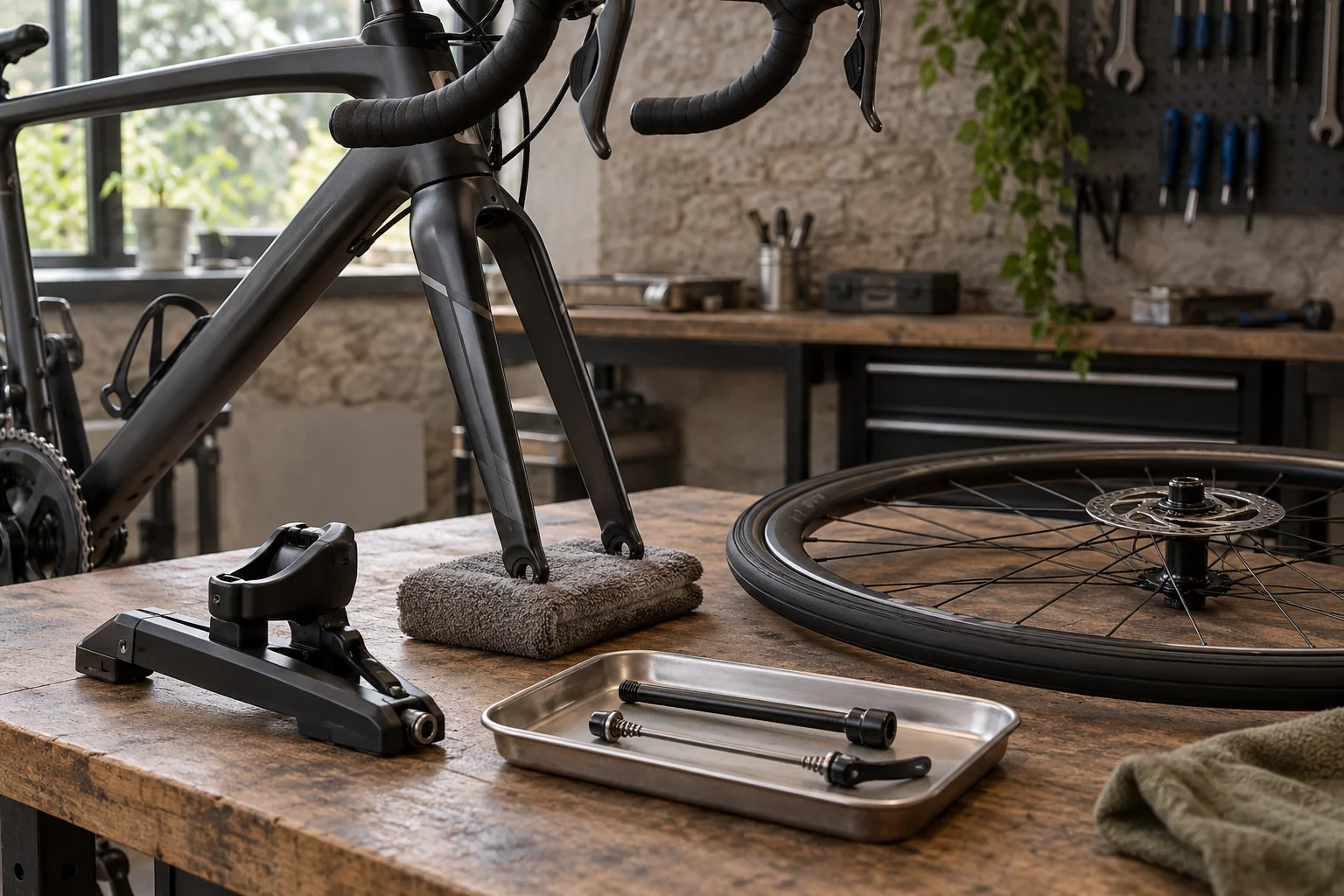
A fork-mounted roof bike rack carries the bicycle with its front wheel removed. The fork attaches to a dedicated mount, and the rear wheel is restrained separately. It can avoid contact with a frame tube, but it introduces its own fork, axle and loading checks.
Start with the bike maker’s transport permission. Identify the axle standard from the bicycle or fork documentation, then match it to the carrier’s exact configuration. A bike described simply as a “thru-axle mountain bike” does not provide enough information to order the right mount.
The two carriers compared here are complete single-bike carriers. Their axle accessories and front-wheel storage are separate selections. Neither is an 18kg allowance for every bicycle that can be lifted into position.
Record diameter, hub spacing and dropout geometry
Write down axle diameter and hub spacing together, such as 12×100mm or 15×110mm. The first number describes a different dimension from the second. Do not confuse a 9mm quick-release interface with every axle whose description contains 9mm.
Also inspect the fork’s dropout shape, retention features and required bearing surfaces against the carrier diagrams. An adapter can have the correct nominal diameter while the fork still cannot seat in the permitted way. Threaded, captive and open-dropout arrangements need the treatment specified for that exact system.
TopRide’s linked manual illustrates a minimum 21mm fork-dropout interface and specific incompatible shapes, including restrictions in its 9mm quick-release illustration. These are diagram-dependent checks, not permission to clamp every carbon fork. Ask the maker to resolve an unclear fork before purchasing or loading it.
Understand FastRide’s additional adapter kit
FastRide 564001 has a standard quick-release arrangement and uses additional equipment for supported through-axle configurations. The selected 564100 kit covers the configurations illustrated in its appendix, including captive 9mm and specified 12×100/110mm and 15×100/110mm arrangements.
The supported 20×110mm arrangement uses a different optional part, 568100. Do not infer that the 9–15mm kit can be opened or modified to take 20mm. Check the inventory supplied with the actual carrier; accessories shown in an instruction appendix are not necessarily included in its carton.
Understand TopRide’s docking routine
TopRide uses an adapter fitted to the approved fork before the bike is docked into the roof carrier. This changes where you prepare the axle interface and how you guide the bicycle into position. It can be useful to assess when reaching the fork attachment is awkward, but the bike still needs lifting and controlling at roof height.
Check the supplied quick-release and through-axle adapter inventory against the actual fork. The selected product supports specified 9–15mm configurations, while 20×110mm requires the separate approved adapter. Keep the bike’s actual axle with its travelling equipment and follow the correct removal and refitting instructions.
A visible or audible docking indication is one step in the prescribed sequence. Complete the required fork checks, rear-wheel restraint and carrier-to-bar inspection; a single click or locked cylinder does not verify the entire installation.
Apply all bike dimensions at the same time
FastRide and TopRide each list 16–32in wheels, tyres up to 3in and a maximum 1250mm wheelbase. They also each have an 18kg per-bike ceiling. A suitable fork adapter does not waive any of those dimensions.
Measure the actual bike rather than assuming a size label predicts its wheelbase. Long mountain-bike frames can exceed a carrier’s range even with relatively ordinary tyres. The wide-tyre and long-wheelbase guide compares those limits with the upright alternatives.
For the roof calculation, count the carrier itself. FastRide is listed at 3.3kg. TopRide’s page lists 3.5kg, but the linked manual shows 4kg: plan with 4kg and confirm the supplied equipment. Add the complete rack, other carriers, adapters and any wheel holder as required by the relevant load definitions.
Match the carrier to the completed roof bars
Confirm the exact bar interface and required hardware. A compatible T-track family name is not permission to use any T-bolt that fits the visible slot. Check the specified head dimensions, attachment arrangement and any separate adapter for square or other bar profiles.
Keep the bars at vehicle-approved positions and within the carrier’s permitted mounting range. Check clearance below fasteners, access to controls and the hatch movement with the actual bike. Use the bar-spacing guide for the measurement approach, while following the bike carrier’s own range rather than a roof box’s range.
A fork-mounted bike also occupies space above and beside its tray. Check handlebar clearance with neighbouring equipment and the actual highest point. Removing the front wheel changes the shape; it does not guarantee a low enough overall vehicle for a garage.
Plan the removed wheel before the first journey
Decide where the wheel, axle and any required brake spacer will travel. Follow the bike and brake manufacturers’ instructions when a wheel is removed; do not pull a brake lever or improvise a spacer contrary to their guidance. Protect the rotor, hub end caps and surrounding luggage.
A front-wheel roof holder can preserve boot space, but needs its own bar footprint and compatible wheel-hub interface. The bike’s fork adapter and the wheel holder’s adapter are separate parts with different jobs.
Rehearse removal, loading and reassembly
Practise the full routine on a level driveway before relying on it at a busy trailhead. Prepare the carrier controls, organise the wheel and support the bike throughout the lift. If you cannot reach an attachment while maintaining control, review the tall-car alternatives.
On arrival, reverse the sequence without resting the fork on an unprotected surface. Refit the wheel and axle exactly as the bicycle instructions require, then complete the bicycle’s riding checks before setting off. Keeping the correct axle, spacers and instructions together makes that transition easier.
Choose a fork mount because the whole approved routine suits the bike and car. A smaller carrier weight or the absence of a frame clamp is useful only after the fork, axle, dimensions and handling checks pass.
Sources and selected Amazon packages checked October 2026: FastRide product information, FastRide instructions, adapter appendix, TopRide product information, TopRide instructions and Wheel Bag XL.
Frequently asked questions
Can a thru-axle bike fit a quick-release fork-mounted carrier?
Only with the exact carrier-approved adapter for the fork’s axle diameter, spacing and geometry. FastRide uses a separate 564100 kit for specified 9–15mm configurations, while 20×110mm needs the separate approved 568100 adapter. An adapter for storing a detached wheel is a different component.
What is the practical difference between FastRide and TopRide?
FastRide uses its fork attachment at the carrier, with additional adapters where specified. TopRide uses an adapter attached to the fork before it docks into the carrier. Both selected models have an 18kg bike limit and 1250mm maximum wheelbase. Compare included adapters and the whole loading sequence, not just the model names.
Does a fork mount automatically suit a carbon bike?
No. Avoiding a frame-tube clamp does not establish fork permission. Check the bike maker’s transport instructions, fork material, dropout shape and the exact carrier diagram. TopRide’s manual includes specific dropout and quick-release restrictions that an axle diameter alone cannot resolve.
How much does TopRide weigh for a roof-load calculation?
Thule’s product page lists 3.5kg, while its linked instructions show 4kg. Use 4kg for conservative planning and confirm the supplied unit and instructions. Include all other roof equipment; the 18kg bike limit is separate from the carrier’s own mass.
Can the removed wheel travel loose in the boot?
No. Protect it from damage and secure it using an appropriate vehicle loading arrangement. A padded wheel bag protects surfaces but is not a load-restraint system. Alternatively, investigate an approved roof front-wheel holder with the correct wheel interface and include its mass and footprint.