
Decision guide / Bikes and sports equipment
Can You Carry an Electric Bike on a Roof Rack? Weight and Loading Checks
Can an e-bike go on a roof rack? Check actual travelling weight, individual carrier limits, vehicle roof load, battery instructions and controlled loading.
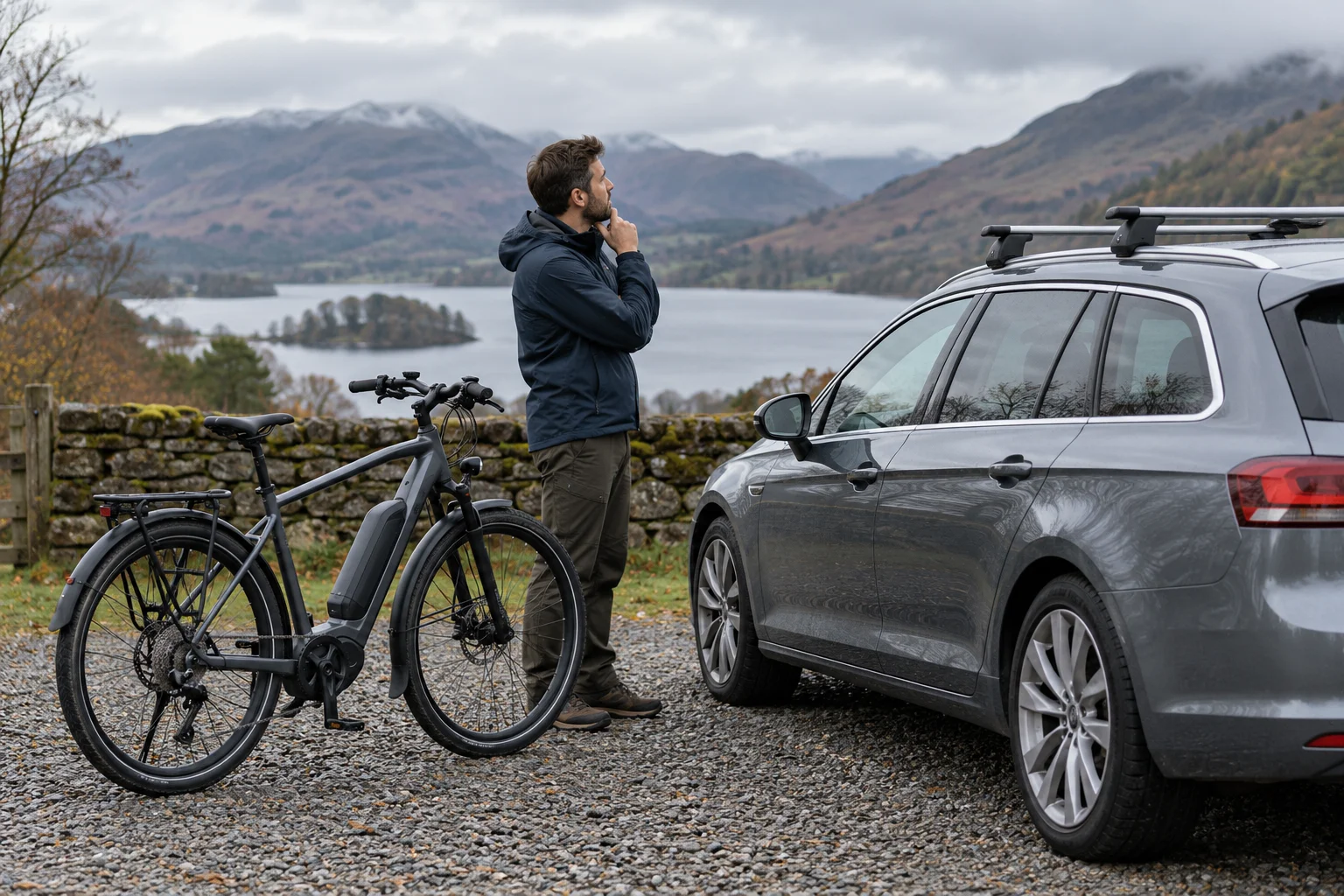
The carrier’s bike limit comes first
An e-bike can use a roof carrier only when its actual travelling weight, dimensions and permitted contact points meet that carrier’s instructions, the whole roof setup meets every applicable limit, and loading remains controlled. Removing a battery is not an automatic route to approval.
Weigh the travelling bike rather than a catalogue description
Electric bikes range from lightweight assisted road bikes to much heavier utility and full-suspension models. The word “electric” does not decide roof compatibility, but it is a reason to check weight early. A bike’s advertised weight may refer to a particular frame size, specification or battery arrangement and may exclude accessories you leave fitted.
Record the actual travelling configuration: battery status, pedals, mudguards, rack, lights, lock, bottle and luggage. Identify what the bicycle maker permits you to remove for transport and what must remain attached. Do not plan around a stripped-down weight that requires an unapproved removal or cannot be reproduced before the return journey.
For a practical weighing method, use equipment suited to the bicycle’s weight and shape, at a manageable height with the bike controlled. A luggage scale’s numerical range does not make its hook suitable for every bike or authorise lifting a heavy cycle overhead. A cycle shop can help if your own measurement would be awkward or uncertain.
Apply the individual carrier limit without averaging
If the travelling bike weighs 24kg and the carrier’s bike rating is 20kg, that candidate fails. It remains unsuitable even when the vehicle roof has 50kg of capacity unused. Nor can a second empty carrier donate part of its rating: each bike must satisfy the limit of the carrier actually supporting it.
Check the carrier’s exact model and instructions. A maker’s towbar product may accept heavier bicycles than a roof model from the same range. A search result that says “e-bike compatible” somewhere on a retailer page is not a substitute for the specific roof carrier’s bike limit and equipment restrictions.
Battery removal needs the bicycle maker’s instructions
Some e-bike makers permit or require battery removal for car transport; the correct approach depends on the actual system. Check the removal process, protection of exposed connections and the instructions for carrying the removed battery. Keep it secure and protected as directed rather than treating it as an ordinary loose item in the passenger area.
After a permitted removal, weigh the remaining travelling bike again. For example, a hypothetical 24kg bicycle minus a genuinely removable 3kg battery is still 21kg, above a 20kg carrier limit. Do not round down or omit a lock or rack to make the arithmetic appear acceptable.
Even when removal gets the weight under the limit, restart the other checks. A battery does not explain whether the frame tube accepts clamping, a front mudguard obstructs a wheel hook, or the bike’s wheelbase exceeds the tray range. The carbon contact-point guide is relevant where carbon parts are fitted.
Inspect the dimensions and contact points
An e-bike can have a broad down tube, step-through frame, long wheelbase, wide tyres or substantial mudguards. Check each characteristic against the carrier rather than assuming one “e-bike” label covers them. Frame-clamping designs need a permitted contact area clear of cables, battery covers and components.
A wheel-holding rack avoids that tube interface, but its hooks must engage in the intended place on a suitable wheel and tyre. A front mudguard is a specific conflict for the UpRide example. A fork-mounted alternative has an axle interface to verify and may have a lower bike rating, so changing styles does not necessarily solve a weight problem.
Add the full roof load independently
Once the bicycle passes its own carrier limit, calculate the complete roof load. Include bars, feet, fitting kit, carrier, bike, separate adapters and any other load. Compare the result with the vehicle’s driving roof allowance and the limits of the complete rack and other components.
A hypothetical permitted 18kg travelling bike, 7.7kg carrier and 5kg complete vehicle rack total 30.7kg. Adding a roof box would add the empty shell, its fittings and its luggage. These example weights do not approve a car, a particular e-bike or a carrying combination.
Use the worked load guide and calculator where a box shares the roof. Enter the other carrier plus its bike together as other roof load. For a bike-only setup, follow the same principle of checking the vehicle and complete-system limits separately; do not mistake a zero-box calculation for a fit approval.
Separate the bike ceiling from spare roof capacity
A light complete roof total cannot compensate for a bicycle that exceeds its own carrier limit. This comparison keeps the bike-only restriction visible beside the larger vehicle calculation.
Inputs and assumptions. Hypothetical ready-to-travel bike masses 18, 20 and 21kg; 5kg complete rack; 50kg vehicle roof allowance. ProRide weighs 4.2kg and UpRide 7.7kg; both selected variants have a 20kg bicycle ceiling. These masses do not establish approval for any particular electric bicycle.
| Travelling bike | Carrier | Bike-only margin | Complete roof mass | Vehicle headroom | Bike-weight screen only |
|---|---|---|---|---|---|
| 18kg | ProRide | 2kg | 27.2kg | 22.8kg | Below ceiling; verify other restrictions |
| 18kg | UpRide | 2kg | 30.7kg | 19.3kg | Below ceiling; verify other restrictions |
| 20kg | ProRide | 0kg | 29.2kg | 20.8kg | At ceiling; verify actual mass |
| 20kg | UpRide | 0kg | 32.7kg | 17.3kg | At ceiling; verify actual mass |
| 21kg | ProRide | -1kg | 30.2kg | 19.8kg | Over carrier ceiling |
| 21kg | UpRide | -1kg | 33.7kg | 16.3kg | Over carrier ceiling |
The 21kg bike leaves 19.8kg of vehicle headroom with ProRide, yet is 1kg above the bicycle limit and must be rejected for that carrier. The remaining car allowance cannot be transferred to the individual bike rating.
If the bicycle maker permits removing a battery, use the complete travelling bike’s resulting mass and its actual contact restrictions. A hypothetical 24kg bike minus a permitted 3kg battery still weighs 21kg. The battery’s separate travel and restraint requirements do not disappear when it leaves the bike.
Calculation method and sources
Bike margin = carrier bicycle ceiling − travelling bike mass. Complete roof mass = rack + carrier + bike. A negative bike margin rejects that pairing regardless of vehicle headroom. A zero margin is an exact paper boundary, not allowance for uncertain weighing or extra fitted items.
- ProRide 598001 specifications: 4.2kg carrier and 20kg bicycle ceiling; frame, wheel and mounting restrictions also apply.
- UpRide 599001 specifications: 7.7kg carrier and 20kg bicycle ceiling; wheel dimensions and contact restrictions remain separate.
- Thule roof-rack safety guidance: Exact vehicle-kit positions and applicable accessory instructions take precedence over general spacing advice.
Download the inputs and workings (CSV). Source review: October 2026.
Rehearse the complete lift and securing sequence
Check whether you can control the bike at the height of the real carrier, for as long as it takes to operate every fastening. Lifting a bike a few centimetres to weigh it is a different task from raising it above shoulder height and holding it upright while reaching a strap.
Consider the return journey as well: fatigue, rain, gravel and a crowded car park can make an already difficult routine worse. A second person only helps if the loading process can remain coordinated and controlled. Do not improvise a ramp, stand on a wheel or use a door step beyond its intended purpose to make the setup seem workable.
Choose a different approved carrying method if any of these checks fails. A suitable lower-loading system may be worth investigating, but it has its own vehicle attachment, bike-weight and dimensional requirements. Finish with the pre-journey checklist and measure the overall loaded height.
Sources checked October 2026: ProRide specifications, UpRide specifications and instructions and the exact bicycle/battery instructions, which must be obtained for your model before selecting a carrier.
Frequently asked questions
Can any electric bike go on a roof rack?
No. Some exceed the individual bike limit of roof carriers before accessories are considered. Even a lighter e-bike needs compatible contact points, dimensions, bars and a controlled loading method.
Does removing the battery make an e-bike suitable?
Only if the bike maker permits removal for transport and the remaining travelling bike meets every carrier requirement. Battery removal does not resolve frame, tyre, mudguard, axle or lifting restrictions.
Can a 24kg e-bike use a carrier rated for 20kg?
No. The individual carrier limit applies to the actual bicycle it carries. Spare capacity under the car’s total roof allowance cannot compensate for an overloaded bike carrier.
Should I weigh an e-bike with its accessories fitted?
Weigh the actual travelling configuration, including anything that remains attached. If removal is permitted, weigh again afterwards and carry the removed items securely according to their own instructions.
What if I cannot lift the bike onto the roof?
Choose another vehicle-approved transport method that suits the bike and allows controlled loading. A compatible roof carrier on paper is not usable if you cannot secure and remove the bike safely.