
Comparison / Box-to-bar mounting
Roof Box Mounting Systems: U-Bolts vs Quick Clamps
Compare roof-box U-bolts, quick clamps and T-track adapters. Check bar profiles, spacing, clearance and genuine replacement parts before buying.
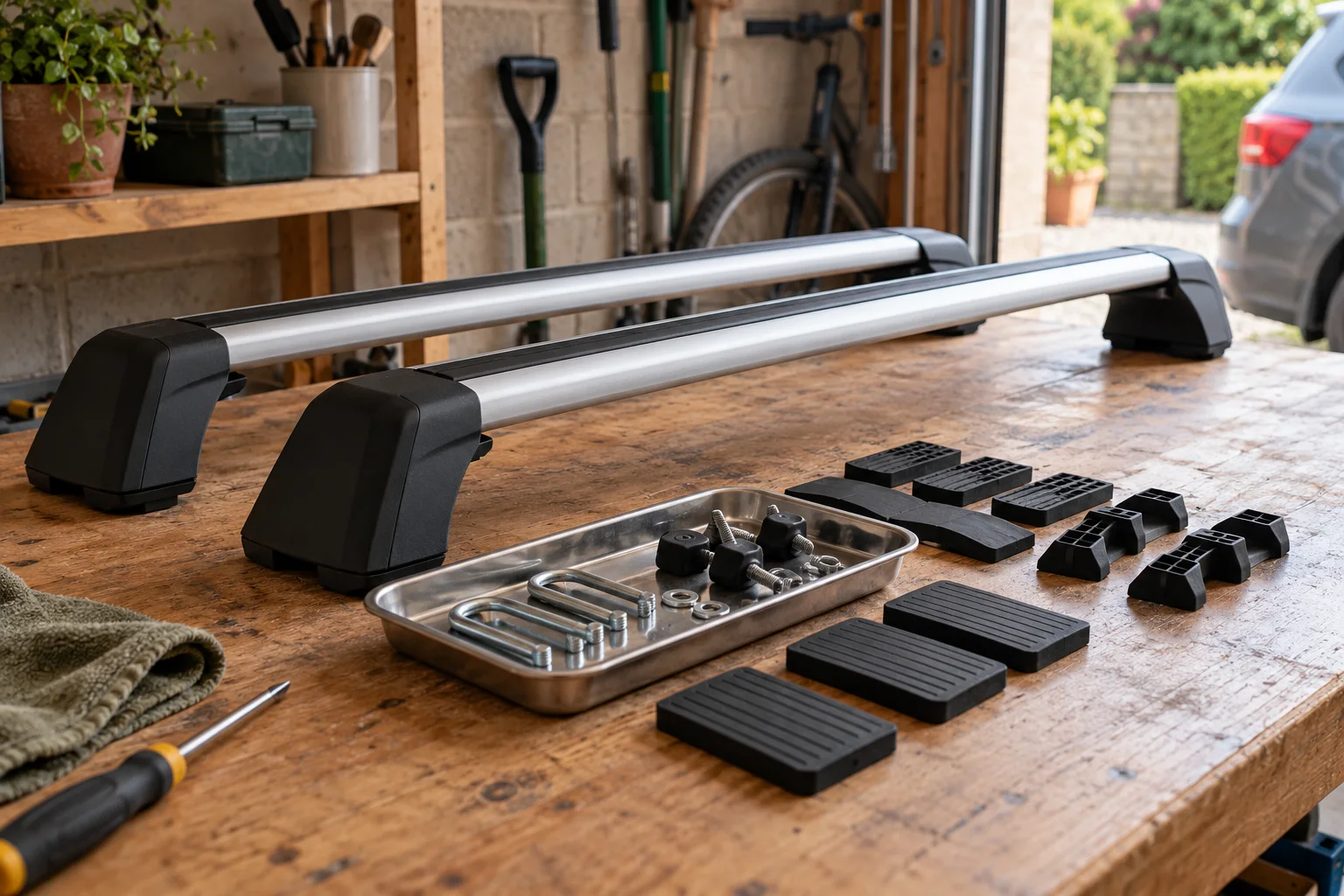
Fit comes before convenience
U-bolts surround the bar and secure through the box’s designed mounting points; quick clamps use their own closing mechanism. Either needs an approved match to the bar profile, spacing and clearance. T-track mounting is another option only where the exact box, bar and adapter are compatible.
Separate the three connections in a roof carrying system
The vehicle-to-rack connection uses the approved feet, pads and fitting kit for the exact car. The box-to-bar connection secures the shell to the crossbars. The luggage restraint keeps the contents secured inside the box. These are different jobs, and hardware for one should not be substituted for another.
Start by confirming a complete rack for your exact vehicle body, roof type and year. A box clamp that fits around a crossbar says nothing about whether those feet or bars may be fitted to the car. Our roof-bar hub explains the components and vehicle selectors.
Only then compare the box mount with that bar. Marketing descriptions such as quick fit or universal do not replace the permitted dimensions and instructions. The complete arrangement has to be supported, accessible and capable of the intended load.
Understand a conventional U-bolt arrangement
A U-shaped bolt passes around the crossbar and through the box's designed holes or mounting arrangement. Internal plates, washers and hand knobs or nuts distribute and secure the connection as specified. The exact pieces and tightening method belong to that system.
Check the clear internal width and depth required around the bar, the usable thread and the condition of every part. A bracket that appears wide enough can still be wrong for the bar height, shell hole pattern or reinforcement plate. Loose, bent or mixed hardware needs to be resolved using approved replacements.
Do not drill extra holes to accommodate a different spacing or buy a generic wider U-bolt on size alone. Changing the mount can change how forces reach the shell. Confirm any replacement or conversion with the manufacturer of the exact box.
Understand quick clamps without treating the click as proof of fit
Quick clamps are designed to make attachment more convenient, using jaws, levers or knobs according to the model. Some have a tightening indication. They still need to engage the approved bar profile correctly and have the required clearance below and around the bar.
Inspect all required mounts and their engagement. A mechanism that is obstructed by a rack foot, trim strip or unusual bar shape should not be forced closed. Do not transfer operating or torque instructions from one quick-clamp generation to another.
Easy-Snap is not the same system as PowerClick
The Ocean 600 illustrates why the range name and supplied hardware matter. Its older Easy-Snap arrangement uses its own bracket and securing sequence; it should not be described as the current PowerClick mechanism merely because it is tool-free.
When buying used, obtain a clear photograph of every mount and the model label. A familiar shell can have incomplete, replaced or inappropriate fittings. The correct manual and a complete manufacturer-approved kit are more useful than the seller's reassurance that it fitted their old car.
Check when a T-track adapter is appropriate
A T-track arrangement uses an approved adapter in the bar's channel instead of wrapping the original fitting around the crossbar. It can be useful where the manufacturers specify it, but the track size alone does not establish a correct conversion.
Check the adapter's exact part number, T-bolt head, fastener length, box interface and the bar's instructions for the rubber strip. Different boxes and mounting generations can need different adapters. An attractive listing for a general T-bolt kit is not a substitute for those checks.
Do not assume an adapter lets you increase the roof load, extend the permitted bar spacing or mount beyond the approved loading area. It changes a connection only within the permissions of the specific system.
Measure spacing and interference before purchase
Record the bar-centre spacing in the positions approved for the vehicle. Compare it with the exact box's permitted range, then check the mounting width and clearance under the bar. Include rack feet, handles, strips, antennae and the shell's position relative to the hatch.
The Motion fitting manual gives a 555–930mm bar-centre range for its named variants. That is an example of a model-specific range, not a universal recommendation. A vehicle's fixed points or kit instructions may prevent using every position a box permits.
If the ranges do not overlap, the setup does not become suitable by drilling the shell, omitting a part or sliding the rack beyond its approved position. Resolve the mismatch before buying. A different box, approved adapter or rack arrangement may be needed.
Compare convenience after compatibility
| System | Practical benefit | Checks that remain |
|---|---|---|
| Conventional U-bolt | Straightforward hardware that can be inspected | Correct bracket, reinforcement, threads and tightening method |
| Quick clamp | Convenient repeated fitting on compatible bars | Approved profile, clear engagement and exact operating sequence |
| T-track adapter | Alternative interface where specifically approved | Correct box/bar/adapter combination and fastener dimensions |
How often you remove the box can influence which mechanism is convenient. So can access to the far-side mounts on a tall vehicle. Choose the approved arrangement that you can inspect and operate properly, then keep its small parts and instructions together.
Inspect and recheck according to the manual
Before driving, check the attachment, internal restraint and closure using the model's instructions. Follow the manufacturer's recheck intervals and any additional checks required after installation or changing conditions. A quick clamp does not make those checks optional.
Stop using equipment with damaged, loose or uncertain mounts until the cause is resolved. Use the manufacturer's replacement-parts route and exact identifiers. Our used-box checklist helps with the wider condition assessment, while the load calculator addresses the separate weight limits.
Mounting guidance checked October 2026 using Force instructions, Motion instructions, Ocean instructions and Thule safety guidance. The supplied instructions govern the actual fitting procedure.
Frequently asked questions
Can I replace U-bolts with quick clamps?
Only if the manufacturer approves the exact conversion for the box and bars. Matching a hole or finding a clamp that grips the bar is not sufficient evidence.
Do quick clamps fit every aero bar?
No. Bar width, height, shape and clearances must fall within the exact clamp system’s approved requirements.
Can I drill new holes to suit my bar spacing?
Do not improvise mounting holes. Use only changes expressly approved in the exact manufacturer instructions; otherwise choose an approved arrangement that fits.
Does a T-track fit mean I can use any T-bolt?
No. Head dimensions, thread, length, box interface and the approved adapter part number all matter. Check the complete combination.
Does the tightening click mean the box is ready to drive?
It is only one indication in the relevant system’s operating sequence. Confirm correct engagement, every required mount, the permitted position, luggage restraint and closure before driving.