
Practical guide / Journey and ownership
Packing Wet and Dirty Equipment in a Roof Box: Separation, Containment and Drying
Plan wet tents, wetsuits and muddy footwear for the journey home. Check suitable bags, closure space, extra mass, box restraints, cleaning and prompt drying.
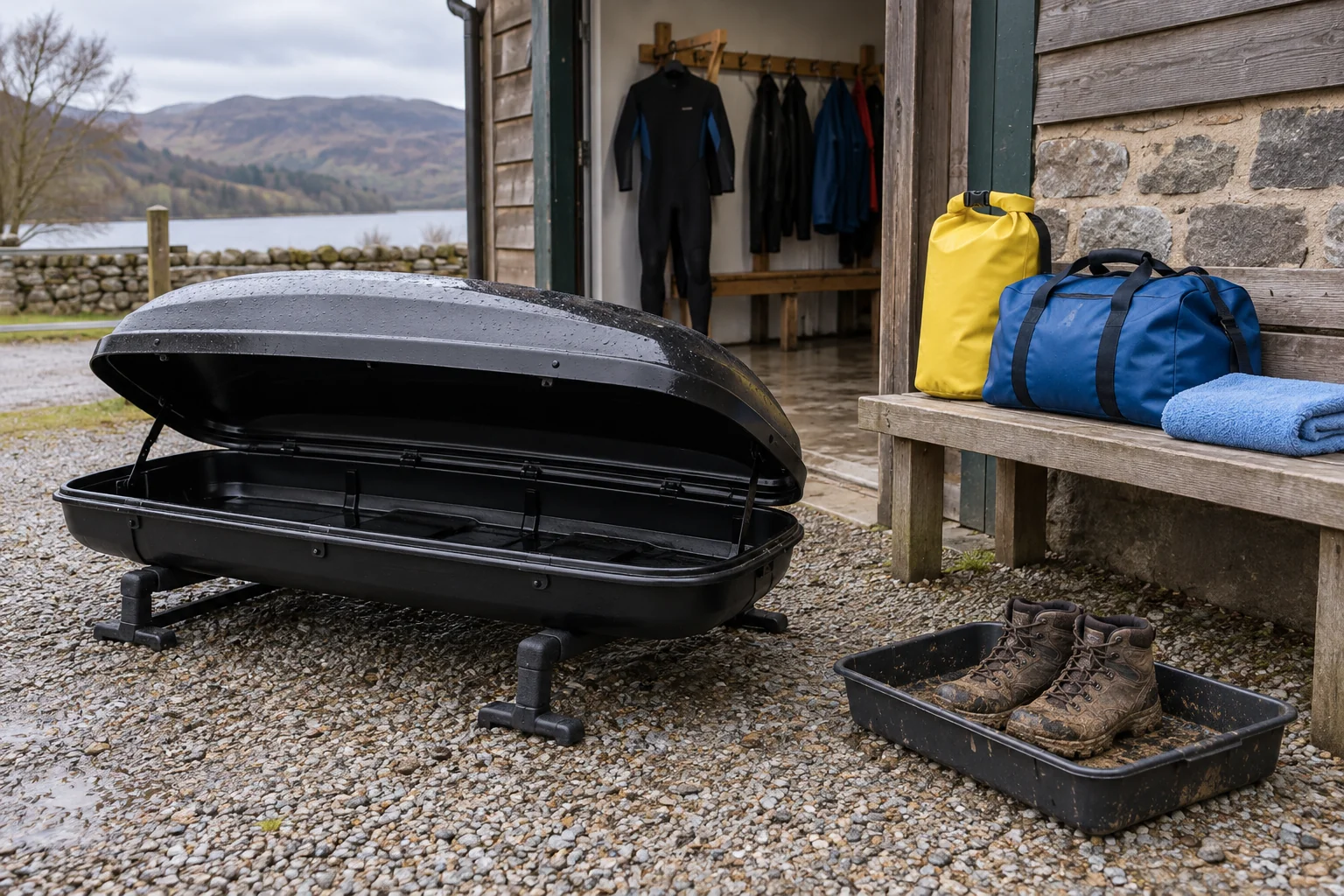
Plan the return load before the equipment gets wet
A clean outward packing plan can become difficult after rain, a paddle or a muddy walk. Wet kit is heavier, dirtier and often less neatly packed. Decide how it will be separated and restrained before departure, rather than searching for an empty corner of the box at the end of the trip.
List the likely wet items and their care needs. A damp tent, saltwater wetsuit and muddy boots are different loads; they need not share one container. Keep ordinary wet equipment separate from fuel, chemicals, sharp objects and other materials requiring specialist handling.
The aim is controlled temporary transport followed by appropriate cleaning and drying. A sealed roof box is not a drying cabinet, and leaving the lid slightly open for ventilation is not an acceptable travelling arrangement.
Remove free water and loose dirt where appropriate
Follow each item’s instructions before draining, rinsing or folding it. Empty water from suitable equipment and remove loose mud in an appropriate place, without polluting a watercourse or damaging a campsite. Avoid vigorous methods that harm coatings, seams or valves.
Do not pack a bag full of unnecessary standing water simply because its outside is waterproof. That water consumes roof and vehicle allowance and can shift inside the container. Weigh the realistic return load where practical and revise a close outward calculation.
For an inflatable kayak, distinguish the packed craft and accessories from a bare-hull brochure measurement. Use the inflatable-kayak roof-box guide for that specific shape, fold and mass assessment.
Separate clean, damp and muddy groups
Keep sleeping equipment and dry clothing in their own suitable inner protection. Give damp fabric a separate bag and keep grit or sharp footwear away from delicate seams. A small washable tray or protected container may suit footwear only if its actual shape, contents and restraint work in the chosen luggage space.
| Group | Planning aim | Check |
|---|---|---|
| Clean dry clothing/sleeping kit | Keep away from moisture and grit | Suitable inner protection and intact closures |
| Damp fabric or wetsuit | Temporary separate transport | Care instructions, permitted folding and prompt drying |
| Muddy footwear | Contain ordinary dirt | Protected hard edges and secure container |
| Water-bearing equipment | Remove unnecessary free water | Actual return mass and material requirements |
| Fuel, chemicals or sharp waste | Separate specialist transport decision | Do not treat an ordinary dry bag as approval |
Label or colour-code bags so the dirty container is not later used for clean sleeping equipment without proper cleaning. Pack accessibly enough that the wet groups can be removed first at home, without being forgotten under an unrelated bag.
Choose a bag by its actual purpose and closure
A suitable inner bag must match the equipment, not just the advertised litres. Check the fabric, welded or sewn seams, closure method and permitted contents. A roll top needs enough unfilled neck to close as prescribed; compressing kit into that space can defeat the closure.
The manufacturer describes water protection from outside under its stated conditions. That does not establish resistance to fuel, cleaning chemicals, hot equipment or puncture by tent pegs. It also does not prove the contents can safely be stored damp for an extended period.
If containment is uncertain, change the packing arrangement before travelling. Do not add liquid, then test leakage over luggage or the car interior. Use an appropriate container and verify it for the actual task according to its maker’s instructions.
On Amazon’s grouped listing, explicitly select 20 Litres and Yellow, then confirm model OB1005Y before buying. A default smaller size has different packed dimensions and does not match this example.
Measure the sealed bag inside the real box
Check the bag after filling and closing, including the rolled neck, buckle, handles and bulging base. Compare that shape with the actual space below the lid and around mounts. The selected 20L tube’s 44cm sealed height can exceed many roof-box interiors even when its volume sounds small.
An alternative orientation is only useful where the bag and contents permit it, the closure remains protected and the load can be restrained correctly. Do not force a bag flat against a buckle, trap it under a mount or use lid pressure to hold it in place.
Use the bag-shape guide for the wider packing layout. A larger outer duffel does not change the sealing, drying or compatibility requirements of the item inside it.
Restrain containers independently of their handles
The roof box’s internal restraints must hold the permitted load through their specified points. A dry bag’s shoulder strap or carrying handle does not become an approved box tie-down merely because it is convenient to reach.
Arrange bags so prescribed straps can be positioned and checked without damaging a closure or concentrating force on a sharp buckle. Keep handles, spare straps and loose folds away from seals and locking parts. Confirm the lid closes and locks normally after restraint is complete.
Do not add straps around the outside shell as a workaround for an interior load that cannot be secured. Return to the box’s instructions and reduce or change the load if the prescribed arrangement is not achievable.
Account for extra mass without inventing an allowance
Water and mud are part of the travelling load. If the outward setup was close to its roof allowance, do not assume the return bags remain within it. Reweigh manageable items or reduce the load enough to resolve the uncertainty.
The roof-load calculator handles the roof arithmetic, while the payload guide considers passengers, boot luggage and axle limits. A containment bag adds mass too; it does not cancel the water it holds.
Where the whole-vehicle mass is excessive, moving wet kit to the boot is not a total-weight solution. It may improve location and access only if the boot restraints and axle limits permit that arrangement.
Recalculate the return load when the kit gains mass
A bag’s nominal volume can stay the same while its contents gain moisture or dirt. A return-journey mass comparison shows how that change can consume a small remaining roof allowance.
Inputs and assumptions. Invented example: 60kg total roof allowance, 5kg rack, 23.2kg empty box, 75kg rack carried-load and 75kg box contents ceilings. Dry packed luggage, including its bags, weighs 26kg. The extra 2, 4 or 6kg values are hypothetical retained mass, not measurements or predictions for any fabric, craft or dry bag.
| Assumed additional retained mass | Revised luggage | Complete roof mass | Remaining luggage allowance |
|---|---|---|---|
| 0kg | 26kg | 54.2kg | 5.8kg |
| 2kg | 28kg | 56.2kg | 3.8kg |
| 4kg | 30kg | 58.2kg | 1.8kg |
| 6kg | 32kg | 60.2kg | -0.2kg |
The original 26kg luggage leaves 5.8kg under these assumptions. An extra 6kg changes the complete roof mass to 60.2kg and takes the model 0.2kg over its vehicle allowance. A container holding the dirt or moisture does not remove that mass.
Use the actual return weights, drain or dry equipment only as its maker permits, and change the carrying plan if a limit is exceeded. Bag containment and prompt drying are separate from load restraint, fit and weight; a litre label cannot establish a transport mass.
Calculation method and sources
Revised luggage mass = original packed luggage + additional retained mass. Remaining allowance = the minimum vehicle/rack/box luggage ceiling − revised luggage. Count any retained mass inside an item once; do not also add it as a separate roof accessory.
- Motion 3 family instructions: PDF pages 14–15: exact Sport, XL and XL Low rows; maximum dimensions do not describe the whole packing envelope.
- Thule roof-box safety instructions: Complete roof load, restraint, fit and operating checks remain separate requirements.
- OverBoard 20L dry-tube information: Containment dimensions and closure requirements are separate from the illustrative retained-water mass below.
Download the inputs and workings (CSV). Source review: October 2026.
Clean and dry promptly after arrival
Unload wet and dirty groups first in a suitable place. Open containers and dry equipment as its maker directs; some fabrics need particular rinsing, ventilation or temperature limits. Avoid intense heat and aggressive chemicals unless specifically approved.
Clean the box by its manufacturer’s method, including the shell, seals and mounting areas. Grit trapped in a cloth can scratch a surface, so remove loose contamination gently and use clean tools. Inspect before storing the empty box.
Dry the bags themselves before putting them away. Retained moisture inside a rolled closure or folded base can make the next clean load damp. Reassign or replace a damaged container rather than repeatedly trusting a worn seam.
Sources and selected packages checked October 2026: OverBoard 20L purpose, closure and sealed dimensions, Thule box safety/care and Osprey duffel specifications. Follow the specific equipment’s drying and material instructions as well.
Frequently asked questions
Can wet equipment go in a roof box?
Only where the equipment and box instructions permit it and you can contain, restrain and account for it correctly. Remove free water where appropriate, keep clean items separate and plan prompt drying. A hard shell does not turn wet luggage into dry storage.
Will a dry bag always stop water leaking out?
Do not assume so. A manufacturer’s water-ingress rating and closure instructions describe its stated use; they do not prove containment of every liquid from inside. Check the actual material, seams, closure and intended load, and do not use it for fuel, chemicals or sharp waste.
Will a 20L bag fit in a 300L roof box?
Volume alone does not answer that. The selected OverBoard 20L tube has a 44cm sealed height and 25cm diameter, so it can be too tall upright for many boxes. Measure the filled bag, permitted orientation and closure clearance against the exact usable interior.
Can I leave a wet tent sealed in the box overnight?
Follow the tent maker’s care instructions and dry it as soon as practical. Temporary containment for travelling is not an approval for prolonged damp storage. Remove and spread the equipment in a suitable place after arrival, rather than assuming the box ventilates it.
Can I drain or ventilate the roof box by drilling holes?
Do not modify the shell, seals or mounts unless the manufacturer expressly approves it. Investigate moisture through the prescribed cleaning and drying method, remove wet contents and repair any fault with the correct parts. An improvised hole can affect the box’s operation and protection.