
Keep it practical
Storage & accessories
Compare roof-box bags, wall mounts, hoists, covers, keys and accessories. Plan storage, check exact parts and troubleshoot common ownership problems.
The short answer
Measure the box and the storage space before buying a mount or hoist. The supporting surface, fixing method and full lifted load matter as much as the box’s size.
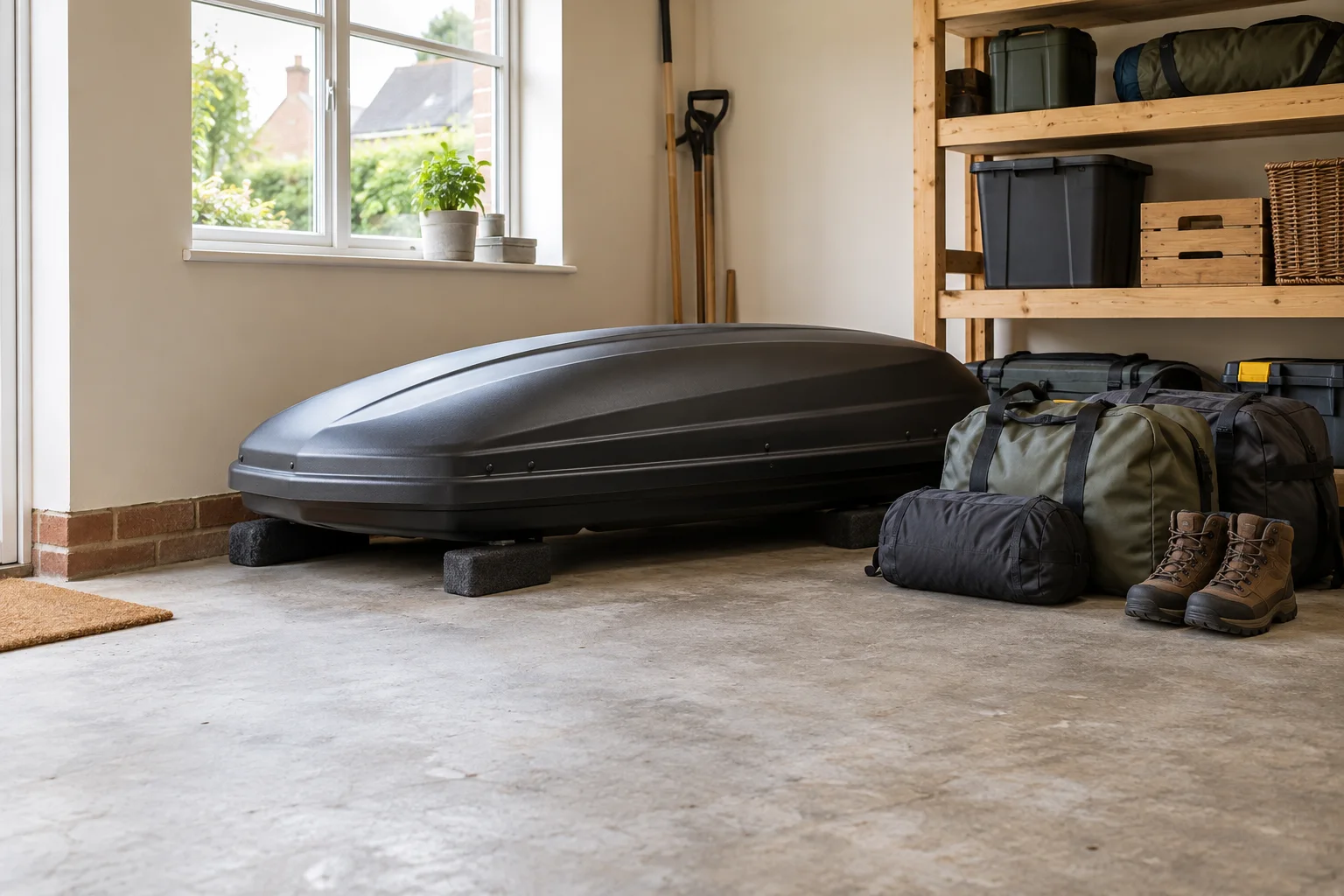
A roof box can solve a boot-space problem and create a garage-space problem. Measure your storage area before buying, including the route through doors and the room needed to lift or move the box.
Choose the next step around the job
For a box coming off the car, start with storage orientation, support and handling. For luggage that will not pack neatly, start with bag dimensions and opening access or soft bags versus hard cases. If something is damaged or will not operate normally, use the fault guides below before ordering an accessory.
A useful accessory solves a specific problem within the box maker's instructions. A cover protects a permitted surface; a mount supports the shell in an approved orientation; a strap secures a load at the specified points. One item cannot be assumed to do all three jobs, and a product that suits another box with similar litres may still be unsuitable for yours.
Choose the storage method around the space
Floor storage needs a suitable support arrangement and protection from knocks. Wall storage needs a mount designed for the box and fixings suitable for the wall. A ceiling hoist needs verified structural support, an adequate load rating and enough working clearance.
Compare wall mounts when the wall and contact arrangement can be verified, or garage hoists when overhead support and a clear lift path can be established. Include opening garage doors, lighting, the car's parked position and the route used to reach the stored box in the measurement.
Do not assume a garage ceiling or an exposed timber can carry the hoist because it looks substantial. Follow the storage-system instructions, and get competent advice if the fixing surface or its capacity is uncertain. Include everything the hoist will lift when checking its load limit.
Measure before you buy storage equipment
- Box length, width and height.
- Required support orientation and contact points.
- Wall or ceiling space, including opening doors and moving parts.
- Lift path and space around the car.
- System load rating and fixing requirements.
Work through the garage-hoist hanging-depth budget and wall-storage projection example before choosing the storage method. For packing, the bag-envelope comparison shows why nominal litres or rounded page dimensions can hide a dimensional shortfall. Sources, assumptions and CSV workings accompany each comparison.
Packing bags: use the interior, not the brochure volume
A shaped bag set can make loading and unloading easier, but four bags with a combined volume similar to the box do not automatically fit it. Compare packed height, width and length with the box's tapered interior. Make sure mounts and straps remain accessible.
Ordinary soft bags may work well if their packed dimensions suit. A bag set is an accessory to choose after the box, rather than a reason to choose a box with the wrong shape.
Keys, locks and small parts
Record the box model and key or lock number somewhere separate from the key. Order a replacement for the exact lock system. Similar-looking barrels and handles are not proof of compatibility.
Use the manufacturer's spare-parts route for replacement hardware and instructions. Do not substitute bolts, clamps or locking parts because they happen to fit a hole. Use the replacement-key identification guide for a lost key and the matching-lock compatibility guide before buying a shared key set. A sticking lock or retained key belongs with the closing and locking checks, rather than an assumption that a new cylinder will solve it.
Straps: replace the right restraint
Keep internal box straps with the box, and inspect the straps used by sports carriers for damage. Buy replacements specified for that exact equipment. A longer strap is not automatically a better or approved replacement.
Put the box away clean and dry
Follow the model's cleaning guidance and inspect mounts, hinges and locks before storage. Thule's roof-box safety instructions call for gentle cleaning and exclude aggressive solvents. Check the instructions for other brands separately.
Remove a box when it is not needed if its instructions and your circumstances permit. Keep the full set of mounting parts and the instructions together so the next fitting starts with the correct components.
Resolve faults before choosing replacement accessories
Water inside the box calls for packing, closure and ingress checks, followed by the correct support or warranty route. A liner or dry bag may help organise permitted contents, but does not repair a seal, cracked shell or misaligned lid. Dry wet and dirty equipment before long-term storage rather than sealing moisture away inside a cover.
If the lid will not stay open, identify the correct lid-support parts and support procedure. For a clamp that feels loose, use the mounting-clamp inspection guide. Cracks or impact damage need the stop-use and manufacturer-assessment route, not an improvised structural repair.
Before buying optional extras, check box-light attachment and power and liner fit and restraint access. For cleaning on the car, check the automatic car-wash restrictions; ordinary off-car washing and storage preparation are separate jobs.
Start with the right box
Our roof-box comparison includes shell dimensions and empty weights. Work through vehicle fit and roof load first, then use those dimensions to decide what you can store comfortably at home.
Product specifications and listing variants checked October 2026. Match accessories to the actual box and follow the storage-system instructions.
Detailed packing and ownership guides
Choose the next guide around the job you need to settle, from bag dimensions and restraints to support systems, cover sizes, keys and cleaning.
Packing bags and restraints
Measure the filled luggage and preserve access to the box mounts and internal restraints.
- Choosing Roof Box Packing Bags: Dimensions, Shape and AccessBuying guide
- Soft Bags vs Hard Suitcases in a Roof BoxComparison
- Roof Box Luggage Straps: Restraint Points and Compatible ReplacementsAccessory guide
- Packing Camping Equipment in a Roof Box: What Goes on the Roof and in the Boot?Detailed packing guide
- Packing Wet and Dirty Equipment in a Roof Box: Separation, Containment and DryingPractical guide
Off-car storage and cleaning
Plan support points, structural fixings, handling and drying before choosing a storage product.
- How to Store a Roof Box Off the CarPractical guide
- Choosing a Roof Box Wall Mount: Support, Space and FixingsBuying guide
- Choosing a Roof Box Garage Hoist: Capacity and ClearanceBuying guide
- Choosing a Roof Box Storage Cover: Size, Protection and ConditionsBuying guide
- Cleaning a Roof Box Before Storage: Shell, Seals and MountsMaintenance guide
Keys and useful accessories
Match the exact box and lock family before ordering a replacement or optional extra.
- Replacement Roof Box Keys: Identifying the Correct Key and LockTroubleshooting guide
- Matching Locks Across Roof Bars, Boxes and CarriersCompatibility guide
- Choosing a Roof Box Light: Compatibility, Attachment and PowerAccessory buying guide
- Roof Box Liners and Protective Mats: Fit, Usable Space and Restraint AccessAccessory buying guide
Faults, damage and manufacturer support
Investigate the cause before buying parts; damaged mounting or shell components need manufacturer advice.
- Roof Box Won’t Close, Lock or Release the Key: Safe Checks Before Forcing AnythingTroubleshooting guide
- Water Getting into a Roof Box: Finding the Cause and Protecting Your LuggageTroubleshooting guide
- Roof Box Lid Won’t Stay Open: Identifying the Correct Support PartsTroubleshooting guide
- Roof Box Clamps Feel Loose: Inspection, Compatibility and Replacement DecisionsTroubleshooting guide
- Cracked or Damaged Roof Box: When to Stop Using It and Contact the ManufacturerDamage assessment guide
Frequently asked questions
Can I store a roof box on any wall bracket or garage hoist?
No. Check the exact box’s permitted orientation and support points, the storage system’s capacity, suitable structural fixings and the complete handling route. A lifting rating alone does not approve the ceiling, wall or box contact.
Should I store the roof box with luggage inside?
Start with an empty, clean and dry box unless the manufacturer explicitly permits another arrangement. Luggage adds load to supports and can trap moisture. Keep keys and mounting parts identified and accessible for the next installation.
Do packing-bag litres tell me whether a set fits?
No. Measure the filled bags, opening route and usable floor beneath the tapered lid. Keep mounts, internal restraints and locking areas accessible, and count bag mass as part of the travelling contents.
Are replacement keys, liners and covers universal?
No. Match keys to the actual lock family and code, and match liners and covers to the exact box model and size. Similar branding, capacity or appearance does not establish a compatible replacement.