
Practical guide / Loading, driving and travelling
Roof Boxes and Car Park Height Barriers: Planning for Clearance
Plan parking with the complete fitted height of your roof box or bike. Check barriers, ramps and route restrictions, and choose an alternative if clearance is uncertain.
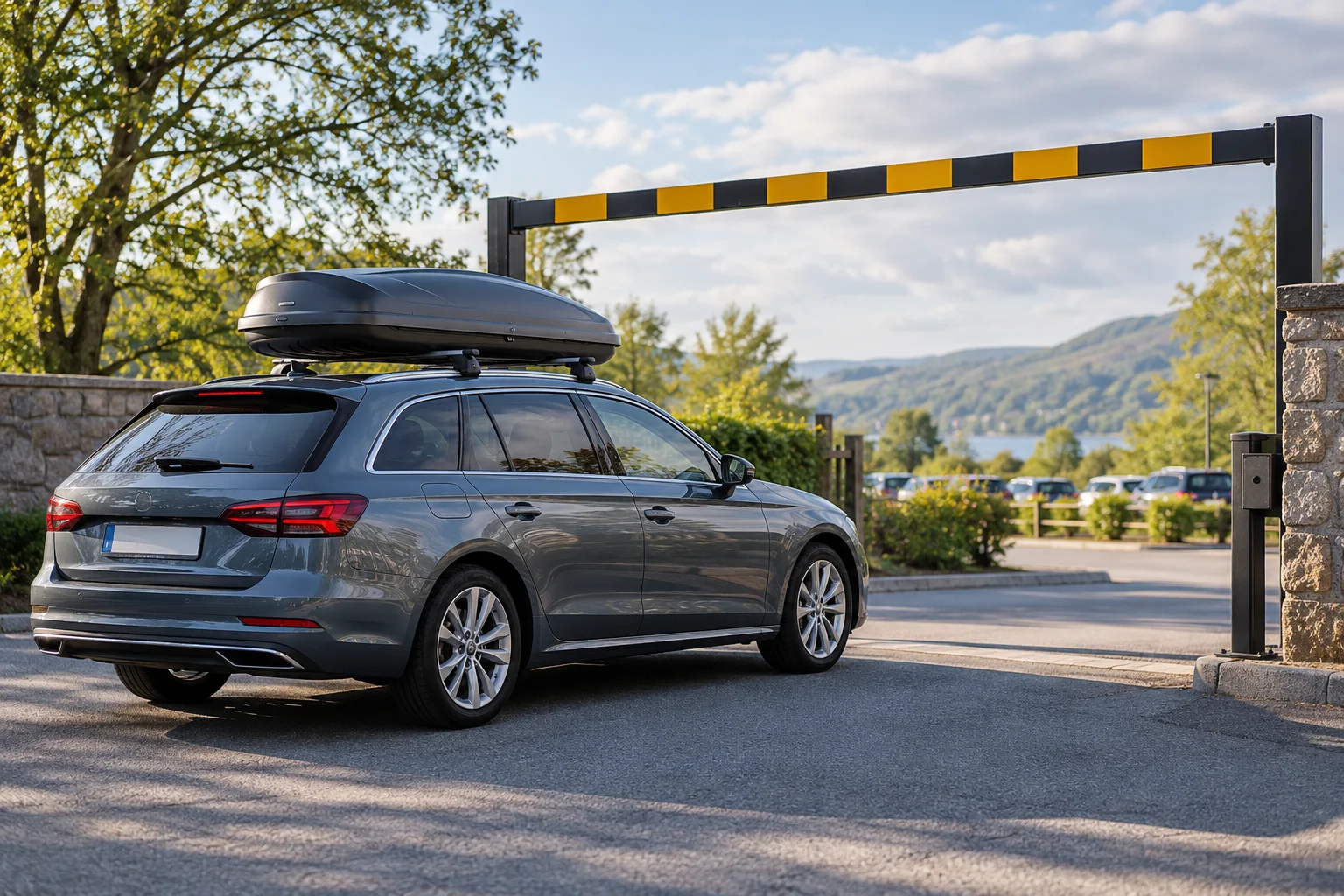
Plan the route before reaching the beam
Use the measured height of the complete travelling setup and check the entire parking route, including ramps, internal structures and the exit. A marginal figure or uncertain approach is not a reason to try driving underneath. Choose suitable alternative parking or obtain clear operator guidance first.
Know the height of the complete setup
Measure the actual car with its approved rack, box and other equipment in travelling condition. The highest item may be a bicycle or carrier rather than the box lid. Record the configuration, units and uncertainty using the height-measurement guide.
A remembered bare-car height is not enough once roof equipment is added. Nor is a total calculated from unrelated catalogue dimensions. Rails, feet, bars and the box base can overlap the reference measurements, while a different roof or suspension option can change the vehicle itself.
Keep the height note available to everyone who drives the car. A driver who did not fit the roof box can easily follow the route normally used by the unmodified vehicle. Include the reminder in the handover before parking or changing drivers, without obstructing the view or controls.
Check the exact car park before booking
Look up the actual car park and entrance, rather than assuming every facility from the same operator has the same clearance. A terminal drop-off area, meet-and-greet facility and multi-storey can have different restrictions even at one airport. Check the current official facility information and any booking conditions relevant to roof equipment.
For example, London Stansted’s current FAQ states a 2.0m restriction for its meet-and-greet and multi-storey parking. Bristol Airport’s parking FAQ describes different restrictions for particular facilities and a separate drop-off/pick-up area. These are facility-specific examples, not a nationwide standard.
If your setup is close to a stated limit or the page does not identify the entrance you need, ask the operator before reserving a space. Give the complete measured height, vehicle and equipment configuration. Do not interpret silence about roof boxes as approval for an arrangement the published dimensions may exclude.
Inspect the whole approach and route
The first overhead beam is not necessarily the lowest structure the vehicle will encounter. Consider the entrance approach, ticket area, ramps, internal beams, signs, pipework and the exit route. A facility can also have different restrictions in different sections or levels.
Slopes and changes of angle matter because a long car and its roof equipment do not approach every structure in the same attitude as they did on level ground. A level-ground measurement remains essential, but it cannot by itself establish clearance through a complex ramp transition.
Do not rely on following another car of similar size. Its tyres, suspension, rack, box or load can differ, and its route may not be appropriate for yours. A space beyond the beam is not useful if the approach or exit cannot be used by the complete setup.
Compare the numbers without treating a small gap as certainty
| Complete measured height | Posted restriction | Decision to make |
|---|---|---|
| 2.08m | 2.00m | Do not enter: the travelling setup exceeds the stated restriction |
| 2.00m | 2.00m | No reassuring allowance for uncertainty; choose another route or obtain clear guidance |
| 2.03m | 2.10m | A nominal 70mm difference still needs measurement, approach and full-route assessment |
| Height not reliably measured | Any restricted entrance | Establish the height before choosing the route; do not use contact as the test |
There is no universal spare gap that makes every car, ramp and obstruction suitable. Avoid inventing a fixed centimetre allowance and presenting it as a guarantee. If the measurement or route geometry is uncertain, use a different parking option or obtain appropriate operator advice rather than rounding the height down.
A hanging indicator can warn of a problem, but do not deliberately contact it to test fit. Stop well before an uncertain obstruction in a suitable safe place and follow the operator’s directions. Avoid blocking traffic or putting a helper in the path of moving vehicles while assessing the situation.
Consider lower equipment before purchase, not at the entrance
Compare a potential lower box against the complete journey. A model that reduces height but cannot carry the actual bags or leaves too little roof allowance may be the wrong solution. The low-profile comparison and load calculator help assess those trade-offs.
Do not substitute unapproved low feet or improvise spacers, clamp positions or shell modifications to change clearance. The vehicle fit and accessory mounting requirements remain the foundation. A setup that clears a beam but has an unapproved attachment is not a usable carrying plan.
Choose alternative parking early
An appropriate outdoor option may avoid a particular covered route, but “outdoor” is not the same as unrestricted. Open car parks, beaches, parks and service areas can still use height bars or restricted access roads. Check the actual entrance and conditions before changing the destination.
For a hotel or holiday rental, ask about both parking and the place where you will unload. A booked space can be behind a garage entrance, and a loading area may have its own canopy or restricted turn. Have an alternative location in mind before arriving tired or in the dark.
At airports and transport terminals, allow time for a suitable alternative rather than depending on a last-minute switch. Follow the operator’s amendment process where a pre-booked facility is unsuitable; do not assume another area from the same operator accepts the booking or equipment automatically.
Plan any removal in a suitable place
If the trip only needs roof equipment for part of the journey, plan removal using the exact instructions, suitable help and secure storage. Do it in an appropriate location, not in the entrance queue or a busy access road. The empty shell can be awkward even after the luggage is removed.
Taking bags out usually does not remove the external height created by the box and rack. Removing the shell may still leave high bars or carriers that need measuring. Recalculate and remeasure the final configuration rather than assuming that one removed component solves every restriction.
Never leave an unsecured box beside a public entrance or travel with it balanced inside or on the vehicle in an unapproved way. If there is no suitable removal and storage plan, choose parking that accepts the complete setup instead.
Repeat the checks when the journey changes
A bike added for a day trip, a different hired box or an approved rack change can invalidate the recorded height. Recheck after such changes and remind other drivers. The return route may involve different car parks or an overnight stop that was not part of the outbound plan.
Transport bookings are separate again. Use the ferry guide and LeShuttle guide for operator declarations; a correct booking does not establish clearance at the terminal’s shops or a nearby garage.
Finish with the pre-journey checklist so height planning sits alongside the approved fit, correct load, restraints and closure. Keeping those decisions together is more reliable than discovering the first conflict at a barrier.
Guidance checked October 2026 against Thule’s height and clearance warnings, London Stansted’s current parking FAQ and Bristol Airport’s parking FAQ. Recheck the exact facility and entrance before booking or arrival.
Frequently asked questions
Is a hanging height bar the only thing I need to clear?
No. Check the whole route, including ramps, beams, sprinklers, signs and the exit. The entrance indicator does not establish clearance through every part of a car park.
Can I drive under slowly to see if the box fits?
Do not use contact or a trial approach beneath an uncertain obstruction as a measuring method. Stop well before it, establish clearance safely or use an alternative parking option.
Does an empty roof box have a lower travelling height?
Normally the external installed shape remains the relevant measurement. Removing luggage does not by itself remove the box, rack or other equipment that creates the height conflict.
Can I remove the roof box at the entrance?
Plan removal in a suitable place with help and secure storage, using the exact fitting instructions. Do not obstruct traffic or leave an unsecured shell beside a public entrance.
What if my measured height matches the posted limit?
An equal or marginal figure leaves uncertainty about measurement and route geometry. Do not assume a pass; use another route or obtain clear guidance from the operator before entering.