
Practical guide / Measuring the usable interior
Roof Box Internal Dimensions: Why Litres Don’t Tell the Whole Story
Measure packed luggage against roof-box interiors, lid taper, mounts and loading openings. Understand why maximum dimensions and litres can mislead.
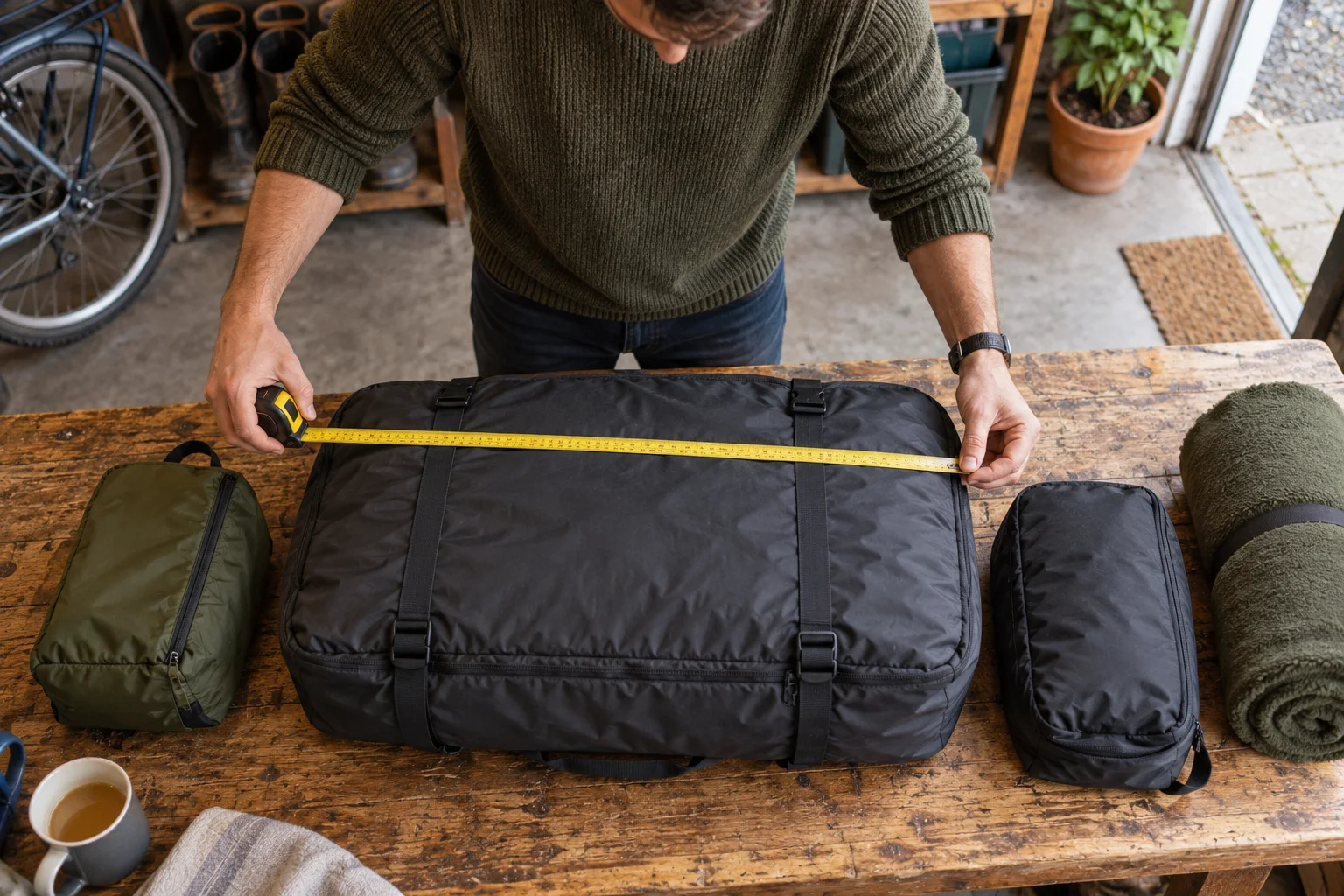
Measure the shape
A roof box’s maximum internal length, width and height do not describe a rectangular space available everywhere. Check the actual packed item against the lid taper, nose, mounts, opening and restraint layout. If the fit is close, use the model drawing and a physical packing check.
Separate external size, internal size and the loading opening
External dimensions tell you about the shell's footprint, handling and storage. Internal dimensions describe the space inside, using the manufacturer's measurement method. The loading opening is the route through which the item must pass. All three can matter to a single awkward suitcase.
A case might be shorter than the stated internal length but too tall under the lid. A long equipment bag might sit inside once positioned but be difficult to turn through the opening. A box with enough volume for your bags might still have mounting housings exactly where a rigid case needs to rest.
Treat a dimension list as a way to rule out unsuitable candidates, not a guarantee that every item below those maximum numbers will fit. For choosing a broad capacity class first, use the size guide. Once you have a shortlist, check the actual shape in more detail.
Measure luggage in the condition it will travel
Fill the bag with the intended contents and close it normally. Measure the longest, widest and tallest points, including wheels, handles, shoulder-strap fittings and pockets that bulge when loaded. A manufacturer's luggage dimension may describe an empty or differently packed bag.
Record whether the item can change orientation. A rigid case containing equipment that must remain upright creates different options from a soft clothing bag. Do not plan on crushing a hard object or repeatedly forcing a zip closed to recover a few centimetres.
For long kit, include the protective bag, bindings or end caps as relevant. The effective shape can be wider or taller at one end. Sketch those changes, because a single length measurement does not show whether the bulky end will meet the tapered roof-box nose.
Understand where maximum dimensions are measured
The widest point may be near the middle, while the longest space follows the centreline. Maximum height may be available only beneath the tallest part of the lid. Multiplying those three figures produces the volume of a rectangle that the curved box does not actually contain.
Imagine a packed case measuring 70 × 45 × 30cm. It may fall below all three maximum interior numbers and still fail at the proposed position because the lid falls to 25cm there. Those figures are an illustration of geometry, not a specification for any model.
Ask for a dimension drawing, photographs of the empty interior or an opportunity to try the packed item in the exact box. A flat floor outline can help compare length and width, but it cannot prove lid clearance. Do not use a generated lifestyle photograph as evidence of an interior shape.
Read conflicting manufacturer figures conservatively
For Motion 3 XL Low, Thule's product page gives 203 × 74 × 30cm internally. The linked manual gives 202.4 × 73.6 × 27.6cm. A suitcase relying on the extra product-page height needs confirmation for the supplied unit before purchase.
The Motion Sport also differs: the page gives 178 × 50 × 38cm, while the manual lists 177.4 × 50.1 × 35.2cm. Use the smaller relevant measurements for preliminary screening without pretending that they form a fully usable cuboid. Ask the manufacturer to clarify any tight fit.
The point is not to reject every box with rounded specifications. It is to recognise when a small discrepancy changes your purchase. Flexible clothing may tolerate a different arrangement; a rigid equipment case may not.
Map mounts, straps and mechanisms before laying out bags
Mount housings and adjustment tracks can interrupt the floor. Straps and restraint points need to remain usable after packing. Locks, hinges and lid supports need their intended clearances. Avoid planning a layout that hides these parts beneath tightly packed cases.
Use the actual supplied restraint system and load-distribution instructions. Empty gaps are not necessarily waste: some space may be needed to close the lid normally, route restraints correctly or reach fittings. A bag wedged tightly against the shell is not a substitute for restraint.
If you need a particular arrangement, write down the proposed position of the least flexible item first. Build around it with smaller luggage rather than filling the easy corners and discovering the main case has nowhere to go.
Check the loading route as well as the final position
Consider the height of the installed box, the opening side and whether the bag can be held safely while it is manoeuvred inside. A heavy case that only fits after being rotated above shoulder height may be an impractical choice even if a drawing suggests enough room.
Do a trial at a suitable height, using safe handling and the manufacturer's instructions. Keep fingers and loose straps clear of closing parts. If a lid needs force to close, remove or rearrange luggage and investigate the obstruction; do not use the lock to pull the lid down over it.
For a box sharing the roof with a bike carrier, check whether the bike prevents the intended opening or lifting path. Read the opening-system comparison when access is a key part of the decision.
Compare bags by packed shape, not added capacity labels
A set of four nominal 75L bags does not necessarily occupy a useful 300L arrangement in a nominal 300L roof box. Bag dimensions, tapered ends, unused gaps and how the luggage compresses affect the fit. Packed height is often more useful than an impressive total-litre figure.
You may find that two larger bags plus several smaller ones use the interior better than a uniform set. Try existing luggage before buying replacements. Keep the bag needed at an overnight stop accessible without unloading everything into a car park.
Keep a repeatable packing record
Once a permitted layout works, record bag dimensions, approximate contents and the actual weight. A photograph of your own completed arrangement can help you repeat it, but recheck when bags, mounts or equipment change. Luggage added for the return journey still counts.
Complete the load calculation separately: an interior that accepts the bags does not establish that the car may carry their weight. The low-profile guide covers installed height, which is different again from internal luggage height.
Manufacturer dimensions checked October 2026 using the Motion instructions, XL Low product page and Force instructions. Confirm close fits with the manufacturer and the actual supplied box.
Frequently asked questions
Why does my suitcase not fit when it is below the published dimensions?
The figures may be maximum measurements taken at different points. Lid taper, the loading opening, mounts or the intended orientation can leave less space where the case needs to sit.
Can I multiply internal length, width and height to calculate capacity?
That gives a rectangular volume, not the actual usable space in a curved box. It should not be used to replace the manufacturer’s capacity figure or a packing check.
Should I measure the empty or filled luggage bag?
Measure it filled and closed as it will travel. Include bulging pockets, wheels, handles and other projections.
Which dimensions should I use if the manual and product page differ?
Use the smaller relevant measurements to screen the load, then ask the manufacturer to confirm the supplied unit. A close fit should be checked physically where possible.
Does a bag that fits inside the box meet the weight limit?
Not necessarily. Check the actual packed weight against the vehicle, rack and box limits independently from the dimensional fit.