
Compatibility guide / Packing, storage and care
Matching Locks Across Roof Bars, Boxes and Carriers
Plan matching locks across compatible roof bars, boxes and carriers. Count cylinder positions, verify One-Key compatibility and distinguish rekeying from spare keys.
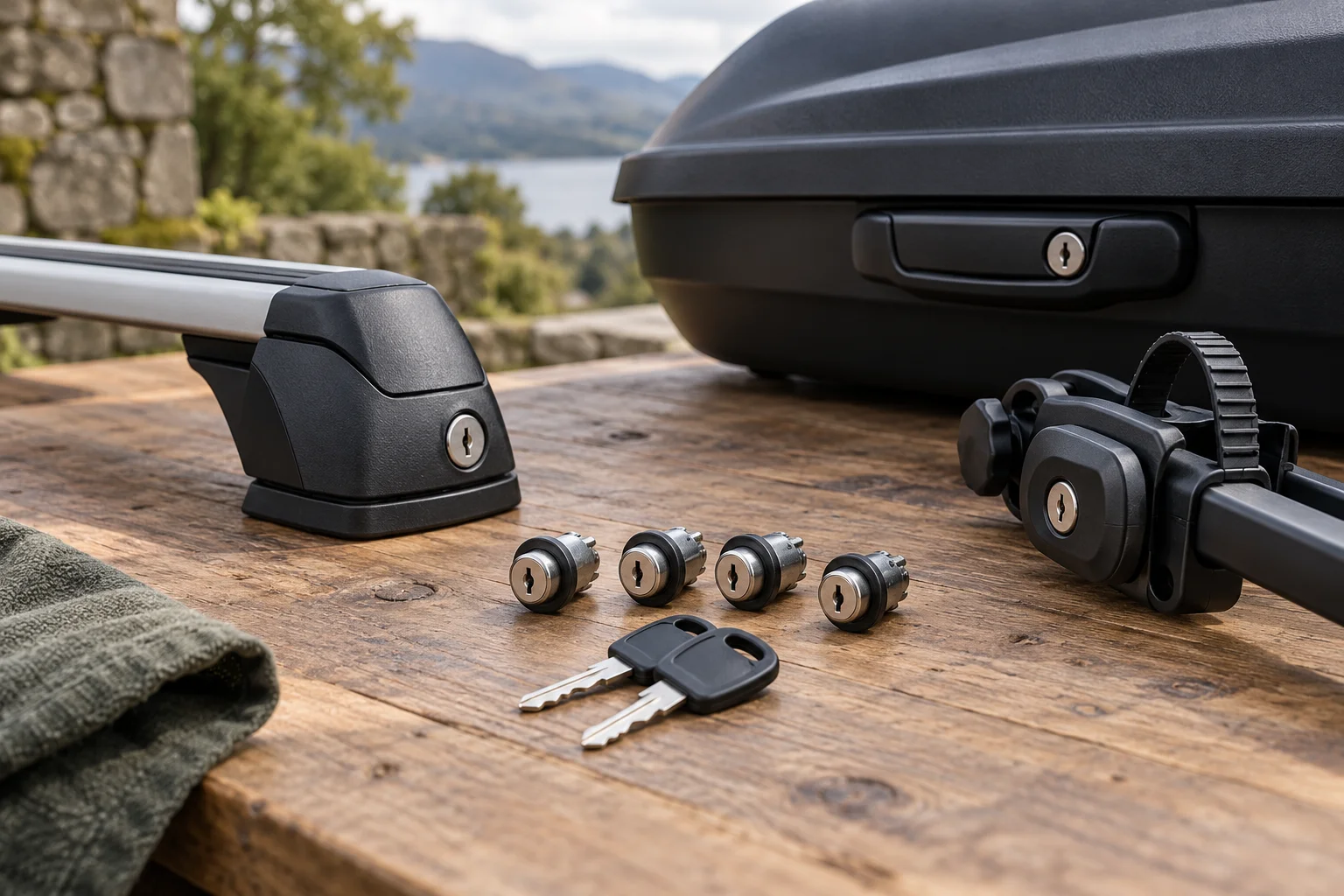
Count compatible lock positions, not accessories
A matching-cylinder set can simplify the keys for an approved family of locks. First identify every actual lock position and verify that it accepts the same system. Replacing a key, changing cylinders and opening a locked mechanism are different tasks.
Make an inventory of the whole carrying setup
List the bars and feet, roof box, bike or watersport carriers and any other equipment with locks. Record the exact model and generation, the cylinder system and the number of lock positions actually fitted. A product can have more than one locking function, so a count of three accessories is not necessarily a count of three cylinders.
Check the instructions and the actual hardware together. A lock-looking cap may not be a removable cylinder, while a separate carrier-to-bar lock can be easy to miss when concentrating on the lock that retains the bicycle. Do not order a pack around a generic diagram for a different generation.
Keep the operating codes and spare-key locations in a private ownership record. This helps distinguish a planned convenience upgrade from a missing-key or damaged-lock problem that needs another route.
Confirm compatibility before comparing pack sizes
A One-Key label describes a particular compatible cylinder system, not permission to fit that cylinder into every product from the brand. Check each exact model and the manufacturer’s current instructions. Mixed generations or another brand’s locks may need separate keys even when the handles look similar.
Do not force a cylinder into an incompatible housing or alter the retaining mechanism to make it fit. The purpose of matching is to simplify normal operation while preserving the correct lock and fastening functions, not to adapt an unrelated component.
If one item cannot be confirmed compatible, keep it outside the proposed set until the maker clarifies it. A partial matching arrangement can still be convenient; it does not need to include every object in the garage to be worthwhile.
Count each functional position
Work through the equipment one item at a time and record the quantity. Inspect all relevant sides and functions. A dual-side opening box may have operating positions on both sides, and a bike carrier can lock the bicycle to the carrier separately from the carrier’s attachment to the bars.
Use a worksheet and leave unresolved entries clearly marked. Do not assume every rack has four replaceable locks or every box has two; confirm the actual system before assigning quantities.
| Equipment | What to record | Before assigning a quantity |
|---|---|---|
| Vehicle rack | Exact feet and lock positions | Check the actual fitted system |
| Roof box | All operating positions and generation | Confirm cylinder compatibility on each side |
| Bike carrier | Bike retention and carrier attachment locks | Inspect every separate locking function |
| Other carrier | Any fitted compatible cylinders | Do not count an optional lock as already fitted |
| Spare components | What remains in use or is being replaced | Avoid mixing old codes into the intended set |
Choose a complete matching set deliberately
Add the confirmed quantities and choose a supported matching package or code-matching route. A spare cylinder can be useful only if it is the correct system and belongs to the intended key code. Do not assume two separately purchased packs will happen to use the same code.
For illustration, an inventory that confirms four rack positions, two box positions and two carrier positions totals eight. Those quantities are hypothetical and must not be copied to a named car or accessory without checking its hardware. A different rack or carrier may produce another total.
Check the existing state and required access
Before purchasing, establish whether each lock works normally and whether the equipment is open or locked. A matching set is not an operating key for an unidentified locked cylinder. Follow the authorised replacement procedure for the actual product and obtain service help where the required existing access is unavailable.
Distinguish the operating key from any installation or change key supplied for the process. They have different purposes. A marketplace title using the word “master” is not proof that an item opens all locks or solves a lost-key situation.
If a lock is damaged, confirm whether the maker requires a housing, handle or other part to be repaired as well. Replacing only the cylinder can leave the original mechanical fault untouched. Use the replacement-key guide when the real need is identification of a missing operating key.
Follow the exact replacement instructions
Use the manufacturer’s procedure and specified parts for each confirmed compatible product. Keep the equipment supported and avoid leaving a box or carrier in an incompletely secured state. If a step does not match the actual hardware, stop and check the model rather than forcing the part or applying another product’s instructions.
Keep removed parts identified so they do not become mixed with the new matching set. Do not discard working old components until the complete approved operation has been checked and their future use is decided. Retain the instructions and record the new code privately.
This planning guide does not substitute for the cylinder fitting procedure or describe a way around a locked mechanism. Where ordinary authorised replacement is not possible, use the manufacturer’s support or a suitable service provider.
Verify operation at every position
After the approved change, check every intended lock using normal operating force and the correct key. Confirm the equipment opens, closes and retains the key as its instructions specify. Check both sides of a box and every separate carrier function rather than testing one cylinder and assuming the rest match.
Do not use a key to overcome a trapped strap, an overpacked lid or misaligned hardware. Correct the underlying packing or fitting problem. Mechanical attachment and load restraint remain separate from whether a cylinder turns successfully.
Before driving, complete the pre-journey checks for all equipment. A matching operating key simplifies the routine but does not confirm vehicle fit, roof load or correct installation.
Manage spares without relying on one key alone
Keep at least one working spare in a suitable secure location separate from the everyday key, and make the arrangement clear to authorised users. A single code across several products can reduce confusion, but losing the only operating key can then affect the whole setup.
Review the record when selling a carrier, replacing feet or adding another box. Confirm how the new item joins the plan instead of assuming its supplied key already matches. Locks help deter theft but do not guarantee security, so choose appropriate parking and off-car storage as well.
Sources checked October 2026: Thule One-Key 450800, Thule parts and instructions and ProRide 598001. Confirm each exact cylinder system and follow its authorised replacement procedure.
Frequently asked questions
Can one key operate all my roof equipment?
Only where every relevant lock accepts the same compatible cylinder system and the cylinders are deliberately matched. A shared brand name or similar key shape does not establish compatibility across all generations.
How many cylinders do I need?
Count each actual lock position, not the number of accessories. Feet, both sides of a box and multiple functions on a carrier can each add positions; confirm the exact equipment rather than using a generic total.
Will two separately bought One-Key packs use the same code?
Do not assume separately purchased packs match each other. Confirm a single matching set or the manufacturer’s supported code-matching route before combining purchases across a larger setup.
Does a change key unlock every One-Key cylinder?
No. An installation or change key has a specific role in the authorised replacement procedure. It is not a substitute for the correct operating key or a solution to an unidentified locked mechanism.
Does matching locks make the equipment theft-proof?
No. It can simplify key management, but locks remain only one part of security. Complete all mechanical fastening checks and plan suitable parking or storage rather than relying on a shared key system alone.