
Packing guide / Watersports carrying
Packing an Inflatable Kayak in a Roof Box: Bag Dimensions, Weight and Wet Kit
Check the complete packed kayak bag against usable roof-box dimensions, load allowance and internal restraint. Plan paddles, pumps, wet return kit and drying after travel.
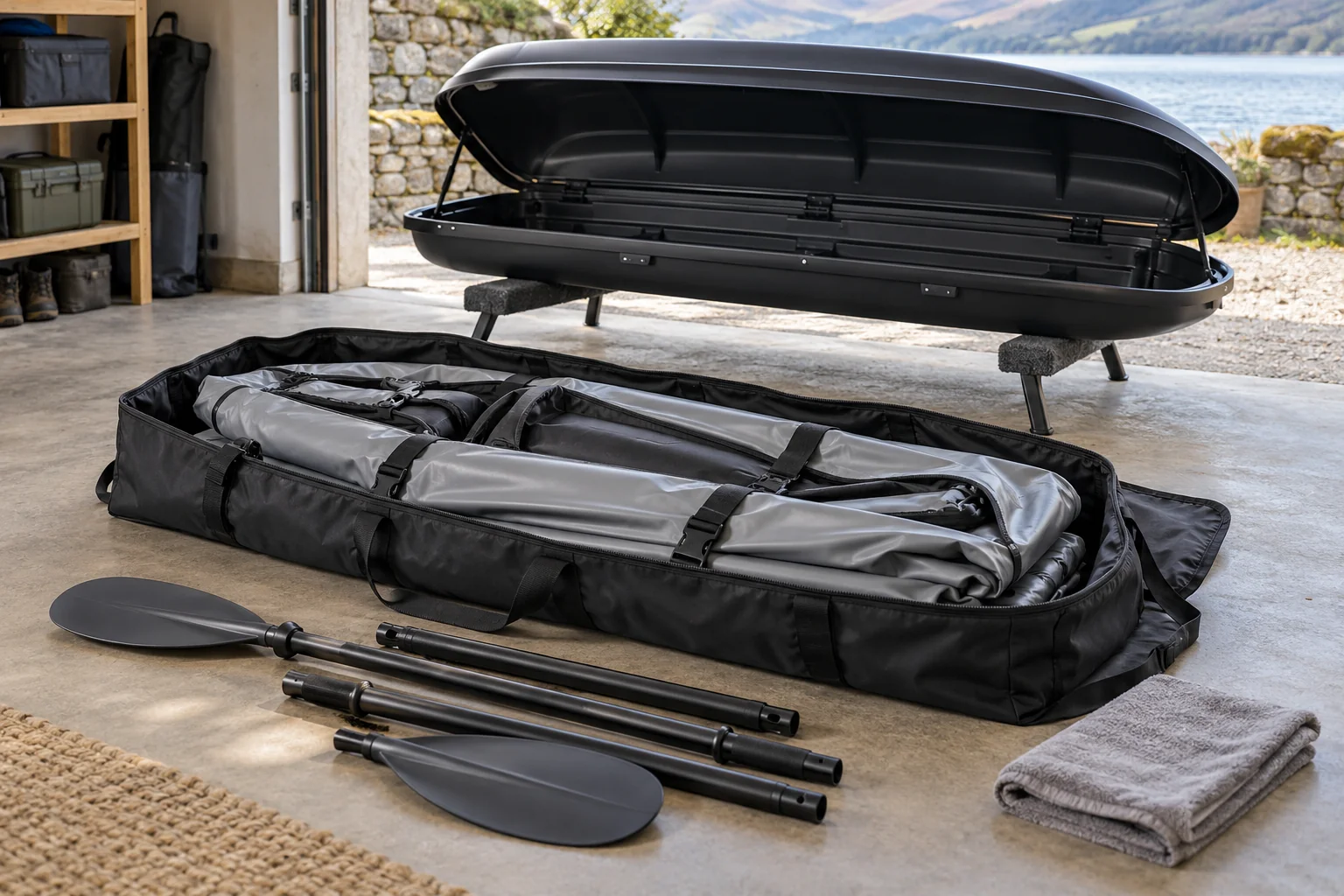
An inflatable kayak can travel in a roof box only if the complete packed load fits and can be restrained correctly. Start with its travelling bag, not just the box volume or the kayak’s advertised deflated hull size. Include the pump, seats, paddles and wet-return plan in the decision.
A roof box can free useful boot space, but its tapered lid and mounting hardware can make a bulky folded load harder to place than ordinary soft luggage. Check the actual shape before buying a larger shell or repacking the craft more tightly.
Measure the complete travelling bag
Pack the kayak as its maker instructs, using the intended bag and permitted folds. Measure maximum length, width and height including handles, bulges and rigid parts. Record which accessories are inside and which travel separately.
A product page’s deflated hull dimensions may exclude the bag and accessory bundle. Sea Eagle’s 380x example lists 26×19×10in, approximately 66×48.3×25.4cm, for the deflated hull. That is useful background, but it does not establish the size of a bag containing the hull, seats, pump and other kit.
If the bag is difficult to close at home, do not assume the roof box can act as the compression device. Resolve the permitted fold and packing method first, especially around valves, fin or skeg bases and removable rigid components.
Compare usable shape rather than litre capacity
Check the box’s conservative internal dimensions, then its actual taper, opening and obstructions. A quoted maximum interior height can occur only near the centre, while the kayak bundle may need that height over a wider footprint.
For example, a hypothetical 72×54×34cm packed bag is wider than a box with a 51cm published internal width. Rotating it or relying on soft sides is not automatically an approved fit. A wider box remains only a candidate until the lid, mounts and restraints clear the real load.
Use the internal-dimensions guide for the measurement approach. Leave the manufacturer’s required clearance around lid mechanisms and mounting controls rather than filling every nominal centimetre.
Weigh the kit as it will travel
Weigh the complete bag and separately packed accessories. A bare-hull figure does not cover a pump, seats, paddles, repair equipment or retained water. Count any additional roof load in the vehicle and rack calculations too.
A heavy bundle can consume much of the remaining roof allowance before other luggage is added. Use the roof-load calculator with verified rack mass, empty-box mass, box payload ceiling and other roof equipment. The lowest applicable allowance governs the box contents.
Keep the fold and pressure on the craft within its instructions
Deflate and fold using the maker’s method. Protect valves, skeg bases, seams and rigid attachments; do not create a sharper fold just to make the bundle match a box measurement. Remove accessories only where the craft instructions permit it.
Sea Eagle’s Explorer instructions, for example, describe a fold that protects the skeg-base arrangement and require dry craft and accessories before storage. That illustrates why a compact-looking roll is not the only objective. Use the exact manual for your own construction and revision.
Keep sharp paddle ends, pump fittings and tools from pressing into folded material. A soft bag does not make those contacts harmless under the box’s required load restraint or during movement.
Plan paddles, pumps and dry accessories separately
Measure dismantled paddle sections with their blades and connectors included. Check that the permitted packing position clears the box’s internal mounts and lid, and use the prescribed restraint. Do not place a long rigid section diagonally across a mechanism just because its tip clears the opening.
Keep the pump and loose small parts organised so they cannot shift into the folded hull. Check storage conditions for any electrical pump or battery separately. A roof box is not an assumption of protection from heat or moisture for every accessory.
Secure the load inside the box
Use the box’s prescribed internal restraints and anchor points. Check the bag and accessories remain correctly positioned while the required restraint is applied. Carry handles and external compression straps are not automatically approved load attachments.
Keep mounting controls, lid supports, hinges and locks clear. Do not route a strap through an unrelated mount or rely on the lid pressing down on a bulky bag to stop movement. The load must fit and be restrained before the lid closes normally.
Complete a stationary closure check with the real contents. If you need to force the lid or use the locks to compress the bundle, unpack and change the arrangement. Consider a suitable secure interior-vehicle load space if the roof box cannot accept the approved packed shape.
Make a separate plan for the wet return journey
Drain and clean the craft as its maker requires before folding for travel. Sand or grit left in a fold can damage material, and retained water adds mass. A wet bundle may be heavier and bulkier than the carefully dried outbound pack.
Where temporary containment is permitted, use a suitable bag or liner and protect the rest of the load. Do not assume an ordinary duffel is waterproof or that the roof-box shell will keep all moisture away from mechanisms and luggage. Keep the internal restraint arrangement effective around any liner.
Unpack and dry promptly after arrival
A closed roof box is temporary transport space, not a drying room or long-term wet store. Unpack the craft, bag and accessories and dry them as their makers require. Check hidden folds and removable components rather than judging only the exposed outer surface.
Follow the craft’s heat restrictions. Sea Eagle warns against excessive heat during storage; do not leave the folded kayak in a hot parked car or roof box as a default storage solution. The permitted conditions depend on the actual materials and equipment.
Finally inspect and dry the box interior using its approved care method, and check restraints and mounts before the next trip. Keep the measured packed dimensions and full-kit weight with your trip notes, but recheck after changing the kayak, pump or packing bundle.
Sources and selected Amazon packages checked October 2026: Sea Eagle 380x hull specifications, Explorer manuals and folding instructions, Motion 3 XL and the selected accessory specifications. Use the current manual for the actual box and kayak.
Frequently asked questions
Will an inflatable kayak fit any large roof box?
No. Measure the complete packed bag, including bulges, handles, pump, seats and any other items inside. Compare it with the box’s actual usable shape, opening, mounts and restraint space. Litres and the bare hull’s deflated dimensions do not guarantee the bag will fit.
Can I use a kayak’s published deflated size as the bag size?
Only if the manufacturer explicitly defines it that way. Sea Eagle’s 380x example gives deflated hull dimensions of 26×19×10in, approximately 66×48.3×25.4cm. A fully packed travelling bag with accessories can have a different shape and mass.
Can I put a damp kayak bag in a roof box for the drive home?
Use a suitable temporary containment and packing arrangement only where the craft, bag and box instructions permit it. Drain the kit, count its actual travelling weight and protect the box and other luggage. Unpack promptly and dry everything properly; the roof box is not long-term wet storage.
Does a waterproof bag replace the box’s internal straps?
No. A bag contains or protects its contents; the roof box still needs its prescribed internal load restraint. Do not attach the load to lid arms, hinges or arbitrary mount parts, or treat a carry handle as an approved restraint point.
Can I squash the bag down with the roof-box lid?
No. The contents must fit without forcing the lid or using its locks to compress the load. Protect valves, skeg bases and folded material as the kayak instructions require. If the approved packed shape will not fit, change the packing arrangement or carrying method.