
Ownership guide / Roof boxes and support
Roof Box Warranties: Coverage, Spare Parts and Checks Before Buying
Compare roof-box warranty terms before buying: eligibility, registration, exclusions, spare parts, claims evidence and the separate rights you have against the seller.
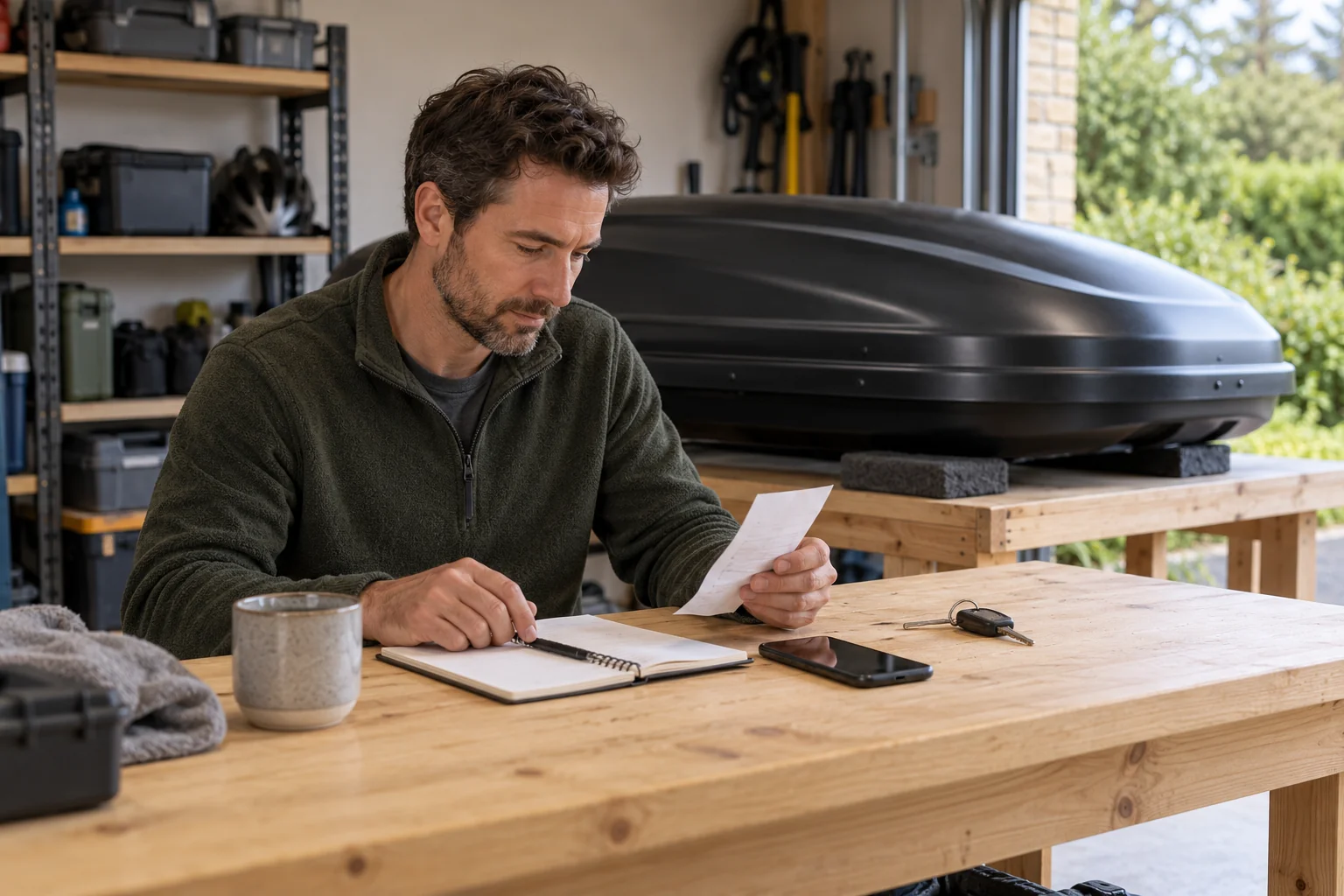
Compare a roof-box warranty by what it covers, who can claim and how support works. A longer headline period is useful only when the applicable terms cover the relevant fault and you can provide the information needed to use it.
Before ordering, establish the exact box, seller and market. Save the product identity, applicable warranty terms and purchase record alongside the fitting instructions. Those details are more useful than a generic promise that a brand offers “excellent aftercare”.
Separate the manufacturer's guarantee from seller obligations
A voluntary manufacturer warranty and your rights against the seller are different routes. GOV.UK's guidance explains that statutory rights are not removed by the absence or expiry of a guarantee.
That does not mean every fault produces the same remedy or that any box is guaranteed to last a fixed number of years. The facts of the purchase, product condition and applicable rules matter. Keep the seller identified, particularly when ordering through a marketplace where the platform and seller may be different businesses.
A change-of-mind return, a faulty-goods claim and a manufacturer warranty claim can also involve different processes. Check which route applies before sending a bulky shell to an address found on an old leaflet.
Check the exact product and purchase eligibility
Record the model number and generation, not just the family name. Confirm that the warranty applies to the product, country of purchase, seller and intended use. Ask about any requirement for an authorised seller or restrictions affecting commercial use.
Check whether cover is limited to the original purchaser and what evidence is accepted. A gift, second-hand purchase or product bought from a seller in another market may require a different enquiry. Do not assume a receipt passed to a later owner automatically transfers a guarantee.
| Question | Keep a record of | Why it matters |
|---|---|---|
| Who supplies cover? | Named brand or seller and applicable market | A marketplace title is not the full contract |
| Who can claim? | Purchaser, proof and transfer conditions | Second-hand eligibility may differ |
| How long and for what? | Standard/extended periods and covered faults | Longer cover may have narrower scope |
| What must I do? | Registration and instruction requirements | Extra cover may require an action |
| What is excluded? | Use, damage and property exclusions | A box guarantee is not general insurance |
| How is a claim handled? | Contact route, transport and evidence | A large shell can be awkward to return |
Save the answers that apply to your actual order rather than relying on a later search for the same page.
Read standard and extended periods separately
The Thule UK policy checked here describes a two-year Guarantee and three additional years of registered extended warranty for boxes and baskets. The extended period concerns materials and workmanship and has its own exclusions; it is not an identical extra period of every kind of cover.
Confirm the applicable registration process and any deadline before assuming an extension is active. Keep the confirmation with the purchase documents. Do not apply US or other regional warranty wording to a UK order without checking the terms that actually govern it.
A detailed warranty comparison should distinguish eligibility and scope rather than award the longest number an automatic buying recommendation.
Resolve registration wording before purchase
VonHaus's current warranty overview says most products receive two-year cover automatically without registration. Its full terms contain additional conditions and registration wording. Confirm the applicable process for the exact box and seller if the documents supplied with the order leave doubt.
Ask a focused question that identifies the model, seller and concern. Keep the response. This is especially useful if a retailer summary and the brand's policy appear to describe different periods or steps.
Read exclusions around the way you will use the box
Check how the policy treats overloading, incorrect fitting, misuse, modifications, accidental damage and maintenance. Look at the distinction between a manufacturing fault and deterioration or damage associated with use.
Do not assume a guarantee covers a collision with a car-park barrier, forced locking, an unsuitable storage position or water damage to luggage. The Thule terms checked here expressly exclude damage to the vehicle and cargo. Other brands need their own terms checked.
Use those boundaries to plan ownership: follow the instructions, keep the box correctly supported and resolve a fault before travelling. The guarantee is a support route, rather than permission to continue using doubtful equipment.
Check spare-part identification and practical availability
Before buying, find whether the manufacturer publishes a parts diagram for the exact model. Look for identifiable mounts, restraint parts, locks, hinges or lid supports where applicable. A diagram helps match a later enquiry, although it does not guarantee indefinite stock.
Ask how replacement components are obtained and whether a repair requires an authorised service route. A family name shared by several generations can hide different mechanisms. Do not assume a replacement advertised for an older shell fits a newer one.
For future reference, keep the key identification guide and original restraint advice alongside the manual. A lost key or misplaced strap may be a paid parts purchase rather than a warranty fault.
Save a claim record when the box arrives
Keep the invoice or other purchase evidence, the named seller, the product model and serial information, and any registration confirmation. Photograph the identification label and the delivered condition while keeping personal order details private.
Store copies of the applicable terms and instructions in a folder you can find later. Include correspondence resolving a particular compatibility or warranty question. Avoid relying on an account page that may become difficult to locate when the product is discontinued.
Check the delivery and returns instructions before discarding useful packaging. A full-size box can need a different collection arrangement from a small parcel, so establish the process instead of mailing it to a company's registered office.
Report faults before attempting an unapproved repair
Describe the problem, when it occurs and how the equipment has been used. Provide the requested photographs or video and product identity. Do not force a mechanism repeatedly merely to demonstrate a fault.
For retailer purchases, the Thule policy directs the buyer back to the point of sale and asks for purchase and product information. Follow the actual brand or seller instructions for your order, including assessment and transport arrangements.
Keep equipment out of service where the fault affects secure attachment, closure or support. Do not drill, glue, substitute structural parts or bypass a locking interlock to preserve a holiday plan. Obtain the correct assessment and approved remedy first.
Compare the complete ownership decision
Assess warranty eligibility, support access and spare-part identification alongside price, fit, usable capacity and storage. A cheaper box with uncertain fitting documentation is not made suitable by a long warranty headline. A higher price also does not prove broader protection.
Keep the replacement-box guide separate from this comparison: it covers retaining bars and recalculating the load. If buying a previously owned shell, use the second-hand inspection checklist and verify any claimed cover independently.
Policies and selected models checked October 2026. Sources: the linked Thule UK policy, VonHaus overview and full terms, VonHaus returns policy and GOV.UK guidance. Confirm the terms applying to the actual purchase before relying on a particular period or remedy.
Frequently asked questions
Does a roof-box warranty replace my consumer rights?
No. An optional manufacturer guarantee is separate from statutory rights against the seller. GOV.UK explains that a seller may still have obligations even when a warranty has expired; the remedy depends on the purchase and circumstances.
Does Thule give every roof box a lifetime warranty?
The UK policy checked here describes a two-year Guarantee and a registered extended warranty of three additional years for boxes and baskets, with different conditions and exclusions. Do not substitute a lifetime claim or another market's terms for the applicable UK policy.
Does a roof-box warranty cover damage to my car or luggage?
Do not assume so. The Thule policy checked here excludes damage to the vehicle and cargo, among other property. Read the applicable brand and purchase terms rather than treating the box warranty as insurance for everything carried.
Can I transfer the warranty when I sell the box?
Check the exact terms before promising that. Policies can be limited to the original purchaser and require proof of the original purchase. Give a later buyer the product identity and history without presenting unconfirmed cover as transferable.
Should I repair a faulty lock or hinge before making a claim?
Contact the relevant seller or manufacturer first and follow their instructions. Keep the box out of use if the fault affects secure carrying. Unauthorised work can complicate the assessment, and a spare part must match the exact model and fault.