
Practical guide / Boxes and accessories
Can You Take a Car Through a Car Wash with Roof Bars or a Roof Box?
Check automatic car-wash restrictions for roof boxes and removable racks. Plan removal, controlled hand cleaning, drying and correct refitting without assuming brushless means safe.
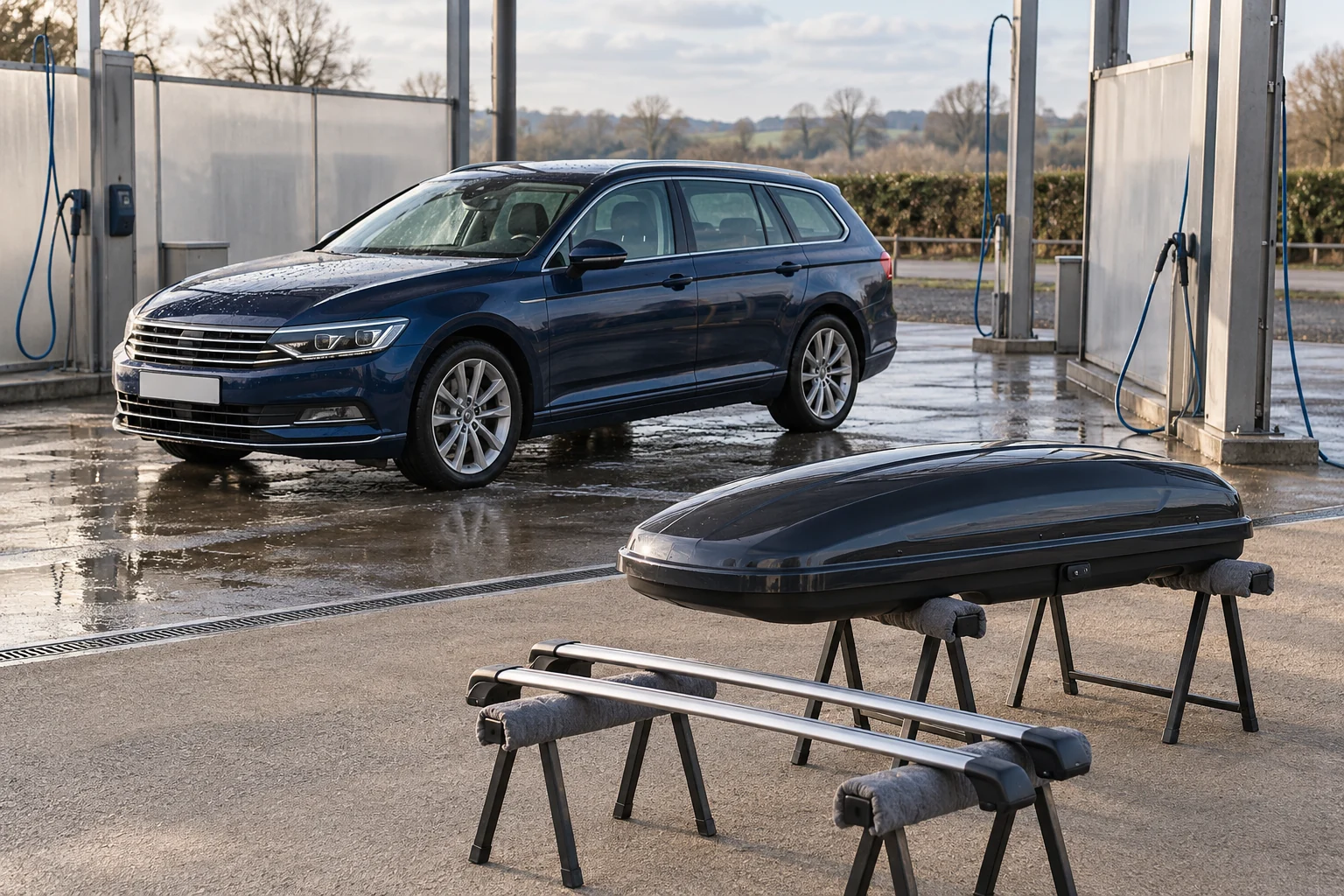
Read the equipment rule before joining the queue
For Thule roof boxes, the manufacturer’s safety instructions require the roof box and roof rack to be removed before using an automatic car wash. The rule is about the complete wash process, not simply whether the entrance is tall enough.
Check the instructions for your own box, bars and vehicle, then the wash operator’s restrictions. If one requirement rules out the arrangement, a permissive sign elsewhere does not approve it. Arrange removal in a suitable place before visiting or choose another permitted cleaning method.
Do not begin detaching a large box while waiting in a wash queue. You need room, stable footing, safe handling and somewhere to put the equipment. A spontaneous lift beside moving cars is a poor substitute for planning the task at home.
Distinguish rails, crossbars and carrying equipment
Factory longitudinal rails run along the car and may be part of its permanent roof equipment. Removable crossbars run across the vehicle and support the box or carrier. Feet and fitting kits form the connection between those bars and the car.
These distinctions matter when reading a wash policy. An operator’s reference to factory rails does not necessarily include added crossbars, and a height limit does not list every prohibited accessory. Describe the actual setup if asking for clarification.
Do not remove factory-fixed or structural parts based on general advice about taking off a rack. Use the vehicle handbook for those fittings. The raised-versus-flush rail guide can help identify the roof type before you interpret the rack instructions.
Do not treat brushless as a general exemption
Automatic washes differ, but a system without brushes still applies water, chemicals and a defined machine procedure. A claim that nothing touches the car does not establish compatibility with every rack, lock, adhesive accessory or roof-box overlap.
Use the actual equipment restriction rather than judging the wash by its marketing name. Thule’s instruction to remove box and rack applies to automatic washing; it does not become optional because the box is empty or the selected programme is shorter.
Similarly, do not fold a carrier flat or remove only its most visible arm and assume the remaining attachments are accepted. Each accessory and the operator may have its own rule. If it remains unclear, resolve it before entering.
| Method | What to establish before use |
|---|---|
| Automatic wash | Remove equipment where its instructions require; meet vehicle and operator rules |
| Brushless automatic wash | No automatic exemption from the equipment restrictions |
| Self-service jet wash | Exact product permission, approved settings and operator conditions |
| Controlled hand wash | Approved cleaners, gentle method, stable access and safe handling |
Remove the equipment where you can handle it safely
Unload the box and follow its removal sequence in a suitable area. Use the prescribed assistance for a large or awkward shell, keeping people and paintwork protected. Do not lift using an open lid, a locking handle or an accessory unless the manufacturer expressly identifies it as a lifting point.
Place detached equipment on appropriate supports in a dry, protected location. Keep clamps, bolts, keys and vehicle-specific pieces together. Photograph the correct installation for reference if useful, but retain the actual instructions and fit details too.
If removing the bars involves vehicle-specific torque or a fitting-kit sequence, follow it exactly. Do not force a seized fastener simply to reach the wash appointment. The off-car storage guide covers the separate task of supporting a detached box.
Clean the shell with its approved materials
Use the method and products permitted for the exact shell and finish. Thule’s safety guidance specifies water with standard household washing liquid without alcohol, bleach or ammonium additives, and warns against cockpit sprays. Do not extend that permission to every chemical sold as a car cleaner.
Remove loose grit gently before wiping, avoid abrasive pads and keep any lock-specific treatment away from plastic where the instructions require it. A clean cloth is useful; an aggressive cleaner is not made compatible by applying it with a soft cloth.
Work from a stable position without leaning your body weight on the lid or using the roof box as a handhold. Detaching the box may make access easier, but the supports and handling still need to suit its instructions.
Keep jets and water out of an improvised test routine
Do not direct a concentrated jet into a lock, lid overlap or mounting area to see whether it leaks. That is not a substitute for an approved diagnostic method. If moisture is already appearing inside, record it and use the water-ingress guide.
For a permitted self-service method, obtain the actual pressure, distance and chemical restrictions from the product maker and follow the operator’s conditions. This guide does not invent a universal safe nozzle distance. If those conditions cannot be established, use an approved controlled alternative.
Keep electrical accessories within their own care instructions. Remove or protect a light only as its maker directs; do not assume an interior lamp’s weather rating permits direct jets or immersion. Check the roof-box light guide for the separate fitting considerations.
Dry and inspect before storage or refitting
Unload any cleaning items and dry the shell, interior, straps and permitted removable accessories as instructed. Check beneath a removable liner rather than leaving water concealed there. Do not store damp bags inside the closed box after washing.
Look for new scratches, distortion, displaced covers or damaged mounting parts. If an automatic wash or impact has already affected the equipment, stop and obtain assessment rather than reinstalling it because the car now looks clean.
Refit from the instructions, then check the journey setup
Use the exact vehicle fit result, bar positions, feet and kit. Complete the prescribed tightening method and security checks rather than simply aligning old marks. A part that was disturbed during removal needs the normal installation checks again.
Refit the box within its permitted spacing and clearance range, secure the luggage and close and lock it correctly. Recheck the total loaded height, including the actual bars and box position. Do not assume the bare car’s wash clearance remains relevant once the equipment is back on.
The pre-journey checklist brings those routine checks together. If the equipment is not needed for the next journey, follow the manufacturer’s removal and storage advice rather than refitting it solely because it has just been cleaned.
Sources checked October 2026: Thule automatic-wash and maintenance requirements, Force 3 instructions and Motion 3 care instructions. The actual vehicle handbook and wash operator’s current conditions remain part of the decision.
Frequently asked questions
Can I use an automatic car wash with a Thule roof box?
Thule’s roof-box safety instructions require both the box and roof rack to be removed before an automatic wash. Sufficient entrance height does not override that requirement. Follow the vehicle, equipment and operator instructions together.
Is a brushless automatic wash safe with roof bars?
Brushless does not automatically mean permitted. The rack and vehicle instructions still apply, along with the wash operator’s restrictions. Do not assume that removing brushes removes risks from jets, chemicals, moving equipment or the overall wash procedure.
Can I leave factory longitudinal rails on the car?
Factory rails and removable crossbars are different equipment. Check the exact vehicle handbook and operator instructions for factory fittings. Do not remove structural or factory-fixed parts based on generic advice about taking off an aftermarket roof rack.
Can I clean a roof box with a pressure washer?
Only use a method expressly permitted for the exact product, with any specified settings and distances. Do not invent a universal safe pressure or aim jets at locks, overlaps and mounts. Controlled hand cleaning with approved materials is the more straightforward option where permitted.
Do I need to check the rack again after refitting it?
Yes. Use the exact vehicle fit result and component instructions for position, hardware and tightening. Recheck the box attachment, closure, restraints and loaded height before travel. A remembered position or an old photograph does not replace the prescribed security checks.