
Accessory comparison / Bike carrying
Front-Wheel Holders for Fork-Mounted Bike Racks: Roof or Boot Storage?
Decide where to carry a removed front wheel: compare roof wheel-holder fit, axle adapters, available bar space and protected, restrained storage inside the car.
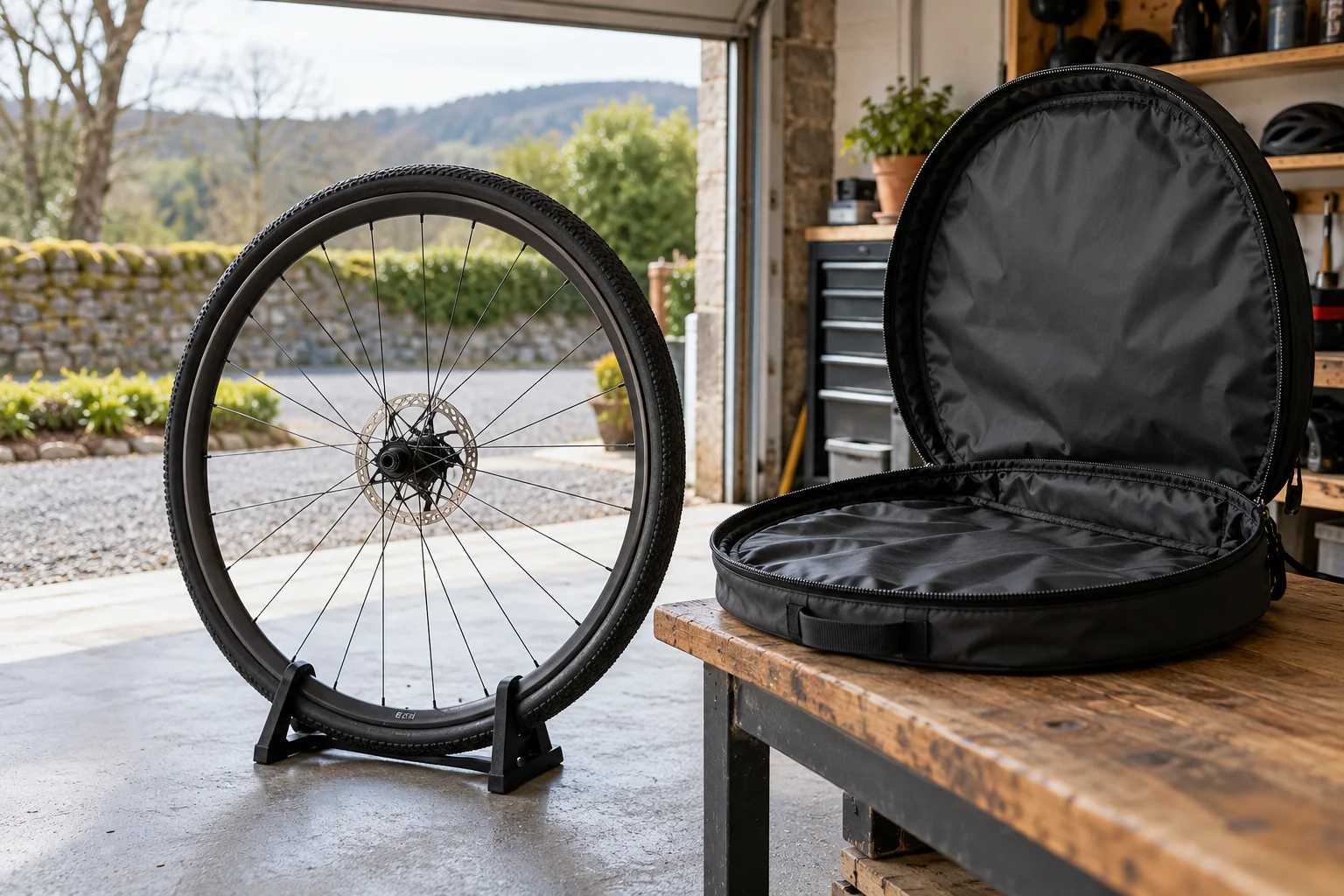
Choose a travelling position for the removed front wheel before buying a fork-mounted bike carrier. A dedicated roof wheel holder saves boot space but adds roof mass, width and another axle interface. A padded wheel bag protects luggage and wheel surfaces, but the bagged wheel still needs secure restraint inside the car.
The right answer depends on the actual wheel, the remaining space on the bars and the available vehicle load area. Neither an empty corner of the boot nor an unused-looking section of crossbar proves a suitable carrying position.
Separate the bicycle mount from the loose-wheel mount
A fork carrier supports the bicycle through its approved fork interface and rear-wheel restraint. Once the front wheel is removed, its hub, rotor and tyre become a separate item to transport. The adapter needed for the bicycle is not necessarily suitable for holding that loose wheel.
Read the fork-mount buying guide for the bicycle attachment. Then identify the detached wheel’s hub type and dimensions independently. Keep small axle pieces and removable end caps together so the bike can be reassembled correctly at the destination.
Check what a dedicated roof wheel holder accepts
Thule’s 547001 Front Wheel Holder is a specific example of a roof-mounted loose-wheel system. Its product features describe 20–29in wheels and tyres up to 3in, with 9mm quick release as the standard interface. A separate adapter is required for supported through-axle wheels.
The same page lists 16–29in in its technical range. Because those statements differ, use 20–29in as the conservative starting range and seek exact manufacturer confirmation for smaller wheels. Do not interpret the broader line as permission when another part of the page excludes the wheel.
The listed holder mass is 1.1kg. Include the wheel, adapter and required hardware in the roof calculation as appropriate. Check the actual unit’s supplied instructions and package; an accessory image or familiar product number does not establish the complete fitted configuration.
Resolve the through-axle adapter specification
The 547100 accessory is for the detached-wheel holder. Its title and linked manual name 12–20mm, but the current product-page feature says 12–15mm. That difference needs resolving for the exact wheel, particularly for a 20mm configuration, rather than selecting a part solely from its name.
Confirm hub spacing, the required bearing surfaces and the illustrated arrangement as well as nominal diameter. If the actual wheel cannot be seated and secured exactly as specified, do not use improvised sleeves, washers or the bicycle’s unrelated fork-mount adapter.
Use the linked manufacturer information to establish the exact holder and adapter required for your wheel. Resolve the conflicting specifications before choosing a supplied package.
Measure the remaining roof space and loading access
A loose wheel on the roof takes more space than the holder’s base. Check the complete wheel’s envelope beside handlebars, saddles, box lids and other bikes. Keep the holder within its permitted mounting area on an approved bar; do not put it on an unsupported bar end to avoid a clash.
Follow the holder’s instructions for the exact bar profile, clamp and any required adapter. Thule describes an around-bar solution up to 90mm for this model, including a specified SquareBar arrangement. That description still needs the correct geometry and supplied hardware for your rack.
Check that you can load and remove the wheel without leaning over another bike. A system that frees boot space but makes the final fastening inaccessible can be a poor choice on a tall car. Use the multiple-bike layout guide to assess the completed roof.
Use a padded wheel bag for protection inside the car
A bag can keep a muddy tyre away from clothing and separate the wheel from other luggage. Check actual outside diameter with the tyre inflated as it will travel, plus tyre width, hub projections and disc-rotor clearance. Avoid forcing the bag closed against a rotor or fragile end cap.
Do not pile heavy luggage onto the bag or position a disc rotor where it can be bent. Keep the axle and any removable small components secure in a suitable separate pocket or container. Check that they cannot press against the wheel during transport.
Plan restraint and keep passenger areas clear
A wheel bag is not a rated tie-down or a replacement for the vehicle’s load restraints. Place and secure it according to the vehicle’s loading instructions, preserving seat operation, child restraints, belts and the driver’s visibility. Do not leave a loose wheel on a passenger seat.
Avoid relying on the bag’s carry handle as a load attachment unless the bag maker explicitly approves that purpose. Similarly, a shopping cord or general-purpose strap is not automatically suitable for the vehicle’s restraint points. Use the approved arrangement for the actual load area.
If the boot is already full, revise the packing plan before departure. A wheel wedged between soft bags may become free as luggage settles. The soft-bag and suitcase comparison can help decide which other items may use a compatible roof box while the wheel travels securely inside.
Consider the routine at both ends of the journey
Prepare a clean place for the wheel when removing it, protect the bike’s fork and follow the brake maker’s instructions for any transport spacer. The correct procedure depends on the bicycle; do not assume every brake can be treated identically with the wheel removed.
On arrival, retrieve the correct axle and end caps, refit the wheel following the bicycle instructions and perform the bike’s riding checks. The carrier’s secure transport does not verify the wheel’s later installation for riding.
For repeated trips, choose the routine you can perform without placing a wheel in an exposed or unstable position while dealing with the bike. A simple bagged-wheel arrangement can be practical where the car has suitable secure space; a roof holder can be useful where its complete fit and access are confirmed.
Sources and selected Amazon packages checked October 2026: 547001 holder, holder instructions, 547100 adapter page, adapter instructions, Wheel Bag XL and FastRide.
Frequently asked questions
Is the adapter for my fork carrier also a wheel-holder adapter?
No. A bike-fork adapter supports the bicycle’s fork on its carrier. A front-wheel-holder adapter supports the detached wheel by its hub interface. Match each part to its own equipment; FastRide 564100 and front-wheel-holder 547100 perform different jobs.
Does Thule 547001 fit every wheel from 16 to 29in?
The current product page is inconsistent: its technical range says 16–29in, while its features say 20–29in. Use 20–29in as the conservative starting range and obtain confirmation for the actual unit and wheel below 20in. The 3in tyre limit and other fit checks still apply.
Can the 547100 adapter take a 20mm thru-axle wheel?
The manufacturer’s title and linked instructions refer to 12–20mm, but its descriptive feature refers to 12–15mm. Resolve the exact hub and axle configuration with Thule and the supplied instructions, especially for 20mm. Do not rely on the title alone to establish fit.
Will Wheel Bag XL fit every 29in mountain-bike wheel?
Do not assume so from the nominal wheel label. Thule states up to 29in or 74cm diameter. Check actual inflated outside diameter, tyre width, rotor clearance and closure. A large tyre can change the outside dimensions and the bag must close without forcing vulnerable parts.
Does moving the removed wheel inside the car reduce vehicle payload?
No. It changes where the mass is carried, not whether it is part of the vehicle’s load. A wheel inside the car is not roof cargo, but it still needs secure stowage and remains relevant to overall payload and axle limits.