
Rules and measurement guide / Journey and ownership
Overhanging Roof Loads in the UK: Measuring Projections and Checking Requirements
Measure front, rear and side projections from the vehicle, check GB marking and notification thresholds, and distinguish Northern Ireland and overseas requirements.
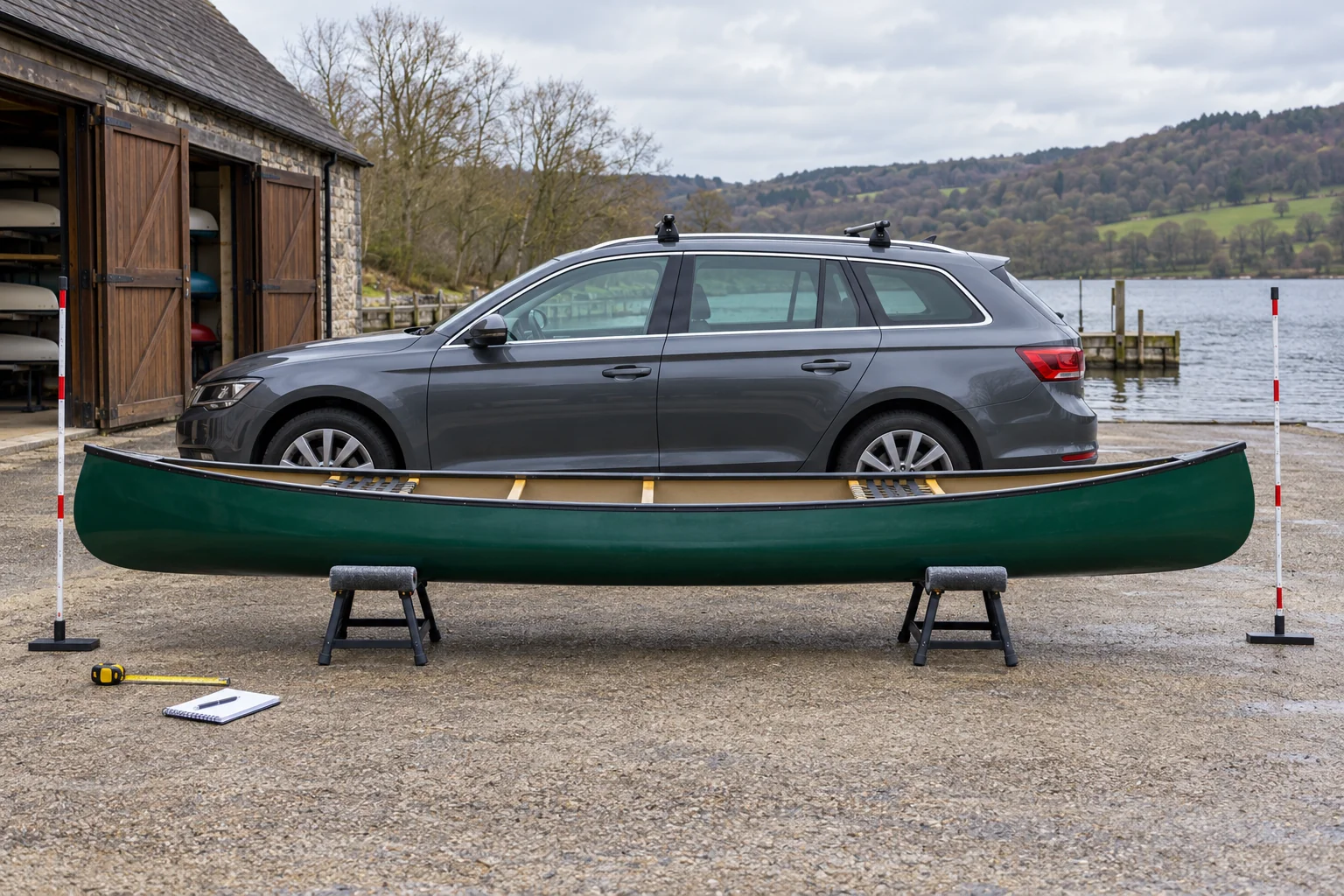
Measure the actual loaded vehicle before choosing a rule
A canoe, long board or other roof load can project beyond the vehicle even when its support points fit the bars. The legal measurement is not simply the distance between the carrier and the end of the equipment. Record the full loaded shape and the vehicle reference points first.
This guide helps UK trip planning, but its numerical projection table is explicitly based on DfT/DVSA guidance for Great Britain. Northern Ireland uses separate legislation and procedures, and an overseas leg needs its own rules checked. Do not carry one country’s marker assumption through an entire international route.
The official GB summary is an overview, with special cases and detailed marker requirements in the regulations. Where the load is unusually long, wide or close to a threshold, obtain the applicable authority’s advice before travelling rather than rounding a measurement down.
Check fit and support before adjusting the position
Start with an approved vehicle rack and a carrier suitable for the actual equipment. Verify bar spacing, contact areas, craft orientation, main restraints and any required end lines. Do not change the support geometry merely to make a projection figure smaller.
A kayak can have a suitable overall length but an unsuitable support position for its hull. Likewise, a roof box’s forward movement may be restricted by its mounting range and hatch-clearance method. The roof-bar overhang permitted by the rack maker is a separate matter from the load projecting beyond the car.
Use the canoe transport guide for gunwale support and the box fit checklist for box mounting. Establish a viable configuration, then measure its legal and practical envelope.
Record front, rear, side and total dimensions
On level ground, identify the relevant extreme points of the vehicle and the loaded equipment. Measure front and rear projection horizontally between appropriate transverse reference planes, using a helper or suitable reference where needed. A tape following the curve of a canoe is not that horizontal projection.
Measure each side separately and record the overall loaded width. A centred load and an offset load can have the same width but different side projections. Do not use mirror-to-mirror width as a casual substitute for the regulatory vehicle reference without confirming how the relevant rule defines it.
Keep the units consistent. For example, 1.10m means 110cm, not a one-metre measurement rounded for convenience. Measure again after changing the craft position or carrier. Allow for measurement uncertainty by resolving a close result, not by assuming the less restrictive category.
Use the GB front and rear summary carefully
The following is a shortened reading aid to the official DfT/DVSA summary, not a replacement for the detailed requirements. “No projection-specific action” below means no action in that summary category; it does not mean an unsafe or incorrectly secured load is allowed.
| Horizontal projection | Rear load | Front load |
|---|---|---|
| Up to and including 1m | No projection-specific action shown | No projection-specific action shown |
| More than 1m, up to 2m | End made clearly visible | No projection-specific action shown |
| More than 2m, up to 3.05m | Prescribed markers | Prescribed markers and attendant |
| More than 3.05m | Police notice, attendant and markers | Police notice, attendant and markers |
The notice category requires at least two clear working days under the official summary. Do not assume sending a message immediately before leaving satisfies it. Special cases, including certain rowing boats, need their own check.
Detailed marker placement and illumination also matter. In particular, the longer-load provisions can require side markers once rear projection exceeds3m, even before the3.05m notice threshold. A summary table alone is therefore insufficient to design a marker arrangement near those boundaries.
Do the separate side-projection check
The GB guidance identifies lateral projection over 305mm on either side and overall loaded width over2.9m as separate triggers for additional requirements. Do not use one passing measurement to disregard the other.
The official provisions cover notification, markers and lighting, with additional conditions for wider categories. Obtain the full applicable requirements before planning such a load. A pair of wide boards or an offset hull can create a lateral issue even where the front and rear figures seem modest.
Keep the loaded shape within the carrier and vehicle permissions as well. Regulatory marking does not create additional usable crossbar width, approve a clamp beyond the allowed bar area or make a poorly supported stack acceptable.
Keep the load visible without obscuring the vehicle
The marker arrangement must meet the requirements for its category and remain visible as prescribed. Do not assume a red cloth, reflective sticker or foreign touring panel satisfies every GB rule. Lighting obligations can also be relevant in darkness or poor visibility.
Check that the load and any marker do not obstruct the driver’s view, lamps, indicators or registration plate, or introduce an avoidable hazard. Nothing should flap loose, strike the car or become a sharp projection near another road user.
This guide does not assign an unverified generic marker product as a compliance solution. Establish the exact requirement first, including marker dimensions, colour, position and illumination. Then select equipment that demonstrably meets that requirement for the route.
Restrain the craft independently of a marker
A visible end is not a secured load. The carrier’s main restraint and any required bow or stern lines must have their own prescribed routing and suitable craft and vehicle attachment points. A marker’s fixing is not automatically a load-bearing tie-down.
Read the bow and stern line guide for that attachment chain. Do not run a line through plastic trim, around a roof-box shell or onto a convenient handle unless the full instructions expressly permit it.
Check Northern Ireland and each overseas leg
PSNI’s abnormal-load guidance identifies separate Northern Ireland construction-and-use legislation and the involvement of PSNI and DfI Roads according to the load. Use those sources for the NI part of the trip instead of treating the GB table as a UK-wide permission.
For travel abroad, check the destination and transit countries, including their marking and lighting requirements. A ferry booking that accepts the vehicle’s declared dimensions does not establish road compliance after disembarkation. Record the complete loaded length and height for the operator as a separate task.
Check the route itself for narrow turns, parking space, access gates and locations where the ends sweep during manoeuvres. Legal thresholds do not guarantee practical clearance. A long load can create problems on a confined approach without reaching the largest regulatory categories.
Keep a measurement and departure record
Retain the actual dimensions, approved carrying configuration, instructions and any required authority correspondence. Recheck after any change to the equipment or its position. Do not reuse a previous craft’s measurements because the same bars remain fitted.
Complete the pre-journey checklist and the separate total-height measurement. Projection, width, mass, secure restraint and safe driving conditions all need to be satisfied together.
Authoritative sources checked October 2026: DfT/DVSA overhanging-load guidance, GB regulation81 definitions, GB regulation82, PSNI Northern Ireland guidance and legislation links and NI vehicle safety. Check the current requirements for your exact load and route before travelling.
Frequently asked questions
Is overhang measured from the roof bars?
No. For the GB load rules discussed here, front and rear projections are measured beyond the vehicle’s relevant extreme points, not beyond the crossbars or roof edge. Side projection and overall width are separate measurements. Record all relevant dimensions of the actual loaded setup.
Does a rear projection of exactly1m need marking under the GB summary?
The DfT/DVSA summary shows no projection-specific action up to and including 1m. More than 1m up to 2m rearwards requires the end to be made clearly visible. Secure loading, visibility, dimensions, manufacturer limits and safe use still apply at any projection.
Can a red cloth satisfy every projection rule?
No. Making a shorter rear projection clearly visible is different from the prescribed marker-board requirements for longer loads. Board specifications, fitting, side markers, lighting, attendants and notification can apply. Do not buy a generic foreign touring panel or cloth as a universal UK compliance solution.
Are the same projection rules used across the whole UK?
This article labels the DfT/DVSA table as Great Britain guidance. Northern Ireland has separate construction-and-use legislation and PSNI/DfI procedures. Check those requirements for that part of the route, and the rules of any overseas country separately.
Can I move the roof bars or boat to avoid a threshold?
Only within every manufacturer’s permitted bar position, spacing, support and restraint arrangement. A shorter projection does not justify unsupported hull sections, blocked visibility or an unapproved mounting. If no approved configuration works, choose another suitable transport method.