
Troubleshooting guide / Boxes and accessories
Roof Box Lid Won’t Stay Open: Identifying the Correct Support Parts
Identify a roof-box lid-support fault, gather model and part details and choose the manufacturer-approved replacement route without props, stronger generic struts or forced hinges.
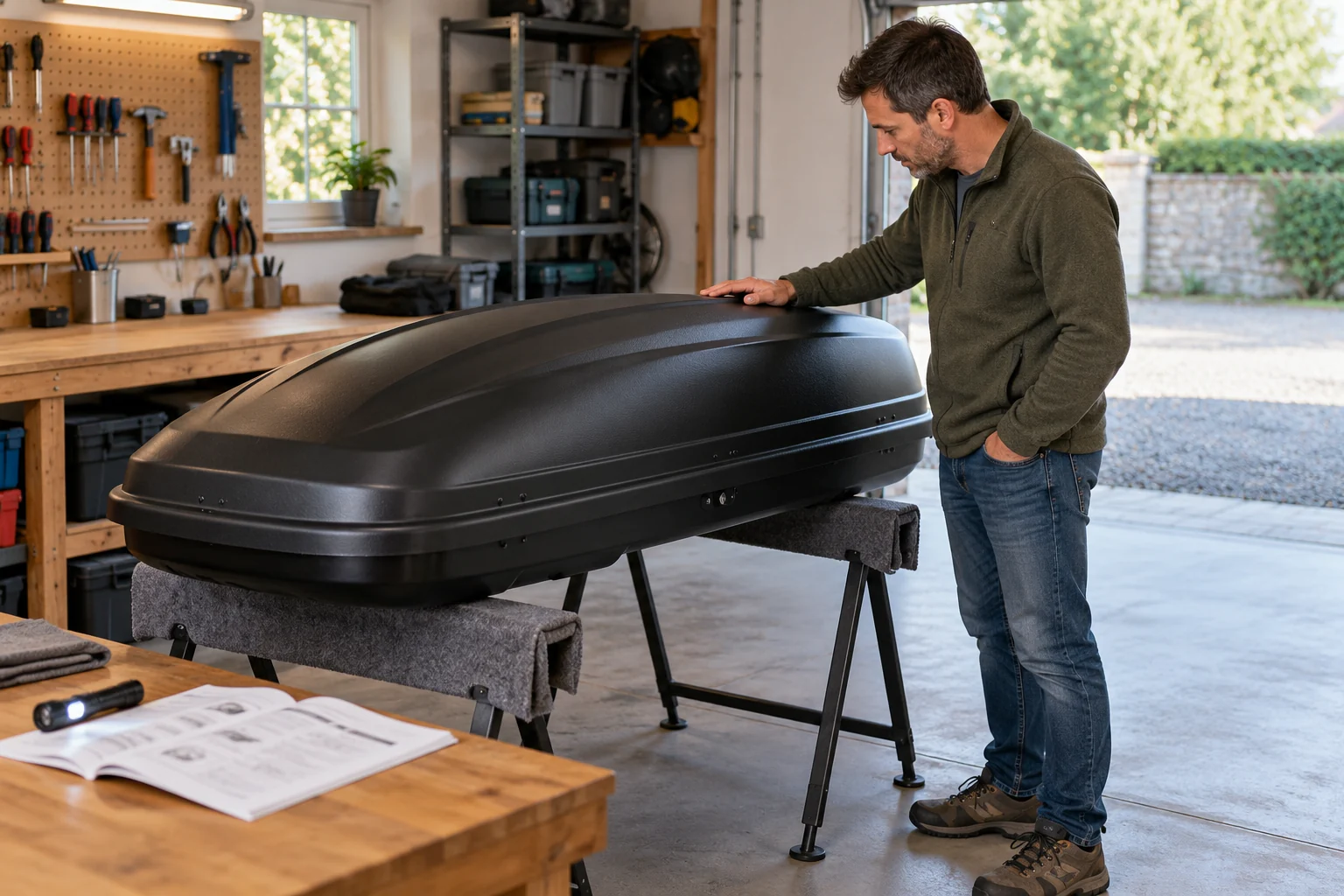
Stop working beneath an unreliable lid
A lid that falls, slowly drops or behaves differently from its normal movement needs attention before the next loading session. Do not ask someone to reach inside while another person repeatedly catches it. The first task is to close it safely if possible and arrange controlled inspection under the maker’s instructions.
Choose a sheltered place with stable footing and adequate room. Wind can make an otherwise manageable lid difficult to control, while poor reach on a tall car can put your face and hands in its path. If access cannot be controlled safely, leave the task for an appropriate service provider.
This guide helps identify the box and the required support assembly. It does not provide a universal removal sequence. Support mechanisms, stored spring force and bracket arrangements vary, so an apparently simple clip can be part of a loaded assembly.
Describe the change before buying parts
Record whether the lid suddenly stopped holding, drops gradually, feels unusually stiff or appears uneven. Note which side was opened and whether the problem follows an impact, long storage or an added accessory. Keep the description factual: a change in behaviour is not proof of a particular failed spring.
Do not repeatedly reproduce the fall for a video. A safe photograph of the closed box, identification label and accessible external detail may be enough to start the support conversation. Explain if the interior cannot be photographed safely.
Consider whether the car was parked on an unusual slope or exposed to gusts. Those conditions help explain what happened, but do not establish permission to keep using a support that now behaves unpredictably in normal conditions. The manufacturer needs the complete account.
Separate support, hinge and attachment problems
The part that holds the lid open is only one element in the system. A loose or damaged bracket, shell attachment, hinge or distorted lid can produce similar symptoms. Replacing a support without checking its mounting points may leave the actual defect unresolved.
Look only where access is safe and does not require loading or dismantling the assembly. Record cracks, missing hardware, loose pieces or an obviously displaced connection. Do not press, bend or pull the mechanism to decide whether it feels strong enough.
If the shell, hinge area or bracket seat is damaged, use the damage-assessment guide before ordering a support. A new part cannot automatically restore the strength of the surface it attaches to.
Identify the model and production reference
Find the product label and record the brand, full model name, size and identification or production reference. In Thule documentation, the BA reference can help the manufacturer identify spares; check the actual label rather than assuming every box uses an identical format.
A familiar range name can span multiple versions. An older Motion, Motion XT and Motion 3 should not be treated as the same mechanism because all are Thule boxes. The same caution applies to size variants and revisions within another brand’s range.
If the label is missing or unreadable, provide overall photographs, purchase records and any legible markings to the manufacturer. Do not rely on a marketplace title saying fits most roof boxes. An uncertain identity is a reason to obtain help, not to select the nearest-looking assembly.
Match the complete approved part, not just a length
Use the manufacturer’s exploded diagram or written confirmation to obtain the precise part number. Ask what is supplied: one support, a pair, brackets, pins, clips or a complete assembly. A small package photo can omit an essential associated component.
Check whether installation is intended for the owner or needs a service provider. Obtain the correct method for supporting and controlling the lid during the work before any fastener is released. Do not assume a detachable end fitting means the job is safe to perform without preparation.
Avoid generic stronger-strut substitutions
A gas strut or spring may look interchangeable while applying a different force or moving through a different arc. End fittings and bracket positions matter as much as apparent length. A part that holds the lid open once can still overload the shell or prevent correct closing.
Do not drill new bracket positions, add washers to change the geometry or fit an automotive bonnet strut because it is available quickly. Avoid clamping the lid open or using a ratchet strap to make an unapproved assembly operate.
An interior light, liner or other accessory also has its own fit requirements. Do not hang extra equipment from the lid and then compensate with stronger supports. The light-fitting guide covers approved attachment without turning the support system into an accessory mounting point.
Decide whether repair is viable before ordering
Ask the manufacturer whether the existing shell and brackets remain serviceable, whether the exact part is available and what checks are required afterwards. If the box has several faults or an uncertain impact history, consider the complete assessment rather than adding replacement parts one by one.
Keep the quote and part reference with the box records. Warranty cover, spare availability and safe reuse are separate decisions. The warranty guide helps organise the purchase and support evidence; it does not promise a free repair.
If the approved part is unavailable, ask whether an authorised alternative exists. Do not treat an aftermarket claim as equivalent confirmation. Where the manufacturer cannot support continued use, choose a replacement carrying plan rather than operating indefinitely with a prop.
Check operation after the approved work
Follow the supplied functional check, including the normal opening range, controlled movement, correct attachment and full closing and locking sequence. Do not test by hanging weights from the lid or pushing it beyond its designed travel.
Refit only after the box has been cleared for use and the ordinary bar, mount and load checks can be completed. Keep hands and luggage clear of the moving mechanism during every opening. If the problem returns, stop and report it rather than increasing the replacement force yourself.
Sources checked October 2026: Thule current Force 3 instructions, Motion 3 maintenance and identification guidance and official spare-parts lookup. No universal lid-lifter part or conversion is recommended.
Frequently asked questions
Can I hold the lid open with a broom handle?
Do not improvise a prop as a normal loading or repair method. It can slip or concentrate force on the shell. Stop reaching beneath an unreliable lid and obtain the manufacturer’s controlled handling or service instructions for the exact box.
Will any gas strut of the same length fit?
No. Length alone does not establish the force, travel, end fittings, brackets or compatibility. Some boxes use spring mechanisms rather than a generic gas strut. Match the exact model and approved part reference before ordering.
Should I buy a stronger lid support so it opens better?
Do not increase the force unless the manufacturer specifies that exact replacement. Extra force can affect hinges, brackets, shell and closure. A heavier replacement accessory on the lid also needs approval; a stronger support is not a universal upgrade.
Do I have to replace both supports?
Follow the manufacturer’s instruction for that model and part revision. Some service procedures may specify a pair or associated hardware; others differ. Do not infer a replacement rule from a visually similar roof box.
Can I drive if the lid no longer stays up but still locks?
Correct closing and locking alone do not establish that a damaged support, hinge or attachment is acceptable. Ask the manufacturer whether the box may be used in its present condition. Do not remove the faulty component or ignore possible loose parts without that assessment.