
Comparison / Journey and ownership
Roof Box vs Rear Cargo Carrier: Choosing Where to Carry Your Luggage
Compare roof luggage with a towbar cargo box: bars, platform, supported load, axle limits, height, rear access, exhaust clearance and complete package costs.
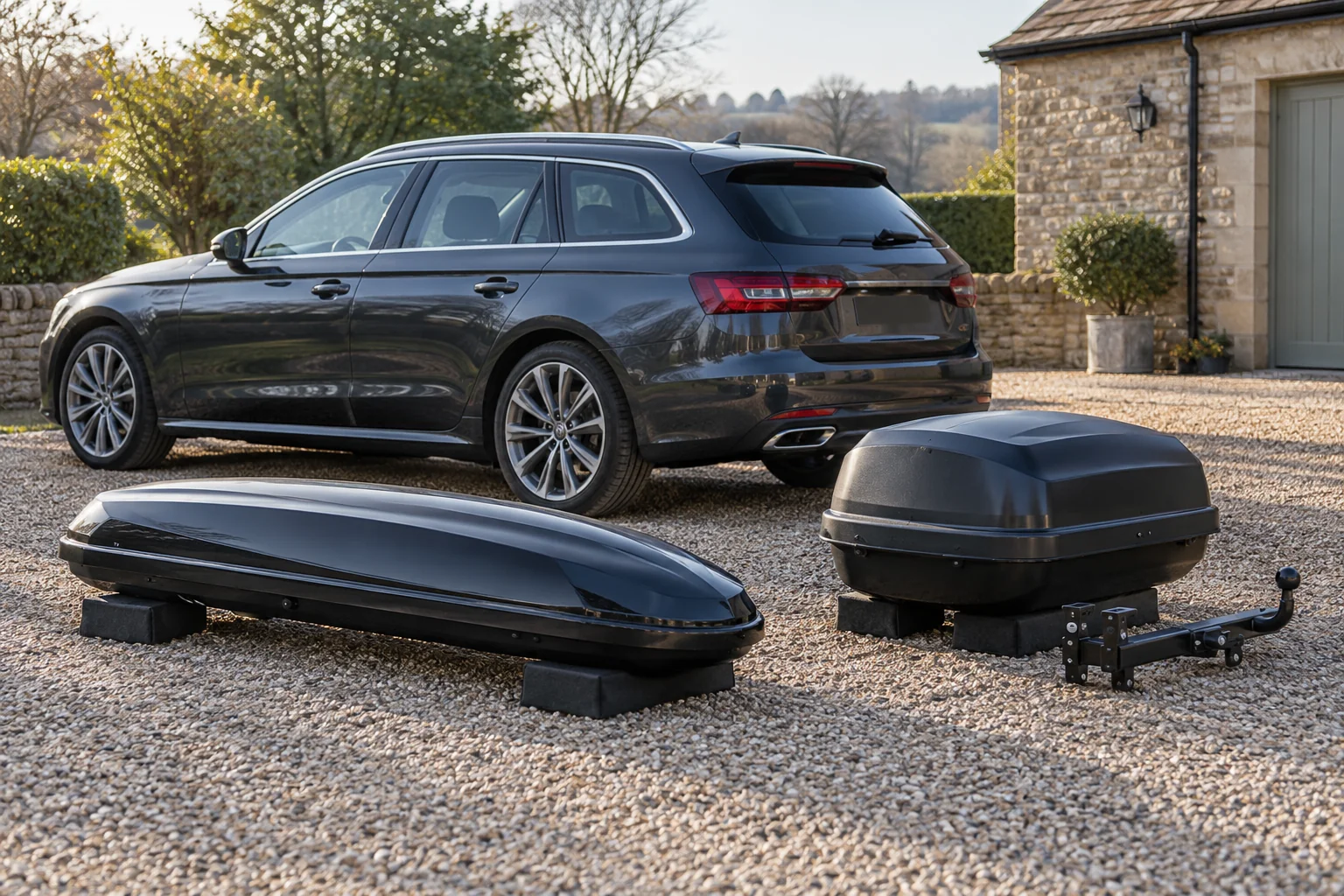
Choose a carrying location that the vehicle permits
A roof box uses approved crossbars above the car. A rear cargo box uses a purpose-made carrier, commonly mounted on an approved towball. Both can free boot space, but they consume different local allowances and change access and vehicle dimensions in different ways.
Start with what the vehicle permits. A car without an approved roof rack cannot be made suitable simply by choosing a lighter box. A car with a towbar cannot automatically carry every rear box: the supported load, towball type, clearance and carrier instructions must allow that actual arrangement.
If either route is unavailable, remove it from the shortlist before comparing litres or prices. A positive vehicle payload result does not approve a mounting location, and a large carrier rating does not increase the car’s limits.
Compare the whole package
| Decision | Roof box | Towbar cargo box |
|---|---|---|
| Required mounting system | Approved bars, feet and any vehicle-specific kit | Approved towbar/towball and matching cargo platform |
| Local load allowance | Driving roof limit, rack and box limits | Supported towbar/vehicle load, platform and box limits |
| Vehicle mass | Rack, box and luggage count | Platform, box and luggage count |
| Dimensions | Adds height; may affect hatch clearance | Adds rear length and width envelope |
| Access | Reach to roof; check lid movement | Lower loading; verify actual hatch and ground clearance |
| Other checks | Roof panel, bar spacing, internal restraints | Axle distribution, electrics, lights/plate and exhaust |
Compare required parts at the same level of completeness. An existing approved roof rack may make a roof box simpler to add. If neither rack nor towbar is installed, include all required components and fitting work in the decision. Do not buy a roof bar, foot pack or rear platform assuming the rest is in the same listing.
Roof example: a narrower box still needs the full rack
The selected Force 3 L Sport is a 300L roof box with a 63cm-wide shell. Its dimensions may suit longer, narrower bags and some shared-roof plans, but they do not establish hatch clearance or space beside a bike or boat.
Use the roof-fit checklist for bars, clamp range, roof restrictions and hatch movement. Keep luggage secured at the prescribed internal points rather than relying on the lid to contain an oversized stack.
Rear example: box and platform are different products
The selected Arcos L 906202 is a 400L rear cargo box weighing 20kg. Thule requires the matching Arcos platform; the separately selected 906300 platform weighs 9kg. Together they account for 29kg before any luggage or additional permitted accessories.
The product photographs help identify the packages, but a mounted illustration does not establish what a listing includes. Recheck selected model numbers and package contents before ordering. Keep the instructions supplied with the exact revisions.
Work out usable rear luggage allowance
Take the lowest applicable supported-load limit for the vehicle, towbar and approved carrier arrangement. Then allow for the platform, empty box and any other permitted equipment before comparing the remainder with the box’s own luggage ceiling.
The linked Arcos manual illustrates a 70kg supported limit. For the L box, 70 − 9 − 20 = 41kg of luggage remains, not 50kg. The 50kg box ceiling has not disappeared; the lower supported-load calculation governs that illustration.
Do not assume a 75kg rating elsewhere in the car’s literature refers to this supported load. Roof allowance, trailer towing mass and vertical towball load describe different things. Where the vehicle restricts rear carriers separately, follow that instruction and resolve its meaning before purchase.
A rear load also acts behind the axle. It can increase rear-axle loading by more than its own mass while reducing front-axle loading. The vehicle payload guide explains why overall headroom is not sufficient evidence that an axle is within its limit.
Measure access and dimensions before choosing
For a roof box, measure assembled height and the lid/hatch relationship. For a rear box, measure the complete rear projection and the width of the actual mounted arrangement. Check reversing space, ramps, departure clearance and any route or parking restriction relevant to those dimensions.
Operate the hatch through the permitted movement with the complete system considered. Do not let a powered tailgate press against a box or assume parking sensors will recognise the altered rear shape correctly. Follow the vehicle’s instructions for cameras, sensors and any carrier setting.
Rear lighting, reflectors and a legible registration plate must have the correct arrangement. Confirm the exact electrical connection and functioning lights before departure. An adapter is useful only where it provides the required functions for the approved system; do not infer that every plug conversion does so.
Check exhaust heat and ground clearance
Thule warns that exhaust heat can damage a rear carrier and that some vehicles may require an exhaust extension. Have the actual relationship assessed rather than judging only by the exhaust outlet’s visible direction. Do not fit an improvised shield or extension without approval.
Rear-mounted luggage can sit low enough to encounter a steep driveway, ferry ramp or uneven campsite entrance. Approach and departure geometry matters as well as the box’s static height. Where clearance cannot be maintained, choose a different permitted arrangement.
With either type, storage is part of ownership. Measure where the complete parts will go off the car and how they will be lifted. A lower travelling position does not mean a large detached box is effortless to move alone.
Compare running costs without promising a saving
A rear position can offer an aerodynamic advantage, and Thule markets Arcos on that basis. That is not a measured saving for your particular car. Roof and rear options also have different empty masses and practical consequences.
Use the fuel and EV range guide to distinguish published evidence from an estimate. An alternative that reduces consumption is only useful if its mounting, payload, axle, access and route checks all pass.
Sources and selected packages checked October 2026: Arcos L906202, platform906300, installation/load diagrams, rear-carrier safety and vehicle weight definitions.
Frequently asked questions
Can I fit a roof box onto a towbar bike rack?
Only if the manufacturers expressly approve that exact carrier, box and adapter combination. A roof box and a bike rack are not interchangeable platforms. The selected Arcos system requires its purpose-made platform; it is not permission to convert another rack.
Does Arcos L include the platform?
The selected Amazon 906202 listing is the 400L, 20kg box-only package. The selected 906300 platform is a separate 9kg item. Confirm the full basket and supplied model numbers rather than assuming a photograph of an installed system means both parts are included.
Can a 50kg rear-box rating always carry 50kg of luggage?
No. The supported vehicle/towbar allowance must also cover the box and platform, and axle and vehicle limits remain separate. In the manufacturer’s L example, a 70kg supported limit leaves 41kg after the 20kg box and 9kg platform, below the 50kg box ceiling.
Will a rear box let me open the boot?
Check the actual vehicle and complete mounted box through the required movement. A manufacturer access feature or a low profile does not guarantee clearance for every hatch, tailgate, spare wheel or towball position. Cameras, sensors and exhaust heat also need checking.
Which option is cheaper overall?
Compare complete compatible systems, not a box-only price against an already owned roof rack. Include required feet/kits or towbar/platform/electrics, installation, storage and expected usage. Current prices vary; no single option is always cheaper or more efficient.