
Evidence-led guide / Journey and ownership
Roof Boxes, Fuel Consumption and EV Range: Understanding the Trade-Offs
Understand roof-box drag, fuel consumption and electric-car range. Separate published test evidence from estimates, compare carrying choices and plan realistic charging stops.
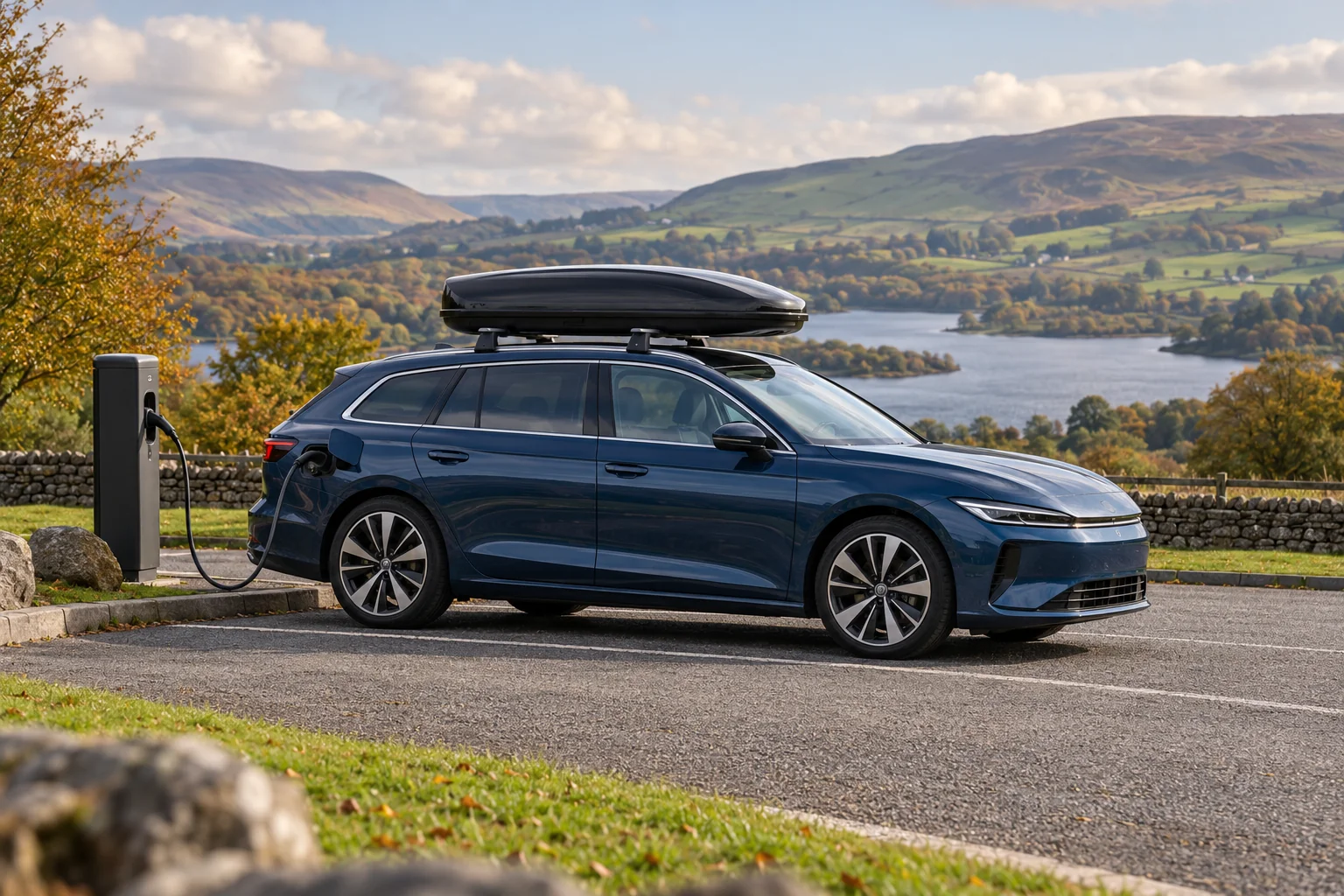
Separate the evidence from a promise for your car
A roof box provides useful luggage space, but the complete roof setup can increase energy use. The practical question is how that trade-off affects your journey, budget and charging stops. A percentage measured on another car is a useful observation, not a correction factor that can be copied into every route plan.
Start with the actual need for extra space. If a careful boot-and-box packing plan carries the trip’s luggage safely, the added consumption may be a reasonable cost. If the box is empty for most journeys, removing it when practical avoids an unnecessary carrying penalty. Neither decision should compromise fit, load restraint or the vehicle’s limits.
This guide combines fuel consumption and electric-car range because both depend on energy demand. An electric car makes the consequence especially visible through charging stops; it does not create a separate set of roof-mounting permissions.
What published tests actually establish
ADAC’s earlier roof-box test used a Volkswagen Touran 2.0 TDI at 130km/h. It reported a 6.1L/100km baseline and additional consumption of 0.94–1.29L/100km across the tested boxes, with the average increase above 18%. These are historical diesel-test observations under those conditions, not results for the boxes shown elsewhere on this site.
The test speed is part of the evidence, not a UK driving recommendation. The current road limit, exact equipment instructions and conditions govern your speed. Read the equipment speed guide for that separate decision.
ADAC’s August 2022 EV experiment compared attachments using a Kia EV6, with the roof-attachment runs averaging 120km/h. ADAC explicitly limits the measurements to the combinations tested. It supports comparing the complete configuration and test conditions; it does not establish a universal penalty for every roof box, EV or charging route.
When a review presents a percentage, check whether its baseline includes empty bars, whether the box was loaded and whether weather, speed and route were controlled. A single outward journey with a tailwind and a return into a headwind cannot isolate the box’s effect.
Why the whole setup changes consumption
Airflow around the car meets the crossbars, feet, box and any neighbouring carrier as one shape. The box’s height matters, but so do its position and the way airflow reaches it from the windscreen and roof. A larger or less streamlined arrangement can change the aerodynamic load substantially at road speed.
Extra mass also matters, particularly while accelerating and climbing. On an EV, some energy can be recovered when slowing down; that does not recover the energy continually lost overcoming drag. A lighter box can improve the remaining roof payload without proving it has the lowest motorway consumption.
Wind direction and strength, rain, temperature, tyres, heating and traffic affect the journey too. They should be recorded as conditions rather than silently attributed to the roof equipment. The driver still needs a safe speed and an approved fit even when an alternative position appears quieter.
Convert consumption to range correctly
Use the same units throughout. For an EV, a useful planning relationship is distance = usable journey energy ÷ consumption per unit distance. The usable journey energy is the portion you intend to spend between charging stops, after retaining your chosen reserve; it is not necessarily the battery’s advertised capacity.
Consider an invented illustration using 60kWh of journey energy. At 20kWh/100km, the arithmetic gives 300km. If consumption rises to 24kWh/100km, it gives 250km. Energy use has increased by 20%, while calculated distance has fallen by about 16.7%.
This example does not predict a box’s effect. It explains why subtracting a consumption percentage directly from range is wrong. Keep a reserve for diversion, unavailable chargers, cold weather and the difference between a display estimate and observed consumption.
For fuel costs, use the additional litres per 100km, your journey distance and the price you will actually pay. For example, an assumed extra 1L/100km over 600km means six additional litres. The money figure then depends on the fuel price; it should not be presented as a permanent cost of owning a box.
Compare energy-use changes with the resulting range
An energy-use percentage and a range-loss percentage are different quantities. Holding the journey energy budget constant makes the conversion explicit and avoids applying the same percentage to both.
Inputs and assumptions. Illustrative available journey energy 60kWh after any reserve you choose separately; baseline consumption 20kWh/100km. The 0–40% increases below are sensitivity inputs, not observations for any named box or car. Charging losses, weather changes and charging-stop constraints are outside this model.
| Assumed consumption increase | Consumption | Distance from 60kWh | Distance lost | Range reduction |
|---|---|---|---|---|
| 0% | 20kWh/100km | 300km | 0km | 0% |
| 10% | 22kWh/100km | 272.7km | 27.3km | 9.1% |
| 20% | 24kWh/100km | 250km | 50km | 16.7% |
| 30% | 26kWh/100km | 230.8km | 69.2km | 23.1% |
| 40% | 28kWh/100km | 214.3km | 85.7km | 28.6% |
At 20% more energy per kilometre, this model loses 16.7% of its distance, not 20%. At 40% more consumption, the reduction is 28.6%. Use measured journey consumption for route planning rather than assigning one row to a box because of its shape.
For a separate fuel-cost example, an assumed extra 1L/100km over 600km is 6L. At an assumed £1.50/L that is £9. Those prices and increments are arithmetic inputs, not current quotes or a permanent ownership cost.
Calculation method and sources
New consumption = baseline × (1 + increase/100). Distance = available energy ÷ consumption × 100. Range loss = (1 − new distance ÷ baseline distance) × 100. Round displayed distances to 0.1km, without treating that display precision as real prediction accuracy.
- ADAC published EV attachment comparison: Published observations are specific to the combinations and conditions described; they are not the assumed percentage inputs below.
- Thule roof-box safety instructions: Complete roof load, restraint, fit and operating checks remain separate requirements.
Download the inputs and workings (CSV). Source review: October 2026.
Plan EV stops from the loaded journey
Before a long trip, fit and load the permitted setup and observe consumption on a representative journey where practical. Compare similar roads and conditions rather than trying to prove a precise improvement from a short dashboard reading. Do not run down the battery to validate a calculation.
Enter the full route in the vehicle’s navigation or charging planner, using any supported roof-load or consumption setting correctly. Identify a usable earlier charging option and an alternative location. Check that the actual loaded height and rear dimensions fit the charging space and approach.
Keep the charging cable and the items needed during a stop accessible. They should not require opening a roof box in an exposed traffic lane or unloading the entire boot. Reassess the plan if consumption rises materially or the weather changes; the original arrival estimate is not a commitment to continue to an unsuitable stop.
Compare roof and rear carrying within their limits
A rear carrier changes where the luggage sits. It may avoid some roof airflow disruption, but it adds rear length and places equipment mass behind the vehicle. It needs an approved towbar system and a separate payload and axle check.
Use the roof-versus-rear comparison to compare the whole system. A change that saves roof height can still fail the supported towbar load, rear-axle allowance, exhaust clearance or access requirements. Choose a viable carrying arrangement before estimating its running cost.
Make useful changes without improvising the installation
Pack only the equipment you need, keep heavier luggage appropriately low and remove unused carriers when the instructions allow. Set tyre pressures to the vehicle maker’s recommendation for the actual load; do not invent an extra pressure increase for a roof box.
Never reverse a box, move bars beyond their approved positions or tape over operating parts to chase a range figure. Keep the manufacturer’s orientation and clearances, then use a safe, appropriate driving style. If luggage does not fit within the permitted setup, reduce the load or choose another approved transport method.
Evidence and product packages checked October 2026: ADAC roof-box test report, ADAC EV attachment experiment, Thule box safety and Arcos L specifications. Published observations, manufacturer claims and hypothetical calculations are distinguished above.
Frequently asked questions
How much extra fuel does a roof box use?
There is no reliable single percentage for every car and box. Published tests demonstrate a penalty under their stated conditions, but speed, wind, vehicle shape, bars and box geometry all matter. Use the test as evidence of a trade-off, then plan from your own loaded journey consumption.
Does 20% more energy use mean 20% less EV range?
No. With the same usable energy, range is divided by the consumption multiplier. A hypothetical 20% increase gives 1 ÷ 1.20 = 0.833 of the original range, around 16.7% less. That is arithmetic, not a measured result for a particular box.
Will a low-profile box always be the most efficient?
Height alone does not establish drag on a particular car. The bar system, box position and combined shape also matter. Choose a permitted fit and enough usable space; do not treat a lower shell or an aerodynamic product description as a tested fuel-saving percentage.
Should I remove empty roof bars?
Follow the vehicle and rack instructions. Removing equipment that is no longer needed avoids carrying its extra mass and aerodynamic obstruction. Record the fit settings and keep components together so the next installation can be completed and checked correctly.
Is a rear cargo box guaranteed to preserve EV range?
No. Its position can offer an aerodynamic advantage, but the actual vehicle and carrier combination still matters. It also uses supported towbar load and vehicle payload, can affect an axle and increases rear dimensions. Check those constraints before comparing possible energy savings.