
Comparison / Bike carrying
Roof-Mounted vs Towbar Bike Racks: Choosing Your Carrying Method
Compare roof-mounted and towbar bike racks by vehicle approval, lifting height, bike fit, roof load, towball allowance, rear clearance and complete equipment cost.
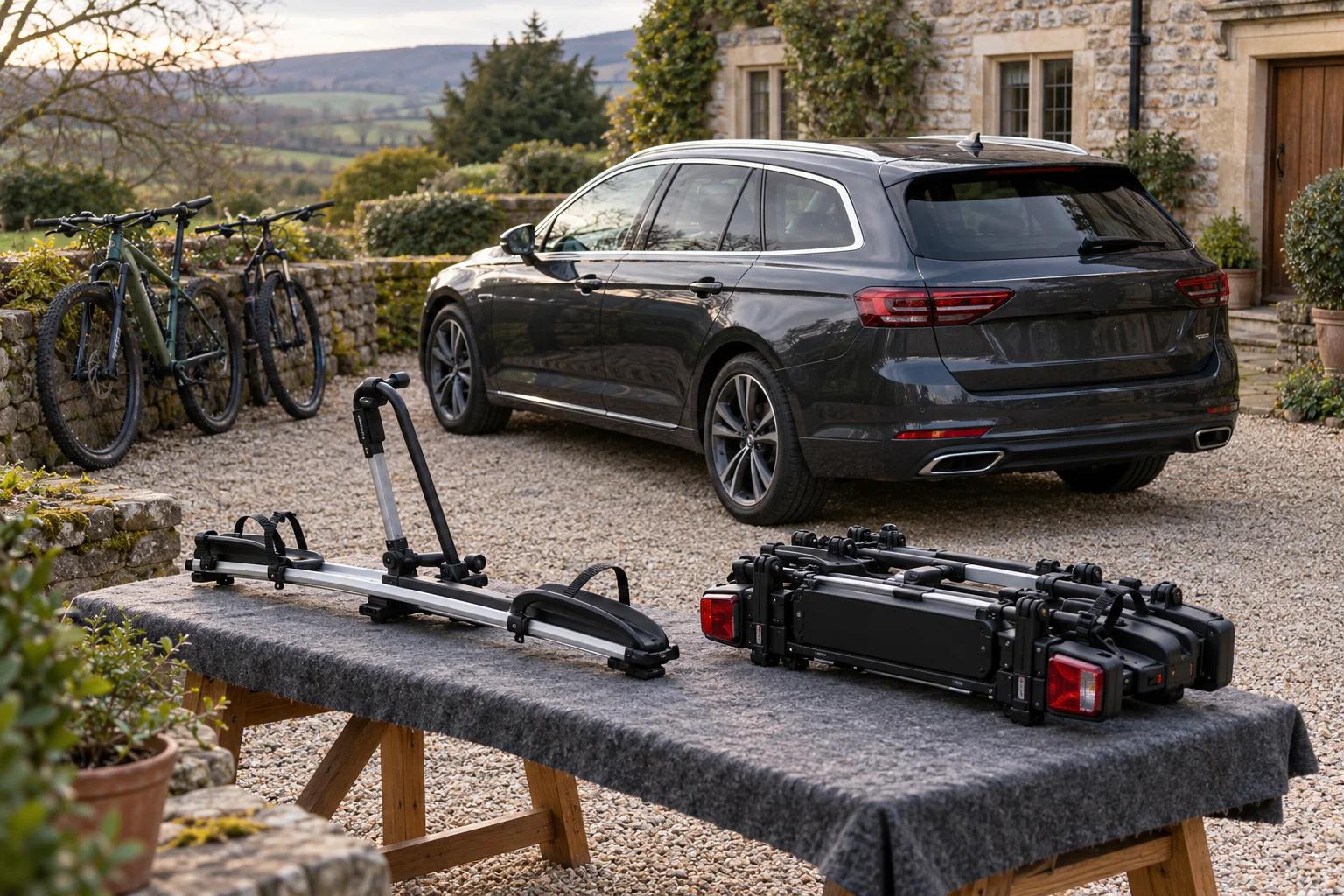
Choose the carrying method your car, bikes and loading routine can all support. A roof carrier needs an approved rack and enough roof allowance for every bar, carrier and bicycle. A towbar carrier needs a suitable approved towball, sufficient vertical allowance and a compatible rear lighting and number-plate arrangement.
The useful comparison is your actual trip: lifting a particular bicycle onto a particular car, securing it correctly and living with the resulting height or rear projection. Neither mounting position establishes compatibility by itself.
Start with the vehicle’s permitted attachment
For roof carrying, identify the exact car, body and roof variant. Obtain a complete approved bar system, including feet and any fitting kit. Factory rails alone are not transverse bars, and a roof that looks suitable does not establish a carrying allowance. The roof-bar selection guide explains those separate components.
For towbar carrying, establish whether the vehicle permits the proposed carrier on its actual towbar. Check the towbar maker’s instructions, towball type, condition and geometry, and any vehicle-specific restrictions. A receiver-hitch carrier advertised for another market is not interchangeable with the UK towball platform considered here.
If the car cannot use one approved attachment, remove that option from the comparison early. Buying a rack before resolving the attachment can leave you with equipment that cannot legally or correctly be fitted.
Compare the load calculations on equal terms
A roof allowance includes the complete fitted roof equipment and bicycles as defined by the vehicle instructions. Each carrier also has its own bike limit. An unused capacity on one carrier cannot be transferred to a bicycle that exceeds another carrier’s limit. For bikes sharing with a roof box, use the roof-load calculator to check remaining box-luggage allowance, including bikes and their carriers as other roof load. For bikes alone, add the complete rack, carriers and bikes and compare every applicable limit.
For a towbar platform, establish the applicable permitted vertical allowance from the vehicle, towbar and carrier instructions. Include the platform itself. Do not substitute the much larger trailer towing figure. The platform’s own combined-bike rating and each position’s maximum still apply, alongside vehicle payload and axle limits.
As a worked illustration, the selected VeloCompact 924001 manual gives a 14.2kg carrier and a maximum 46kg of bikes, with no bike above 25kg. A hypothetical 50kg permitted vertical allowance leaves 50 − 14.2 = 35.8kg for the bikes. Two 17kg bikes total 34kg, which passes that arithmetic only; bike geometry, vehicle approval and all the other conditions still need checking.
Assess the lift before choosing the roof
Roof loading asks you to control the bicycle above the side of the car while reaching its attachment points. Roof height, your reach, bike shape and the carrier’s controls all affect the task. A light road bike can be manageable where a bulky mountain bike with a similar quoted mass is awkward to position.
Practise the movements with the car parked on level ground before planning a trip. Can you reach the rear wheel strap while supporting the bike? Can you see the engagement indicator rather than fastening by feel? Can you reverse the process after a tiring ride? Read the tall-car loading guide if any step depends on stretching or climbing.
A towbar platform lowers the bike positions, but the platform itself still needs carrying, mounting and storing. Confirm that you can handle that assembly as well as the bikes. Lower loading does not remove the need for a controlled routine.
Match the bike to its contact points
Frame-clamping roof carriers need an approved tube shape, size and material. Wheel-holding designs avoid that frame contact, but wheel size, tyre width, wheelbase and mudguards can rule them out. Fork-mounted designs require front-wheel removal and the correct axle interface. See the mounting-style guide for the wider choice.
Towbar platforms also need suitable wheel trays, tyre restraint and approved frame attachment. A lower position does not override a carbon-frame restriction. Keep the dedicated carbon-frame and electric-bike checks central when those apply.
Plan for height, rear projection and access
Roof-mounted bikes alter the vehicle’s highest point. Measure the finished combination and plan garages, height barriers and covered parking. Do not use the empty-car height or assume taking off the front wheel removes every height problem. Put the actual figure somewhere you will see before driving.
A rear platform adds length and can change access to the hatch, parking sensors, cameras or spare wheel. Check ground and exhaust clearance, the platform’s permitted tilt procedure and the actual hatch sweep. Do not open a hatch into a bike because a product description mentions tilting.
For the UK, keep the registration correctly displayed and check that the required rear lights remain visible and functional. Confirm the selected carrier’s lighting connection with the car’s electrics and the instructions for any approved adapter. Check destination rules separately when travelling abroad.
Compare the complete purchase and storage space
For the roof, price the approved bars, feet, fitting kit, every bike carrier and any required bar or axle adapters. Add detached-wheel protection where relevant. Existing bars can reduce the additional purchase only if they remain approved and compatible with the new carriers.
For the towbar, include any approved towbar and electrical installation, the platform, required plate and suitable storage. A folded rack’s quoted dimensions do not tell you whether you can comfortably lift it into a cupboard or carry it down steps.
Choose the arrangement you can load, inspect and store repeatedly. A system that works only when someone else is available to rescue an awkward lift can be a poor everyday choice even when its specifications look suitable.
Sources and selected Amazon packages checked October 2026: ProRide, UpRide, VeloCompact 924/925 instructions and UK number-plate guidance. Follow the instructions supplied for the exact equipment.
Frequently asked questions
Is a towbar bike rack always better than a roof rack?
No. A platform can reduce lifting height, but it needs an approved vehicle and towball, sufficient vertical allowance, suitable electrics and compatible bike dimensions. A roof carrier can suit a lighter bike on an accessible car with an approved rack. Compare the complete arrangement and the loading routine.
Can I use the towing capacity as the bike-rack weight limit?
No. A trailer towing figure does not give the permitted vertical load for a bike platform. Establish the applicable vehicle, towbar and carrier allowances and their definitions, then include the platform and bikes. Vehicle payload and axle limits also remain relevant.
How much weight does the two-bike VeloCompact example allow?
The selected 924001 manual lists a 46kg combined-bike maximum and 25kg per bike. Its 14.2kg carrier mass also counts against the applicable vertical allowance. With a hypothetical 50kg allowance, only 35.8kg remains for bikes before other relevant conditions are considered.
Will a roof rack leave my boot fully accessible?
It often avoids putting a platform behind the hatch, but a long carrier or bicycle can still conflict with the opening hatch or spoiler. Check the actual arrangement through its permitted movement. A tilt function on a towbar rack also does not guarantee clearance on every car.
Can I carry an electric bike on either type?
Only if the exact bike and carrier satisfy every limit and the loading method is manageable. Roof carriers can have relatively low per-bike limits; towbar platforms also have individual, total and vehicle-related restrictions. Use the linked electric-bike guide for battery, bike-weight and handling checks.