
Compatibility guide / Watersports carrying
Carrying Two SUPs on Roof Bars: Stacking Permissions, Supports and Straps
Check whether two SUPs may be stacked, then verify both boards, width, combined carrier limits, separator padding, fins, strap reach and full roof load.
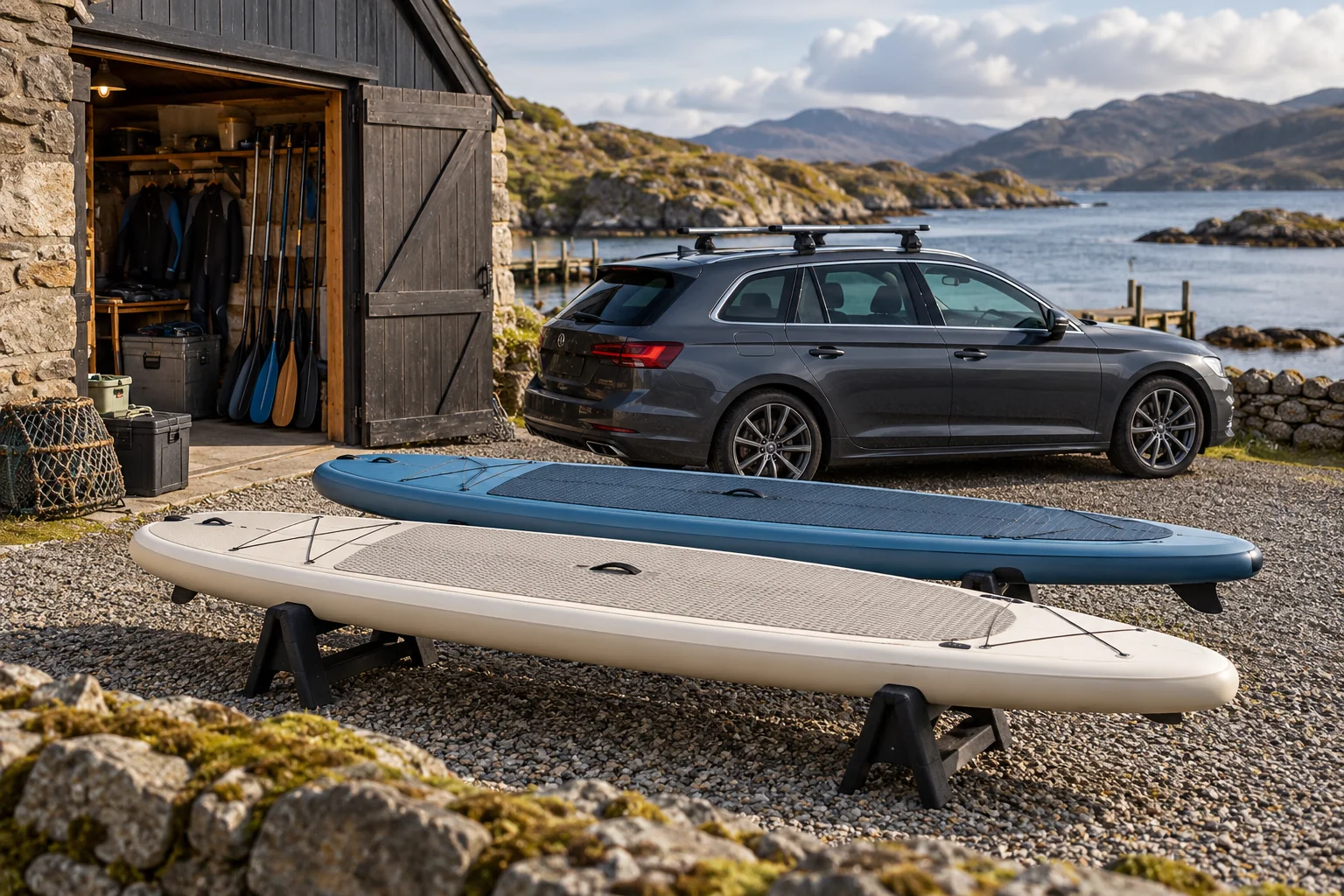
Two SUPs can share a roof arrangement only when both boards and the carrier permit the complete stack. Check combined mass, width, supported surfaces, separator requirements, fins and restraint reach together. A two-board claim is a configuration limit, not a promise that every pair will sit correctly.
Begin with the actual board models and constructions. A rigid touring board, a wide leisure board and an inflatable board can need different contacts and handling. Do not assume that matching nominal lengths makes their transport instructions interchangeable.
Obtain stacking permission for both boards
Read each board maker’s guidance about roof transport and stacking. Confirm the permitted orientation, contact surfaces, padding and any limit on objects placed above it. If one board prohibits the proposed contact, the other board’s permission cannot override that restriction.
Check shape as well as size. Rocker, deck pads, handles and rails can create a concentrated contact between boards that appear similar when laid side by side. The stack needs its prescribed support rather than resting on a projecting handle or fin box.
For mixed constructions, ask the makers where the instructions do not clearly cover the combination. An inflatable board’s softness is not automatic protective padding for a rigid board, and a rigid board is not automatically a suitable base for an inflatable one.
Calculate the combined board load first
Record both ready-to-travel weights, including any fitted items the makers permit to remain. Add the boards before comparing with the carrier ceiling. Then add the complete rack, carrier and other roof equipment for the vehicle and rack calculations.
The selected SUP Taxi XT 810001 has a 25kg combined equipment limit. Two 14kg boards total 28kg, so that pair fails the carrier limit even where the vehicle has ample roof allowance. Do not treat 25kg as a separate allowance for each layer.
Compare the second carrier without transferring approval
Board Shuttle 811000 lists up to two boards and a 50kg combined ceiling, with 70–86cm board widths. That makes it a different capacity candidate for the 28kg example, but the remaining fit checks are still unresolved.
Do not transfer the straps, separator arrangement or mounting instructions from one carrier to another. A successful fit on SUP Taxi does not establish how the same pair should be positioned on Board Shuttle, and the higher number is not permission for a taller or wider unsupported stack.
Check width and support at the actual bar positions
Measure both boards and compare them with the carrier’s stated range. A wide lower board does not automatically make an undersized upper board compatible. The carrier and board instructions must address the actual arrangement.
Confirm the complete vehicle-approved rack and resulting bar-centre spacing. Both selected carrier examples specify a minimum 610mm, but the car’s permitted positions and any greater board requirement still govern. Do not move feet outside their approved locations to create more span.
Inspect the contact at front and rear. Different rocker profiles can leave a gap at one support or force the top board onto a small contact area. Do not close that gap by applying more strap tension or inserting unrelated blocks.
Provide the specified separation and fin clearance
Follow the exact instructions for padding or separators between boards. Board Shuttle’s diagram illustrates separating layers; that does not mean any towel, bag or foam offcut has the correct stability or contact properties for every stack.
Check fins, fin boxes, handles and deck fittings throughout the stack. Remove components only where their maker permits it, and keep screws and fins securely stowed. Avoid creating a contact point that loads a fitting designed for another purpose.
A board bag can change the stack thickness and surface grip. Confirm whether it is permitted in the actual arrangement, and check the board is seated correctly rather than hiding a poor contact under the bag. Bag handles and zips are not automatic transport anchors.
Check strap reach around the complete stack
Use the prescribed load straps and routing for the chosen carrier. Confirm that the full stack leaves enough adjustment and correct engagement at every buckle or lock. A strap that barely reaches can be unsuitable even if it appears closed at rest.
Complete any required end restraint as well as the main straps. Keep buckles protected and tails secured as instructed. The bow/stern line guide explains the separate anchor checks where end lines are specified.
Treat inflated transport as a board-specific choice
Some inflatable-board makers permit temporary inflated roof transport between locations. That does not establish the same method for all constructions or allow long-term storage on the car. Follow each maker’s pressure, heat and handling instructions without inventing a universal psi adjustment.
Red Equipment’s linked example recommends a particular orientation and the largest board underneath for its approach. Use it as a model-specific source to compare with the actual boards and carrier, not a rule that replaces their own instructions.
If either board needs deflating, consider packing it separately in its approved bag. Recheck the load and restraint plan when replacing a rigid stack with a mixed roof-and-interior arrangement.
Rehearse loading, then measure the whole vehicle
Prepare the supports and straps, choose a level working area and maintain control of each board while loading. The first secured board should not become an improvised rest for an unsecured second one. Allow for wind and the reach needed around the complete stack.
Measure actual loaded height, including fins and bags where they remain. Check hatch clearance and the full front/rear projection, then use the pre-journey checklist and required journey inspections.
For a single rigid board, start with the rigid-SUP guide. For the second board, retain every additional stacking and combined-load check rather than repeating the single-board routine unchanged.
Sources and selected Amazon packages checked October 2026: SUP Taxi XT, SUP Taxi instructions, Board Shuttle instructions, Red Equipment transport guidance and Starboard guidance.
Frequently asked questions
Can any two paddleboards be stacked on roof bars?
No. Both board makers and the exact carrier must permit the arrangement. Check supported surfaces, relative board sizes, separator padding, fins, total thickness and the complete restraint. A carrier’s two-board illustration is not approval for every pair of boards.
Is SUP Taxi XT’s 25kg limit for each board?
No. The selected 810001 has a 25kg combined board-load ceiling. Two 14kg boards total 28kg and exceed it, even if the vehicle has roof allowance left. The carrier’s own 7.6kg mass also counts in the complete roof calculation.
Does Board Shuttle’s 50kg rating guarantee two SUPs will fit?
No. The selected 811000 has a 50kg combined ceiling for its permitted up-to-two-board arrangement, but it also lists 70–86cm board widths and requires the correct support, stacking and restraint geometry. Both boards and the actual vehicle/rack must satisfy all conditions.
Should the larger SUP always go at the bottom?
Some board-maker guidance, such as the linked Red Equipment example, uses the largest board underneath. Apply that only where the instructions for both actual boards and the carrier agree. Do not assume a general size order resolves fin, rocker or pressure-point conflicts.
Can I transport two inflatable SUPs while inflated?
Only where both board makers permit that temporary transport method and the carrier accepts the actual dimensions and construction. Follow the specific pressure, temperature and restraint guidance. Do not invent a universal reduced pressure or leave inflated boards stored on a hot car.