
Compatibility guide / Bike carrying
Roof Bike Racks for Children’s Bikes: Wheel Size, Frame Fit and Alternatives
Check whether a child’s bike fits a roof carrier using actual wheel diameter, wheelbase, tyre width, frame-clamp access and restraint reach, plus practical alternatives.
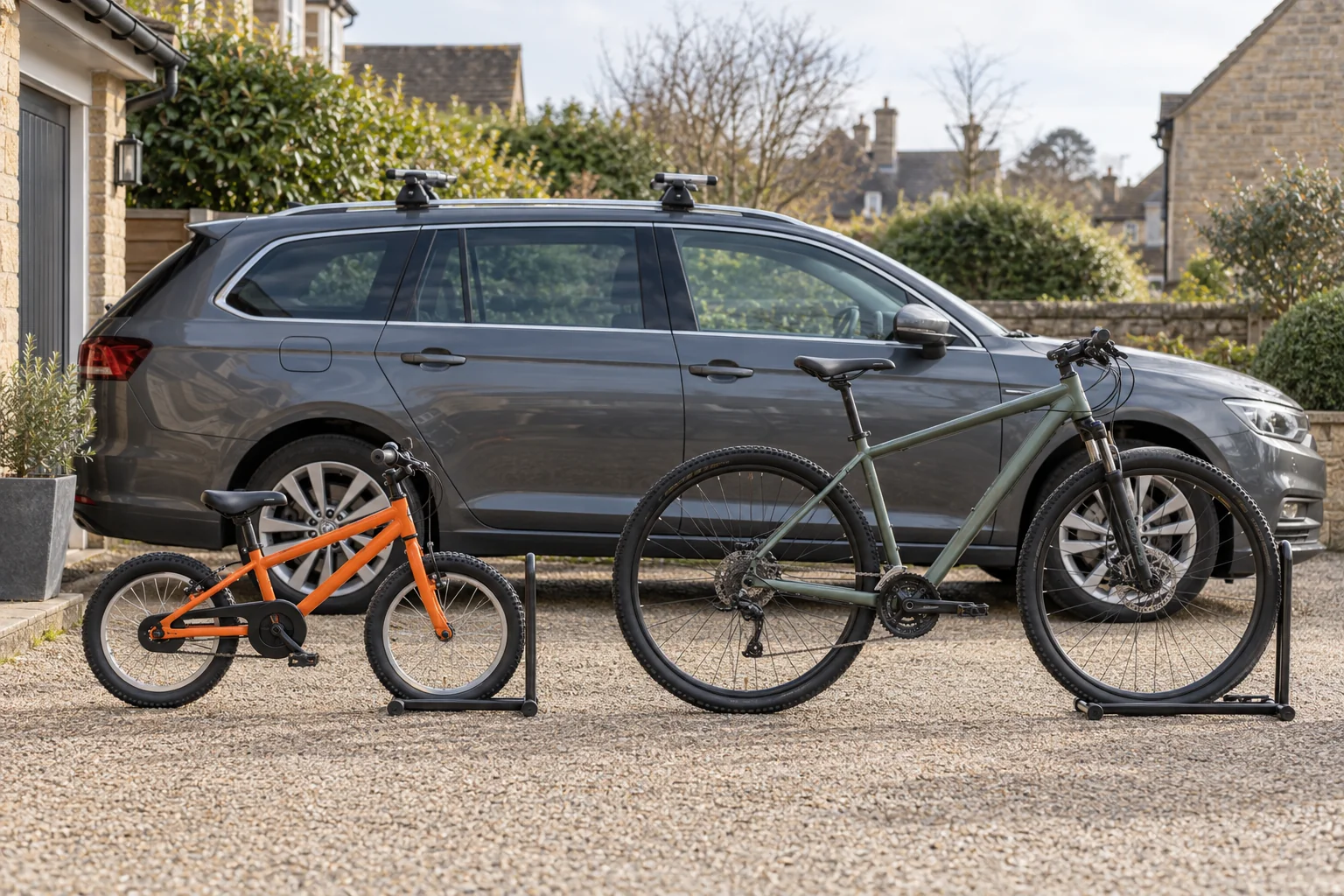
A child’s bike fits a roof carrier only when its actual dimensions and restraint positions match the instructions. Low weight does not compensate for wheels that are too small, a frame clamp that cannot reach its permitted tube or a strap that cannot hold the wheel correctly.
Start with the bicycle, not the child’s age. The same family can have a small pedal bike, a larger junior mountain bike and an adult bike that each need different carrying arrangements.
Record the bike as it will travel
Read the wheel-size markings and the bicycle documentation. Measure wheelbase between the wheel axle centres, then record the inflated tyre width and the dimensions of any frame tube proposed for clamping. Weigh the bike with the accessories that will stay fitted.
Include mudguards, baskets, stabilisers, chaincases and racks in the compatibility check. These can obstruct a carrier even if they contribute little weight. Remove an accessory only where the bicycle maker permits it and it can be refitted correctly; do not assume every obstruction is safely removable.
Keep a photograph of the complete bike and its model details with the measurements. That gives the carrier manufacturer a clearer basis for answering a fit question than “a bike for a six-year-old”.
Check minimum wheel size before anything else
The selected ProRide 598001 lists a 16–32in wheel range. The selected UpRide 599001 lists 20–29in. A 16in bike therefore fails the UpRide wheel-size check even if it is far below the 20kg weight ceiling. Do not continue trying to position its wheel hooks around the smaller tyre.
Within a stated range, confirm that both wheel supports and restraints operate as illustrated. A minimum wheel diameter is not a guarantee that every bike built around that wheel size has suitable frame geometry or wheelbase.
| Check | ProRide 598001 | UpRide 599001 |
|---|---|---|
| Listed wheel range | 16–32in | 20–29in |
| Bike maximum | 20kg | 20kg |
| Main contact decision | Approved frame tube and wheel restraints | Approved wheel contact; no front mudguard |
| Small-bike conclusion | Minimum wheel size alone is insufficient | Below 20in is outside the listed range |
Do not convert between a child’s age, nominal frame size and wheel diameter. They describe different things. If the wheel marking is unclear, establish the wheel specification from the bike maker before selecting equipment.
Test the frame contact on a frame-clamping carrier
A small frame can have a short, low or steeply angled tube that is difficult for an adult-bike carrier arm to reach. Check that the clamp meets the permitted tube at the prescribed angle, with no contact on a cable, bottle fitting, weld area or another excluded position.
For the selected ProRide, the published round-tube range is 22–80mm, with an oval maximum of 80×100mm. Those figures do not approve every tube material or shape within the dimensions. The bicycle maker must allow that transport contact.
Do not use a crossbar adapter intended for a different rack style as an improvised clamping tube. An added accessory needs explicit approval for the exact carrier and bike arrangement.
Check short wheelbase and restraint reach together
Place the wheel supports only in their permitted positions. Confirm that each wheel sits in the designated support and its restraint follows the prescribed path, with the required engagement and protection. A strap that just reaches a ratchet may still be routed incorrectly.
Short bikes can leave the rear support close to the main arm or put a strap near a valve, spoke or obstruction. Check the full range of adjustment in the correct manual. The carrier’s maximum wheelbase says nothing about whether an unusually short layout works.
If the prescribed pieces cannot restrain both wheels correctly, stop the trial. Extra straps, knots or foam wedges do not extend a carrier’s approved adjustment range. Investigate another carrier or an alternative travelling position instead.
Inspect mudguards, baskets and unusual shapes
A wheel-holding design can seem attractive where the frame is too small or unusually shaped. It still needs the correct wheel diameter and unobstructed contact points. UpRide’s front-wheel attachment is not a solution for a bike with a front mudguard contrary to its instructions.
Check stabiliser brackets, baskets and chaincases against the carrier’s moving parts and the neighbouring bicycle. A carrier that closes on an empty trial may be blocked once the bike is fully seated. Do not let an accessory carry the load in place of the intended contact surface.
Plan the family roof layout around the smallest bike
Check every family bicycle independently, then plan the group. The small bike can change loading access, while adult handlebars or pedals may intrude into its position. Do not assume the narrowest-looking bike is automatically easiest to place in the centre.
Use the multiple-bike layout guide to count every carrier and bike, check usable bar width and rehearse the order. Include the full rack mass; the child’s low bike weight does not remove those fixed contributions.
Only use permitted carrier orientations and mounting positions. If a small bike requires an awkward stretch between loaded adult bikes, revise the layout before the journey rather than asking a child to steady or fasten equipment above the car.
Compare alternatives when the fit is marginal
Inside-car transport can work where the vehicle provides an appropriate load area and restraint arrangement. Protect the interior from pedals, chain and axle ends, and secure the bike against movement. Preserve the correct operation of passenger seats, child restraints and seat belts, following the vehicle’s loading guidance.
A suitable rear carrier is another possibility, but its wheel supports, frame contacts and restraint range still need to fit the small bike. Low mounting height does not create compatibility with short wheelbases or tiny frames. Compare the roof and towbar carrying methods before changing systems.
The best choice is the one that holds the actual bike as intended and can be checked consistently. Keep the measurements and component list, then recheck when the child changes bikes or when new mudguards, tyres or other fittings are added.
Sources and selected Amazon packages checked October 2026: ProRide specifications, ProRide instructions, UpRide specifications and UpRide instructions. Bike-maker permission and the actual supplied carrier revision remain essential.
Frequently asked questions
Can a 16in child’s bike fit a roof bike rack?
Some carriers list 16in at the lower end of their wheel range, including the selected ProRide 598001. That is only one condition. Frame contact, wheelbase, tyre width and both wheel restraints must also work exactly as instructed. The selected UpRide starts at 20in and is not an alternative for a 16in wheel.
Does a child’s age tell me which roof rack fits?
No. Age recommendations describe bicycle sizing in broad terms, not carrier compatibility. Read the bike’s actual wheel size and measure its wheelbase and relevant frame dimensions. Use those measurements with the exact carrier instructions.
Can I shorten or add a wheel strap for a small bike?
Use only the carrier maker’s approved parts and adjustment range. Do not knot, cut, extend or substitute a generic strap to make an unsuitable wheel position appear secure. If the prescribed restraint cannot engage correctly, use a different approved carrier or carrying method.
Will a wheel-holding rack clear a child’s mudguards?
Do not assume it will. The selected UpRide instructions exclude front mudguards, and small wheels can put other fittings close to its contact points. Check the exact carrier, wheel size and accessories before considering the arrangement.
Is carrying a small bike inside the car an option?
It can be, if the vehicle has a suitable loading space and the bike can be restrained correctly without compromising occupants, seat belts, child seats or visibility. Protect sharp and dirty parts, follow the vehicle’s load guidance and account for the bike in vehicle payload. A loose bike on a seat is not a secure alternative.